A reader who opens an offer thinking about $1,000 may also see a headline built toward $40,000, and the working figure here is forty times the bonus alone with a ceiling the cashier does not publish, AUD throughout, assuming the bonus alone carries the playthrough, the deposit is not added to the multiple, and every amount is read in Australian dollars before any choice is made.
Scope of the material
These terms govern use of the pages published by Lucky Aussie Reels at luckyaussiereels.com. They describe what the material is, where its figures come from, what it does not settle, and the boundary between reading a calculation and receiving a promise from a supplier. The site is an editorial publishing service. It writes about the cost of an offer on stated assumptions, cites published primary material by claim number, and keeps its arithmetic visible. It is not a cashier, a licence holder, a complaint handler, a payment provider, a legal adviser, a tax adviser, or a party to any account opened elsewhere. Reading a page does not create an account here, and using a link does not move any obligation from a supplier to this publisher.
The material is written for Australian readers and uses Australian English. Amounts are stated in Australian dollars, and that convention is declared once at the opening paragraph rather than repeated next to every figure. Where a page says that a figure is modelled, the model is a cost calculation from the stated assumption. It is not a quotation from an operator, a reading of a live cashier, or a statement that any particular supplier will apply that term to a particular person. The site models, calculates and cites. It does not play, does not test accounts, and does not report first hand play.
The statutory material cited on this site is confined to claims 1-25, 26-53 and 156-165, cited by number. Claims 1 to 5 describe the shape of an online casino as a gambling service, the internet carriage limb, the closed list of exclusions, the place-based gaming exclusion, and the absence of a licensed online casino category. Claims 13, 14 and 15 explain why the licence route that exists for a closed class of regulated interactive gambling services does not reach an online casino served to a person at home. That is the load-bearing fact for every boundary on this page: there is no domestic licensed online casino market against which an offshore product can be compared as though two equivalent licences were being weighed. The site does not argue "licensed in Australia versus licensed offshore", because no Australian licence exists for this product.
A claim number is a citation to the appendix label under which the fact sits. A citation does not turn a statutory outline into personal advice, and it does not enlarge the fact beyond what the cited claim says. Where the appendix says AT SOURCE, the page may state the fact with the provision or publisher named. Where it says SOURCES DIFFER, the page may say what each source says and must not pick one. Where it says NOT PUBLISHED, the page may state that nothing is published and must state nothing else from that gap. Claims 22 to 25 are gaps of that kind, and this page respects them. A sentence that begins with a gap and finishes with a confident inference is not a citation. It is an invented fact.
Use of the site includes reading, scrolling, opening the contents links, using the calculator, reading the frequently asked questions, and following the onward reading links. It does not include any instruction about account opening, identity checks, self-exclusion registers, bank controls, or access to a gambling service. Pages on this site state consequences and absences. They do not provide procedures for getting past a control, and no section of these terms should be read as granting permission to treat a safety boundary as a puzzle. A reader who wants help with gambling harm is directed by the separate support material to published services, not to a method of continuing play.
The organisation name Lucky Aussie Reels is used here in one of the five places permitted by the adapted gate. It identifies the publisher of the terms, not a regulator, not a licence holder, and not a guarantor of any third party. The domain identifies the publishing address. No page on this site carries a second title, a second H1, a hidden report, generated prose about the build, a word count, a JSON-LD block, or a script that changes the meaning of the visible text. A fragment starts with its heading and ends with the last content block. Anything after that last block is not part of the page.
Figures, assumptions and the calculator
The opening figures are deliberately ordinary. A $1,000 deposit is the amount a reader can picture before a bonus is added. A $40,000 turnover figure is the product of forty times the bonus alone on a $1,000 bonus. Those numbers are not caps, win limits, withdrawal thresholds, legal thresholds, or published operator terms. They are arithmetic from the assumption printed in the same paragraph as the money. AUD throughout means that the reader should not convert the figures mentally into another currency while following the calculation. If an offer uses another currency in its own copy, that is the supplier's copy and not a figure sourced by this site.
The calculator is a reading aid. It shows what the stated multiple does to a stated bonus under the stated assumption. It does not fetch live terms, does not read a cashier, does not predict a result, does not approve an offer, and does not decide whether any sum can be withdrawn. Its output is a model result. The reader supplies an input; the model applies the assumption; the result is displayed. A blank, a changed input, or a refreshed page changes only the model. It changes no agreement with any third party and creates no record on this site beyond what the separate storage page describes.
Bonus amount in AUD: 1000
Playthrough multiple: 40
Assumed base: bonus alone
Model turnover: 40000
Assumption stated with the opening figures. Claims 1-25, 26-53 and 156-165 govern the statutory material cited elsewhere on the page; this calculation is arithmetic and is not a cited operator term.
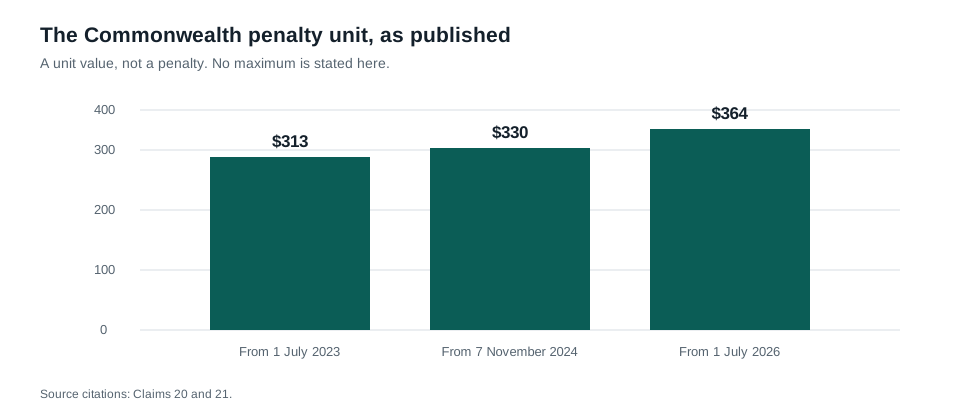
Claims 20 and 21 publish unit values. Claim 6 states 5,000 penalty units for an offence under section 15(1), claim 7 states 7,500 penalty units for the civil penalty under section 15(2A), and claim 8 says both run per day. Claim 22 says no primary source states a dollar maximum penalty under section 15, because the Act states units, the instrument states a unit value, multiplying is arithmetic, and the body corporate multiplier was not verified. Accordingly, no page publishes a dollar maximum for that provision. The figure above is a unit value drawing, not a penalty calculation, and its caption says so. No reader should add a zero, multiply a unit, or treat the drawing as a schedule of what a court would impose.
Claim 9 is about the provider. The section 15 liability is written about the provider, as are sections 15AA, 15A and 15C in the simplified outline's scheme of duties on providers, internet service providers and advertisers. No offence or civil penalty provision directed at a customer for using a prohibited service was found in the sources cited by that claim. This site says that statutory liability falls on the operator. It does not say "it is legal for you to play", and it does not say the opposite. Claim 23 records that no primary source states in terms that an Australian player commits no offence by using a prohibited service, and state law was not researched. Those two boundaries sit together. A reader should not convert a structural reading of the Act into a personal clearance, and should not convert silence into a warning that a customer offence has been identified.
Claim 10 says the prohibition reaches an operator wherever it sits, because an Australian-customer link exists if any customers are physically present in Australia and section 15(5) applies extended geographical jurisdiction category D. Claim 11 sets out a defence where the person did not know and could not with reasonable diligence have ascertained the link, and claim 12 lists reasonable diligence factors. Those are provisions about providers and their knowledge. They are not a checklist for a reader, not a method, and not a promise about how any offshore business behaves. The site cites them to keep the liability in the right place, then returns to the cost of an offer from outside the Australian system.
Claims 16 to 19 identify ACMA's published descriptions of banned services, the compliance report's wording about online casino services, the department's description of casino-style games, and the advertising limb in Part 7A. None of those claims supplies a bonus term, a withdrawal time, a deposit minimum, a return figure, a hit rate, a volatility figure, or a maximum win. Claim 142 says no published figure for Australian deposits, withdrawal times or payout speeds at offshore casinos exists on the sheet, and that no page may state a withdrawal time or present a minimum deposit as anything other than a term an operator has stated for itself. A cost calculation here stays inside the assumption. It does not borrow authority from a regulator's page to make a marketing figure look checked.
Boundaries of the material
The boundary that matters most is the licence boundary. Claims 5, 14 and 15 establish that no Australian licence exists for this product. The licence aside below states that once. It is not a label for one supplier and it is not a comparative grade. A reader who sees a licence label in advertising elsewhere is seeing supplier copy or a supplied advertising chip. This page does not adopt that copy as a fact about Australian authorisation, and it does not set up a contest between a domestic licencee and an offshore licencee. There is no domestic licensee whose obligations an offshore one can be held against.
The next boundary is the player-conduct boundary. Claim 9 places the statutory liability on the provider. Claim 23 leaves open, in terms, any statement that an Australian player commits no offence by using a prohibited service. The terms therefore say neither "it is legal for you to play" nor its reverse. The absence of a customer offence provision in the sources read is not a licence to the reader, and it is not a threat. It is a limit on what this material can responsibly assert. Losses described on this site are losses of protection, not statements about liberty.
The third boundary is the agreement boundary. Claim 24 says no regulations under section 69A were located. Section 69A is a regulation-making power about agreements having no effect and civil proceedings not lying to recover money, and the instruments page lists one 2019 instrument and names no regulations. Claim 165 keeps the same question open: whether an agreement with an offshore casino is enforceable, and whether civil proceedings lie to recover money, turn on whether regulations under section 69A exist, and none was located. These terms do not assert that such an agreement is enforceable. These terms do not assert that such an agreement is unenforceable. The question stays open because the source base leaves it open.
The fourth boundary is the consumer-rights boundary. Claim 163 says no source reached says whether or how Australian Consumer Law is enforced against an offshore gambling operator with no Australian presence, that no ACCC source was located, and that a page may not say a reader has Australian Consumer Law rights against an offshore casino and may not say they have none. Claim 162 is a State consumer page addressing Australian providers. These terms repeat the limit rather than filling it. A reader should not take a sentence about consumer protections for Australian providers and apply it to an offshore operator, and should not take the absence of a sourced answer as a declaration that no protection of any kind exists.
The fifth boundary is the dispute boundary. Claim 164 says no Australian alternative dispute resolution scheme, ombudsman or arbitration body covering online gambling was located, and the sheet names none. These terms name no Australian ADR provider, ombudsman, arbitration service, or complaint body that will hear a dispute against an offshore casino. The boundary is not an invitation to guess one from another market. The British sheets in the source history cite named ADR providers; this Australian build does not, because none was found. What can be stated is the shape of the regulatory complaint: ACMA takes complaints and enforces against the operator, while the consumer's recourse is described by ACMA as little or none.
The sixth boundary is the self-exclusion boundary. Claims 59 and 60 say BetStop's obligations reach Australian-licensed online and phone wagering operators and do not reach a casino game or an offshore operator. BetStop's own wording, quoted at claim 60, says the register does not apply to online casino games or other gambling services that are illegally provided in Australia and that a complaint about these services can be made to ACMA. Claim 81 says no primary source quantifies how many offshore casinos accept registered individuals, and that the published scope rule is a statement about a duty, not about behaviour. This page says only that the register does not, by its own terms, reach an offshore casino. It does not say an offshore casino will accept a registered person, does not say any of them checks, and does not say any of them does not. Claim 82 records that nothing describes, and no page may describe, how a registered individual could gamble. These terms contain zero material on getting past a self-exclusion register, an identity check, a bank block, a mirror, a proxy, a second account, or registration without documents. The consequence is stated; no procedure is supplied.
The seventh boundary is the tax boundary. Claim 148 identifies IT 2655 as a ruling issued 17 October 1991 with immediate effect, and claim 149 quotes its sentence that there is no Australian case in which the winnings of a mere punter have been held to be assessable. Claim 150 says the ruling does not say winnings can never be taxed, and claims 151 and 152 set out the factual inquiries. Claim 153 says "Income Tax Rulings do not have the force of law", so any reference to claim 149 must identify it as a 1991 ATO ruling and must not present it as a statutory exemption. Claim 154 says no ATO source addresses winnings from a gambling service unlawful to provide in Australia and that no page may state winnings from an offshore casino are tax-free in Australia. Claim 155 says no ATO source on the deductibility of gambling losses for an individual was located. These terms state none of those forbidden conclusions, and they give no tax advice.
Claims 26 to 53 add further edges that the material must not cross. Claim 25 says no count of offshore operators serving Australia is published by any source reached. Claim 48 is a news-labelled claim about a cumulative website-blocking total and permits per-quarter figures 44 to 46 at source but not a cumulative total as a sourced figure. Claim 49 says two ACMA pages give different counts of services that left the market and a third gives a different framing, so no page presents one as the figure. Claim 50 says two offshore-expenditure estimates in one ACMA document differ by about eight times and no page may state a single Australian offshore spend number. Claim 52 says ACMA publishes no register of offshore operators, no list of "safe" offshore operators and no rating of any operator. Claim 53 says no provider count could be read from the licensed interactive wagering providers page. A terms page that quietly turns any of those gaps into a market statistic would be asserting a fact the sheet does not hold.
Complaints, liability and limits
Complaints about the material published here are editorial correspondence. A reader can point to a sentence, a figure, a citation, a calculation, a link label, or a caption and ask for correction. The desk will compare the visible text with the claim numbers and the stated assumption. A correction to a model changes the model. A correction to a citation changes the citation. A request to convert an open question into a firm answer is declined, because the source base does not permit it. A request for an operator's money, an account balance, a withdrawn sum, or a decision about a third party's terms is not a correction to this site and is not handled as one.
Claims 156 to 159 define what a regulatory complaint is and is not. Claim 26 says ACMA may investigate on its own initiative or on a complaint under Division 1. Claim 27 says only an individual residing in Australia, a body corporate carrying on activities in Australia, or the Commonwealth, a State or a Territory may complain. Claim 28 says the Part 8 toolkit is civil and administrative, not compensatory, listing formal warnings, civil penalty enforcement, infringement notices, injunctions, enforceable undertakings, remedial directions and continuing contraventions. Claim 156 says a complaint to ACMA is a regulatory complaint, not a claim, and that nothing in Part 3 or Part 8 provides for a complainant to recover money or gives a complainant a remedy. Claim 158 says BetStop's own route for an online casino complaint is ACMA and nothing else. ACMA accepts complaints; the Part 8 regulatory toolkit is not a compensation mechanism.
Claim 159 records ACMA's own consumer wording: "Consumers who access these websites have little or no recourse"; "Winnings may not be honoured, and incentives and pressure tactics are used to target gamblers"; and these services "do not have the customer protections we expect in Australia." Those phrases are quoted, not softened. The site does not add a dollar value to "little or no recourse", does not promise that a complaint will produce a payment, and does not say that a payment will never happen. It states what the regulator says about the consumer's position and what the statutory toolkit does. Claim 160 records the Commonwealth's 2017 wording about limited legal recourse if consumers run into difficulties obtaining winnings or deposits. That is a published description of a protection gap, not an adjudication of any reader's account.
Claim 161 is the contrast that works only for licensed operators. Queensland's consumer page tells a consumer to talk to the business first, then, if unsatisfactory, to lodge a complaint with the government agency that issued the provider's licence, which should be displayed on the provider's website. Queensland complaints go to the Office of Liquor and Gaming Regulation, and for Northern Territory licensed providers the page points to Northern Territory Consumer Affairs. That route depends on an issuing agency and a displayed licence. It is not a route this site can supply for an online casino served to a person at home, because claims 5, 14 and 15 say no Australian licence exists for this product. These terms do not extend the Queensland page beyond the providers it addresses.
Liability for the material is limited to the publisher's own editorial acts. Lucky Aussie Reels is responsible for the words it composes, the assumptions it prints, the citations it uses, and the maintenance of the blocks a reader can see. It is not responsible for supplier copy, for the order in which advertising is bought, for a third party's cashier, for a third party's account decision, for a third party's payment handling, or for a third party's refusal or agreement to pay. Claim 9 keeps the statutory liability on the provider. Claim 37 and claim 159 keep the consumer protection gap in ACMA's own words. These terms do not shift either of those positions onto the publisher, and they do not shift them onto the reader.
No page of this site supplies legal advice about an agreement, tax advice about winnings, a determination about Australian Consumer Law against an offshore operator, or a named Australian dispute body for an offshore casino dispute. Claims 24, 163, 164 and 165 are open or negative findings, and each stays in that state. Claim 22 bars a dollar maximum penalty. Claim 23 bars a personal legality declaration in either direction. Claim 154 bars a tax-free statement about offshore casino winnings. Claim 155 records that nothing is published on deductibility of gambling losses for an individual in the sources reached. A careful reader should treat each of those as a fence, not as a hint about what sits beyond it.
Claims 29 to 47 are cited only where a page explains the regulator's powers and publications. Claim 36 says website blocking as practised is a request to internet service providers, not a statutory direction under the Act, and that quarterly reports describe referring websites to internet service providers for blocking and separately reporting URLs to family-friendly filter providers. Claim 51 says no ACMA page reached states that website blocking can be got round, and the sheet says nothing about how. These terms repeat no method and give no workaround. A sentence about a control's existence is not an instruction to test it.
Changes, questions and onward reading
The material can change when a cited primary source changes, when a claim label changes, when an assumption is corrected, or when a reading error is identified. A correction is made in the visible text, not in a note that quietly contradicts it. The calculator continues to show its assumption beside its output. The figure caption remains byte for byte as published in the figure store. The licence aside remains a single statement rather than a row of labels. The onward links keep their capitalised page titles because a page title is a name wherever it stands. No lower-case page name is used as link text here.
The questions below use ASCII quotation marks and ASCII apostrophes only. They are short because the answer is a boundary, not a sales line. Section 4 of this page contains no em dash, no en dash, no double hyphen, no exclamation mark, no smart quote, no star rating, no vote count, no invented testing, no "guaranteed", and no promise. It uses Australian English, with "licence" as the noun, "organisation", "analyse", "authorised" and "practise" where those forms belong. It does not say "we tested", "our team", "we played", or "we verified first hand". It does not say that anything is guaranteed. It does not describe a reader who does not exist.
Frequently asked questions
- Does this page say it is legal for me to play?
- No. Claim 9 places the statutory liability on the provider, and claim 23 says no primary source states in terms that an Australian player commits no offence by using a prohibited service. The page says neither "it is legal for you to play" nor the reverse.
- Does this page decide if an offshore agreement is enforceable?
- No. Claim 24 says no regulations under section 69A were located, and claim 165 keeps the question open. The page does not assert that such an agreement is enforceable and does not assert that it is unenforceable.
- Does ACMA recover money for a complainant?
- ACMA accepts complaints. Claim 28 describes the Part 8 regulatory toolkit as civil and administrative, not compensatory, and claim 156 says nothing in Part 3 or Part 8 provides for a complainant to recover money. ACMA also says consumers who access these websites have "little or no recourse" and "Winnings may not be honoured".
- Does this page name an Australian ombudsman for an offshore dispute?
- No. Claim 164 says no Australian alternative dispute resolution scheme, ombudsman or arbitration body covering online gambling was located, and the sheet names none. The page names no Australian body that will hear a dispute against an offshore casino.
- Does this page state a dollar maximum penalty or tax-free winnings?
- No. Claim 22 says no primary source states a dollar maximum penalty under section 15. Claim 153 says IT 2655 does not have the force of law, and claim 154 says no page may state that winnings from an offshore casino are tax-free in Australia. Claim 155 says nothing is published on deductibility of gambling losses for an individual in the sources reached.
The site keeps its material inside the cited claim slices: claims 1-25, 26-53 and 156-165. It does not cite a claim outside those ranges, does not mix an operator name with a statutory provision in one sentence, and does not turn a NOT PUBLISHED finding into a number. Claim 22 leaves no dollar maximum. Claims 24 and 165 leave the agreement question open. Claim 23 leaves the player-conduct declaration closed in both directions. Claim 163 leaves the Australian Consumer Law question against an offshore operator open. Claim 164 leaves the ADR field unnamed. Claims 156 to 159 keep the complaint route regulatory and non compensatory. That is what "boundaries of the material" means here.
Where a reader wants the commercial arrangement, the reading method, the arithmetic margin, the support material, the storage description, or the correspondence route, the onward links open the relevant site page. Each link text is a capitalised page title. None of them leads to a cashier, a licence register, a dispute body, or an operator account. The desk handles editorial correspondence about this site only. Regulatory complaints about services go to ACMA as claim 60 and claim 158 describe, and the limits in claims 156 to 159 apply. No section on this page describes a way round a block, a check, an exclusion, or a document request.
Onward reading
- How this site is paid
- Reading the offers
- The margin we assume
- Knowing when to stop
- What this site stores
- Write to the desk
Published by Lucky Aussie Reels at luckyaussiereels.com. These terms cover use of the site, the stated assumptions behind its figures, and the limits of the cited material. They do not create a contract with any supplier, do not confer a licence, do not settle an open legal question, and do not promise a payment. The calculator remains a model, the figure remains a unit value drawing, the licence aside remains one sentence, and every claim citation remains confined to the permitted slices. A reader who uses the site after a correction is using the corrected visible text, not a hidden draft, not a report, and not a note appended after the page ended.