A $1,000 headline against a $40,000 bonus pool can look like a cheap entry until the turnover is read as forty times the bonus alone, with a $12.50 spin ceiling used here as the working cap, a cashier ceiling the offer does not publish, AUD throughout, and the assumption stated plainly: we assume the multiple applies to the bonus alone rather than deposit plus bonus, we assume the currency stays AUD throughout, and we assume no ceiling, weighting schedule, expiry, cap or cashout rule is added later by a term the reader has not been shown.
What the multiple is applied to
The first sentence to read in a bonus term is not the amount. It is the base to which the multiple is applied. Offers of this kind usually ask forty times the bonus alone, and that phrase decides the size of the task before a single game is opened. A $1,000 bonus read that way asks for $40,000 of qualifying staking before the bonus balance is treated as withdrawable. A term that applies the same multiple to deposit plus bonus changes the task without changing the headline. If a $1,000 deposit earns a $1,000 bonus, the same forty times then attaches to $2,000 rather than $1,000, and the reader has doubled the work while the advertisement has stayed identical. This is why the assumption belongs in the opening paragraph and why it must be held in view while the rest of the offer is read.
The distinction also governs the order in which money is spent. A term that attaches the multiple to the bonus alone may still describe the deposit as real balance, bonus balance, restricted balance or some other cashier label, but the arithmetic is about the bonus base. A term that attaches it to deposit plus bonus makes the deposited money part of the restricted calculation. The reader who assumes one and signs up to the other has not misread a game. They have accepted a different contract, with a different amount of play required before a cashout request is even considered. The page at The margin we assume sets out how this site treats an assumed term, but the offer itself has to be read from its own wording.
The statutory setting explains why the wording carries so much weight. Section 4 definition, paragraph (e) of the Interactive Gambling Act 2001 (Cth) includes a service for the conduct of a game played for money or value, of chance or mixed chance and skill, where a customer gives or agrees to give consideration, and online pokies, slots, roulette, blackjack and live dealer tables sit inside it. Claim 1, at source. Section 5(1) then describes a prohibited interactive gambling service as a gambling service provided in the course of carrying on a business and provided to customers using, among others, an internet carriage service. Claim 2, at source. Section 5(3) is a closed list of exclusions and the only gaming exclusion is place based under section 8B, which requires customers to be at a particular place using equipment made available there and the provider to hold a State or Territory licence authorising provision at that place. Claims 3 and 4, at source. An online casino served to a person at home is therefore a gambling service under paragraph (e), provided in the course of a business over an internet carriage service, prohibited under section 5(1), and excluded by nothing in section 5(3). Claim 5, at source, reading sections 4, 5 and 8B together.
That is not a comparison between two kinds of Australian licence. The Commonwealth Act contains no category for a licensed online casino, so there is no domestic licensee whose standard bonus wording can be used as a benchmark. Section 15AA is a separate offence for services that can be licensed, but "regulated interactive gambling service" is defined by section 8E(1) as a closed list: telephone betting, excluded wagering, excluded gaming, place based betting, designated broadcast or datacast link, excluded lottery and exempt service. Claims 13 and 14, at source. A State or Territory licence cannot authorise an online casino served to a person at home, because the section 15 prohibition applies regardless of any licence, and the only provision making a State or Territory licence relevant applies to that different closed class. Section 69 preserves concurrent State law but does not create a category the Commonwealth has prohibited. Claim 15, at source, reading sections 15, 15AA, 8E and 69 together. The consequence for an offer reader is direct: the term in front of them is the supplier's own wording, not a form prescribed by an Australian licence condition.
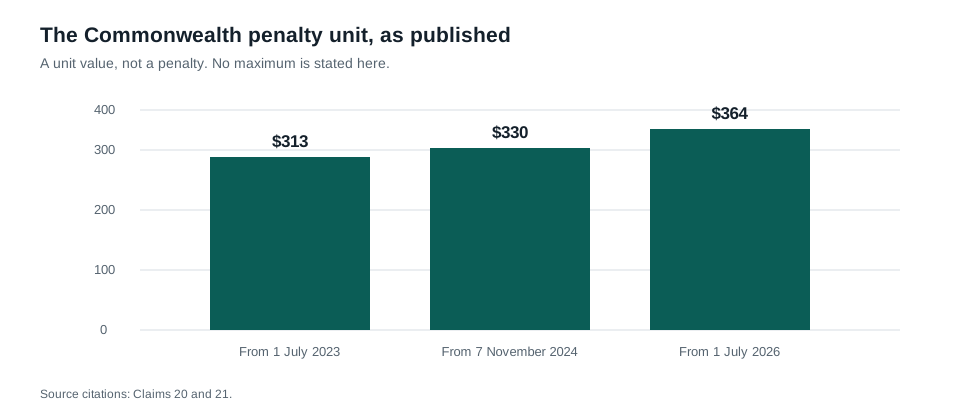
The Commonwealth penalty unit belongs in this discussion only as a published unit value, not as a sentence about a maximum penalty. The Crimes (Amount of a Penalty Unit) Instrument 2026, made 15 June 2026 under section 4AA(1A) of the Crimes Act 1914, publishes $364 for offences committed on or after 1 July 2026. Claim 20, at source. AFSA publishes $330 from 7 November 2024 and $313 from 1 July 2023 to 6 November 2024. Claim 21, at source. Section 15(1) states 5,000 penalty units and section 15(2A) states 7,500 penalty units, with both running per day under sections 15(2) and 15(2B). Claims 6, 7 and 8, at source. No primary source states a dollar maximum penalty under section 15; nothing is published beyond that negative finding. Claim 22, NOT PUBLISHED. A bonus term is not made clearer by multiplying a unit value by a number of units and calling the product a published figure.
What the ceiling does not say
The second sentence to read is the one that limits a stake while turnover is outstanding. A $12.50 cap is used here as a working figure, not as an operator's stated term, because a cap changes the number of individual plays needed to complete a $40,000 requirement and because a cap that appears only in the cashier is easy to miss. If the terms allow a higher stake, the same turnover can be completed in fewer plays. If the terms allow only $12.50, the reader needs a great many more plays to reach the same nominal figure. The cap is therefore not a minor usability note. It is part of the price of the offer. A headline that says $1,000 and a cashier that says $12.50 are describing two different parts of the same bargain, and the reader should hold both before deciding that the offer is affordable.
A ceiling the cashier does not publish is a different problem. Offers of this kind rarely publish the maximum cashout from bonus play in the headline, and where the ceiling is absent from the terms the reader cannot tell whether completing the multiple produces a small withdrawable balance, a large one, or a balance that is later reduced by a separate rule. The honest treatment of that gap is to say that nothing is published and stop. No primary source states a dollar maximum penalty under section 15, and nothing is published for that claim. Claim 22, NOT PUBLISHED. No primary source states in terms that an Australian player commits no offence by using a prohibited service, and nothing is published for that claim. Claim 23, NOT PUBLISHED. No regulations under section 69A were located, and nothing is published for that claim. Claim 24, NOT PUBLISHED. No count of offshore operators serving Australia is published by any source reached, and nothing is published for that claim. Claim 25, NOT PUBLISHED. Those four examples show the discipline needed for a cashier ceiling: record the absence, do not fill it from a neighbouring offer, and do not turn an estimate into a sourced term.
The regulator's own published material has the same shape. ACMA may investigate on its own initiative or on a complaint under Division 1, section 21(1). Claim 26, at source. Section 19 limits complainants to an individual residing in Australia, a body corporate carrying on activities in Australia, or the Commonwealth, a State or a Territory. Claim 27, at source. Part 8 is civil and administrative rather than compensatory, with formal warnings, civil penalty enforcement, infringement notices, injunctions, enforceable undertakings, remedial directions and continuing contraventions under sections 64A to 64G. Claim 28, at source. Section 59 allows the Federal Court to order a person to cease supplying internet carriage services for breach of the online provider rules. Claim 29, at source. ACMA states it can refer directors and principals of offending companies to the Australian Border Force and that some operators are not allowed to offer or enable lines of credit to Australians. Claim 30, at source. A 2017 government paper describes the same mechanism as placing directors on the Movement Alert List. Claim 31, at source. ACMA publishes a list of licensed interactive wagering providers, and BetStop's about page points to it. Claim 32, at source. None of those provisions supplies a cashout ceiling for a casino offer.
ACMA quarterly reports carry per quarter figures, not a running market denominator. July to September 2025 records 411 enquiries, 350 valid, 29 investigations into 30 sites, breaches in 28, 44 breach findings, 20 formal warnings and 71 websites referred for blocking. Claim 46, at source. January to March 2026 records 422 enquiries, 366 valid, 25 investigations into 60 sites, 44 breaches, 13 formal warnings and 109 websites referred for blocking. Claim 45, at source. April to June 2026 records 465 enquiries and complaints, 417 valid, monthly complaints of 118 in April, 145 in May and 154 in June, 30 investigations involving 76 gambling sites, breaches in 27, 56 breach findings, 18 formal warnings, 187 websites referred to internet service providers for blocking and 187 URLs reported to family friendly filter providers. Claims 42, 43 and 44, at source. On a cumulative website blocking total, sources differ. A Yogonet news report of 17 October 2025 says "Since November 2019, a total of 1,338 illegal gambling and affiliate websites have been restricted", attributed to ACMA in general terms without naming a report, while no cumulative total is available from any readable ACMA page. Claim 48, SOURCES DIFFER, with both sources stated and no cumulative blocking total chosen. The same discipline applies to an unpublished ceiling: state what each source says, or state the gap, and never invent a number to make the paragraph feel complete.
ACMA's 2020-21 compliance report says "Winnings may not be honoured, and incentives and pressure tactics are used to target gamblers", "Consumers who access these websites have little or no recourse" and "do not have the customer protections we expect in Australia". Claim 37, at source. The same report says it contacted 52 software providers and providers of local payment services, records that Australian traffic to the majority of targeted casinos decreased by at least 90 per cent by June 2021, and identifies 56 illegal offshore online casino services as targets. Claim 38, at source. The 2024-25 report records 63 software providers contacted, 27 committed to compliance, a further 7 took down or geo-blocked games, and further disruption of one of the major players in the illegal offshore gambling market. Claim 39, at source. It also records named outcomes against Australian licensed wagering operators, including 10 investigations commenced, 10 closed with adverse findings, a $1 million penalty and enforceable undertaking for Betchoice, enforceable undertakings for Ultrabet and PointsBet, a remedial direction for ReadyBet, formal warnings for Topbet and Vicbet, and no action against Buddybet, which left the market. Claim 40, at source. It says there was a very high level of compliance with the credit card and crypto ban, with no investigations commenced, and that a March 2025 review found 50 services still referring to credit card or crypto deposits, all removed by 30 June 2025. Claim 41, at source. Those are regulator outputs, not cashier terms.
Website blocking as practised is a request to internet service providers rather than a statutory direction under the Act, with quarterly reports describing referring websites for blocking and separately reporting URLs to family friendly filter providers. Claim 36, at source. No ACMA page reached states that website blocking can be got round, and nothing is published for that claim. Claim 51, NOT PUBLISHED. ACMA publishes no register of offshore operators, no list of "safe" offshore operators and no rating of any operator, and nothing is published for that claim. Claim 52, NOT PUBLISHED. ACMA's licensed interactive wagering providers page did not render a list on retrieval and no provider count could be read, and nothing is published for that claim. Claim 53, NOT PUBLISHED. For a reader, the useful point is narrower: an absent ceiling cannot be checked against an Australian register, a published operator list or a rating held by ACMA.
Weighting, expiry and caps
Game weighting is the third term that changes the apparent price. A bonus may advertise forty times the bonus alone while the terms count only a fraction of each stake on some games, exclude other games entirely, or apply a separate schedule to free spins. The multiple has not moved, but the qualifying turnover has. A $40,000 requirement with full weighting on one game and reduced weighting on another is not one requirement. It is a set of different requirements expressed through one headline. The reader needs the weighting table before choosing a game, because choosing first and reading later can leave a balance that looks large and qualifies slowly. Where the weighting table is absent, the correct line is that the offer has not published the schedule, not that every game contributes equally.
Expiry works in the opposite direction. A multiple without a deadline is a task; a multiple with a short deadline is a schedule. The same $40,000 of qualifying staking has a different practical cost if it must be completed in seven days, thirty days or before the bonus balance is forfeited at an hour the cashier does not display. Expiry also interacts with the stake cap. A $12.50 cap means the deadline is not merely about time available to log in, but about the number of plays that can fit into the time allowed. A reader who models the bonus as a single pool of money will miss that interaction. This site models and calculates, and it does not play, so the model has to state the cap, the weighting and the deadline as separate inputs rather than implying that a session would reveal them.
Capped winnings are the third member of this group. A no deposit style offer, a free spin bundle or a matched bonus can all carry a maximum amount that may be withdrawn from bonus play even after the multiple is completed. If the cap is lower than the balance shown, the displayed balance is not the amount at risk of being paid. The cap may also be expressed as a multiple of the bonus, as a fixed AUD amount, or as a rule that converts the rest of the balance to bonus funds again. A term that publishes neither the cap nor its conversion rule leaves the reader with a completed wagering requirement and no way to price the result. The proper response is to identify the missing term, keep it missing, and refuse to average it from other offers.
One calculator belongs on a page of this kind, because it lets a reader keep the assumptions visible while changing one input at a time.
Enter the bonus, the multiple, the base, the stake cap and any weighting figure printed in the offer. The result is a modelled turnover requirement, not an operator's stated term and not a prediction of a session.
Bonus in AUD $1,000
Multiple forty times the bonus alone
Base bonus alone or deposit plus bonus
Working stake cap in AUD $12.50
Weighting figure as printed nothing is published
Expiry as printed nothing is published
Capped winnings as printed nothing is published
On the stated assumption, $1,000 at forty times the bonus alone gives a $40,000 modelled turnover requirement. A $12.50 cap gives 3,200 capped plays to reach that figure. If the offer instead applies forty times to a $1,000 deposit plus a $1,000 bonus, the modelled requirement is $80,000 and the capped plays rise to 6,400. Those are arithmetic outputs from the inputs on this page, not published operator terms.
The legal material around a dispute reinforces why a printed term is worth more than a displayed balance. A complaint to ACMA is a regulatory complaint, not a claim. Section 21(1) is the power to investigate and sections 64A to 64G are the toolkit; nothing in Part 3 or Part 8 provides for a complainant to recover money, and no provision found gives a complainant any remedy at all. Claim 156, at source. Only a person with an Australian connection may complain at all under section 19. Claim 157, at source. BetStop's own route for an online casino complaint is ACMA and nothing else. Claim 158, at source. ACMA says "Consumers who access these websites have little or no recourse", "Winnings may not be honoured, and incentives and pressure tactics are used to target gamblers", and that these services "do not have the customer protections we expect in Australia". Claim 159, at source. The Commonwealth said in 2017 that many consumers are unaware the offshore sites they use are unlicensed in Australia and that "there is limited legal recourse if they run into any difficulties obtaining winnings or deposits". Claim 160, at source. That paper also lists what offshore operators do not do: pay Australian taxes or racing and sporting fees, share suspicious betting information with law enforcement or sporting bodies, or provide more than minimal harm minimisation and consumer protection. Claim 160, at source.
The complaints route that does work works only for licensed operators. Queensland's consumer page tells a consumer to talk to the business first, then if unsatisfactory "lodge a complaint with the government agency that issued the provider's licence", which should be displayed on the provider's website; Queensland complaints go to the Office of Liquor and Gaming Regulation, and for Northern Territory licensed providers the page points to NT Consumer Affairs. Claim 161, at source. Australian Consumer Law is stated to apply to gambling businesses, and the same Queensland page says "You have consumer protections when using online gambling services", that it is illegal for businesses to act misleadingly or deceptively, to act unconscionably, or to claim to offer gifts or prizes and not provide them, and that "Australian online wagering providers must honour your consumer rights and meet their gaming licence requirements". Claim 162, at source. No source reached says whether or how Australian Consumer Law is enforced against an offshore gambling operator with no Australian presence, and nothing is published for that claim. Claim 163, NOT PUBLISHED. No Australian alternative dispute resolution scheme, ombudsman or arbitration body covering online gambling was located, and nothing is published for that claim. Claim 164, NOT PUBLISHED. Whether an agreement with an offshore casino is enforceable, and whether civil proceedings lie to recover money, turn on whether regulations under section 69A exist; none was located, and nothing is published for that claim. Claim 165, NOT PUBLISHED. A weighting schedule read late, an expiry missed, or a cap discovered after completion therefore has no Australian ombudsman on this record to restore the bargain.
Currency and the cashout line
Currency is not decoration in a bonus term. AUD throughout is the assumption on this page, and every figure in the model stays in that currency. If a headline is written in one currency, a cashier balance in another, and a capped winnings clause in a third, the reader is no longer comparing amounts but conversion rules, fees and timing. The per brand record used for an editorial comparison would keep each figure in the currency the operator publishes in and would never convert it, but this site page does not carry an editorial comparison grid. It carries a method for reading one offer. That method starts by writing the currency beside the headline, the deposit, the multiple output, the stake cap and the cap on winnings, then checking that the same currency is used in the cashout line.
The cashout line is where the offer becomes a buying decision. It should state what counts as withdrawable, what happens to bonus funds, whether winnings from free spins are treated separately, whether the deposit itself is restricted, and what maximum may be withdrawn. If it says only that general terms apply, the reader has a marketing figure and no price. The sensible order is to read the base, the ceiling, the weighting, the expiry, the cap and the currency before entering any amount into the calculator. The calculator on this page then does one job: it keeps the arithmetic honest while the reader changes an assumption. It cannot turn an unpublished term into a published one.
ACMA's own material shows how easily a number can be overstated when sources differ. On services that left the market, two ACMA pages give different counts and a third gives a third framing: "over 100" on the Act page, "Over 220" on the interactive gambling landing page, and "about 220 ... over eight years" in the 2024-25 report. Claim 49, SOURCES DIFFER, with each source stated and no single figure chosen. On offshore expenditure, two estimates in one ACMA document differ by about eight times: GBGC US$175 million for 2020 and H2 Gambling Capital A$1,475 million for 2020, with ACMA noting the difference and not reconciling it; the 2017 paper says the Review estimated "could be as high as $400 million annually". Claim 50, SOURCES DIFFER, with each source stated and no single offshore spend chosen. A cashout line deserves the same care. If two pages of one offer disagree, record both and do not select the friendlier number.
The same caution applies to payment language. ACMA's 2024-25 compliance report states "significant risks to consumers through the use of high-volume, small-value transactions to illegal services". Claim 133, at source. ACMA's payment work is directed at the services rather than the schemes, with its 2020-21 report recording contact with "the providers of local payment services used by the targeted casinos" alongside 52 software providers. Claim 134, at source. The 2024-25 report's contents carry a heading "Financial transaction blocking" with no text beneath it in the retrieved document. Claim 135, at source. The statutory position on cards and wallets is narrower than most pages assume: a credit card and a credit card funded wallet are banned for licensed Australian wagering, and nothing in section 15C speaks to a debit card, a bank transfer, PayID, a voucher or a wallet funded from a bank account, and nothing in section 15C binds an offshore casino at all. Claim 136, at source, reading section 15C. This page does not turn those provisions into a payment promise.
The figure below is about a published unit value, not a penalty and not a bonus ceiling. Its caption is reproduced from the figure register, and the token is supplied to the pages plugin rather than an image tag.
Reading the whole offer
Reading an offer well is a sequence, not a search for the biggest number. First, write down the headline amount and the currency. Second, find the multiple and the base, because "bonus alone" and "deposit plus bonus" are different contracts. Third, find the stake ceiling and any game weighting, because they decide how many qualifying plays the multiple represents. Fourth, find the expiry, because a deadline gives the task a schedule. Fifth, find the cap on winnings and the cashout rule, because a completed requirement is not the same thing as a withdrawable amount. Sixth, check that the deposit, the bonus, the turnover output and the cap all use the same currency. Only then compare the offer with another one.
That sequence also keeps the reader away from two common errors. The first is treating a displayed balance as a price. A balance can include restricted funds, bonus funds, free spin winnings or an amount that will later be reduced by a cap. The second is treating an absent term as a permissive one. If the ceiling, weighting schedule, expiry or cap is not printed, the reader has less information, not more freedom. This site states that nothing is published where the source record says nothing is published, and it does not fill the space with a neighbour's term, a plausible average or a remembered figure from an affiliate page.
The statutory facts are part of the reading because they explain what is absent. Section 15 is written about the provider, and the same is true of sections 15AA, 15A and 15C; the section 3 simplified outline lists duties on providers, internet service providers and advertisers, and no offence or civil penalty provision directed at a customer for using a prohibited service was found. Claim 9, at source. The prohibition reaches an operator wherever it sits, because section 8 says an Australian customer link exists if any customers are physically present in Australia and section 15(5) applies Criminal Code section 15.4, extended geographical jurisdiction category D. Claim 10, at source. Section 15(3) provides a defence where the person did not know and could not with reasonable diligence have ascertained the Australian customer link, with the evidential burden on that person. Claim 11, at source. Section 15(4) lists reasonable diligence factors, including whether prospective customers were told Australian law prohibits provision to persons physically present in Australia, an express condition not to use the service while in Australia, personal details required and what they suggested, network data indicating customers were outside Australia at account opening and throughout, and any other relevant matters. Claim 12, at source. Those provisions address provision, not the clarity of a bonus term.
ACMA lists banned services as "online casinos", "in-play sports betting", "sports betting services which do not hold an Australian licence" and "betting on the outcome of a lottery". Claim 16, at source. Its compliance report describes "prohibited interactive gambling services, such as online casino services (for example, online slots, poker and roulette)" and says "Online casinos that provide slots, roulette, poker and other casino games are prohibited in Australia". Claim 17, at source. The Department of Infrastructure page says "Prohibited interactive gambling services include casino-style games such as online blackjack and roulette", lists pokies and slot machines, and groups services into wagering, lotteries and gaming. Claim 18, at source. Part 7A defines "designated interactive gambling service" in section 4 as a prohibited interactive gambling service or an unlicensed regulated one, with section 61DA prohibiting broadcast or datacast advertising in Australia and section 61EA prohibiting publication. Claim 19, at source. Advertising a prohibited or unlicensed service is prohibited and this limb does reach offshore casinos, because Part 7A operates on a designated interactive gambling service, which includes a prohibited one. Claim 96, at source. Part 7A contains exceptions a writer should know exist, including political communication, websites and business documents, premises of providers, management advertisements, products or services sharing a name, anti-gambling advertisements, regulations, trade communications, telephone directories, exempt libraries, acknowledgments, accidental or incidental broadcast, publication by a person receiving no benefit, and advertisements during flights. Claim 97, at source. ACMA acts on this limb against affiliate sites, and quarterly breach findings count advertising separately: 2 in April to June 2026, 1 in January to March 2026 and 3 in July to September 2025. Claim 98, at source. An advertisement can therefore be within a statutory advertising rule while its bonus wording remains a supplier's own term.
The 2026 amendment must not be blended into that reading. The Interactive Gambling Amendment (Gambling Reform) Act 2026, Act No. 72 of 2026, was assented 26 August 2026. Claim 105, at source. Its section 2 commencement table has three rows: sections 1 to 4 and anything not elsewhere covered on the day of Royal Assent, all Schedules except Schedule 5 on 1 January 2027, and Schedule 5 on 27 August 2026. Every substantive change is not in force on 1 November 2026 and comes into force on 1 January 2027. Claim 106, at source. Anti-avoidance bridges the gap and is already live: section 4(1) makes it a contravention to enter into, begin to carry out or carry out a scheme after commencement of section 4 and before commencement of Schedule 1 whose sole or dominant purpose is to avoid new Part 7C or 7D, with a civil penalty of 7,500 units, and section 4(4) applies it whether the scheme is in Australia, outside, or partly in each. Claim 107, at source. The compilation and the amending Act are two documents with two dates and do not describe the same law. Compilation date 14 October 2024; the amending Act was assented 26 August 2026 with substantive commencement 1 January 2027. No compilation incorporating the 2026 Act was located and this sheet does not claim one exists. Claim 122, SOURCES DIFFER, with both documents stated and no blended reading chosen. The register page for the 2026 Act shows 26 August 2026 beside the citation but did not label it the assent date, while the Act's own text does. Claim 123, SOURCES DIFFER, with both sources stated and the Act's text used for the assent date. A reader of bonus terms should apply the same rule to a cashier page: do not combine two versions of one term and call the result current.
Section 69 says the Act is not intended to exclude or limit the operation of a law of a State or Territory to the extent that law is capable of operating concurrently with the Act. Claim 124, at source. Where a State or Territory licence matters under the Commonwealth Act it matters in three places, all place based or wagering: section 8B excluded gaming service needs a licence authorising provision at that place, section 8BA place based betting service the same, and section 15AA unlicensed regulated service offence turns on whether the provider holds such a licence. Claim 125, at source. Section 15AA(7) says a holder of a State or Territory licence authorising a kind of regulated interactive gambling service does not contravene section 15AA(1) or (3) by providing that kind in the State or Territory or outside it, and section 15AA(8) says subsection (7) is enacted for the avoidance of doubt. Claim 126, at source. A Queensland consumer page says providers "are regulated by the state that licenses them", that in Queensland the regulator is the Office of Liquor and Gaming Regulation, and "Many online providers are licensed by the Northern Territory Government". Claim 127, at source. None of that supplies an online casino licence condition for a home player, and none of it writes the missing cap, weighting or expiry into an offer.
Identity language is another place where a reader should not infer a bonus term. AUSTRAC says "From 29 September 2024, all online gambling service providers must complete ACIP", the applicable customer identification procedure, "before creating an online gambling account or commencing to provide any designated service", that "the AML/CTF Rules have been amended to strengthen the applicable customer identification procedures", and that special circumstances formerly allowing delayed verification under section 10.4 "have been repealed". Claim 143, at source. It says interim arrangements were in place from 29 September 2023 to 28 September 2024, allowing some delay in special circumstances. Claim 144, at source. The Commonwealth records the same as National Consumer Protection Framework measure 3, AUSTRAC under the AML/CTF Rules, implemented 26 February 2019 and updated 2 May 2022 and 29 September 2023. Claim 145, at source. AUSTRAC's page says "all online gambling service providers" without qualifying the phrase, and this sheet does not resolve how far that reaches an offshore operator with no Australian presence; nothing is published for that claim. Claim 146, NOT PUBLISHED. No source states what an offshore casino does or does not verify, and nothing is published for that claim. Claim 147, NOT PUBLISHED. This page gives no procedure for getting past an identity check, a bank block or a self-exclusion register. It states the consequence of a missing Australian rule and describes no method.
BetStop is a useful example of scope read carefully. Section 61HA(1) says "The ACMA must arrange for a body corporate (the Register operator) to keep, on behalf of the ACMA, a register to be known as the National Self-exclusion Register", in electronic form and not as a legislative instrument. Claim 54, at source. BetStop says "Dataworks Group Limited (ABN 85 612 182 368) operates BetStop - the National Self-Exclusion Register on behalf of the ACMA", and section 61HA(6) bars ACMA from arranging with a gambling service body corporate, a related one, one holding an ownership interest in one, or one undertaking gambling related lobbying, with section 61HA(7) requiring that as a condition. Claim 55, at source. The start date is 21 August 2023, with the Commonwealth gambling reforms page giving that implementation date, an ACMA provider FAQ saying cost recovery arrangements "commenced on 21 August 2023", and the statutory mechanism being a proclaimed start day under section 61GC(1). Claim 56, at source. Section 61KA(1) creates an offence for "a licensed interactive wagering service provider" who provides a licensed interactive wagering service to "a registered individual", with 500 units and a civil penalty of 750 units under section 61KA(3). Claim 57, at source. Section 61GB defines "licensed interactive wagering service" as a regulated interactive gambling service that is a wagering service, has an Australian customer link, and is not provided in contravention of subsection 15AA(3). Claim 58, at source. BetStop's obligations reach only Australian licensed online and phone betting operators; they do not reach a casino game, which is not a wagering service under paragraphs (a) or (b) of the section 4 definition, and they do not reach an offshore operator, because paragraph (c) requires the service not to contravene section 15AA(3). Claim 59, at source. BetStop says "BetStop - the National Self-Exclusion Register does not apply to online casino games or other gambling services that are illegally provided in Australia. You can make a complaint about these services to the ACMA". Claim 60, at source. That is a statement about the duty's scope. No primary source quantifies how many offshore casinos accept registered individuals, and nothing is published about their behaviour. Claim 81, NOT PUBLISHED. Nothing here describes how a registered individual could gamble, and nothing is published for that claim. Claim 82, NOT PUBLISHED. A bonus page that turns that absence into a feature has stopped reading the offer and started selling a way around a protection.
Frequently asked questions
- "Is forty times the bonus alone the same as forty times deposit plus bonus?"
- "No. On a $1,000 deposit with a $1,000 bonus, forty times the bonus alone gives a $40,000 modelled requirement, while forty times deposit plus bonus gives $80,000. The base is part of the contract, not a wording detail."
- "Why does a $12.50 stake cap matter if the multiple has not changed?"
- "Because the cap sets how many individual plays are needed to complete the same turnover. At $40,000, a $12.50 cap gives 3,200 capped plays in the model. A different cap changes the schedule without changing the headline."
- "What should I do when the ceiling, weighting, expiry or capped winnings line is missing?"
- "Treat it as absent information. This page says that nothing is published where the source record says nothing is published. It does not borrow a figure from another offer, average two terms, or convert an unpublished term into a permission."
- "Does an Australian licence condition set a standard cashout cap for these offers?"
- "No Australian licence exists for this product. Section 15 prohibits provision of the service, section 8E defines the closed list for section 15AA, and section 15AA does not reach online casino. Claims 5, 14 and 15, at source. The cashout cap, if there is one, is the supplier's own term."
- "Can ACMA recover a bonus balance for a reader who completes the wagering?"
- "A complaint to ACMA is a regulatory complaint, not a claim. Parts 3 and 8 provide no complainant money remedy on this record, and ACMA describes consumer recourse as little or none. Claims 156 and 159, at source. No Australian alternative dispute resolution body covering online gambling was located, and nothing is published for claim 164."