A cashier that shows Apple Pay on an offer of this kind commonly puts a $1,000 deposit against a headline ceiling of $40,000, and the number that decides the purchase is the turnover attached to the bonus: forty times the bonus alone. On that assumption the $1,000 deposit carries a $1,000 bonus and $40,000 of qualifying stakes before the bonus is treated as withdrawable, and the smallest paid unit we use below is $12.50. AUD throughout. The organisation publishing this guide is Lucky Aussie Reels, and the assumption is that the reader is comparing a wallet cashier on an offshore casino offer with the protections that attach to licensed Australian wagering, a different product that does not reach the offer.
What sits under this paragraph is advertising. Its order was bought, none of its wording was composed here, and no figure in it has been held against a source cited anywhere on this site. The arrangement behind it is set out at How this site is paid.
The offers in this block are advertising. Placement is paid. Copy is supplied by the operator and is printed unaltered. More at How this site is paid. The arrangement is itemised at How this site is paid.
The money before the wallet
Apple Pay casino is a search for a cashier, not a search for a game. The reader has usually seen a headline sum, a match percentage and a wallet mark near the deposit button, and wants to know what the wallet changes. On the model used here it changes the path by which money reaches the cashier. It does not change the arithmetic of the bonus. A $1,000 deposit is still a $1,000 deposit. A ceiling of $40,000 is still a ceiling. Forty times the bonus alone is still the sentence that decides how much has to be staked before the promotional balance is treated as money that can be withdrawn. AUD throughout, and no conversion is made anywhere in this guide.
The first useful habit is to separate three figures that marketing copy often places in the same line. The deposit is the reader's own money. The match is the amount the offer adds under its own terms. The turnover is the amount of qualifying stakes the terms require. When the terms ask for forty times the bonus alone, a $1,000 matched deposit creates a $1,000 bonus and $40,000 of turnover. If the terms instead asked for forty times the deposit plus bonus, the same $1,000 deposit would carry $80,000 of turnover. That second model is not ours. It is written here only so the reader can see why the phrase "the bonus alone" is doing work. The assumption is stated in the standfirst and held for every calculation below.
The ceiling of $40,000 is a cap on the promotional sum, not a promise about the balance at the end. A reader who deposits $1,000 under a headline ceiling of $40,000 is not handling $40,000 of house money. The reader is handling $1,000 of deposited money, $1,000 of promotional money on our assumption, and a rule that asks for $40,000 of qualifying stakes before the promotional portion changes character. This is why the page leads on money rather than on the wallet. The wallet is a way into the offer. The terms are the cost of the offer.
Class F is a payment method class, and that class has a particular trap. A payment label feels like a legal category. It is not one. Apple Pay is a search intent and a cashier interface. The statutory material cited on this page is about licensed interactive wagering services, credit, digital currency, BetStop, identity verification and complaints. It is not a set of scheme rules about a wallet brand. Claim 140 records that no scheme rule from Visa, Mastercard, Apple Pay or Google Pay about Australian gambling was located. The honest way to handle that gap is to say nothing is published and to keep the arithmetic on the reader's side of the cashier.
Nothing is published about Apple Pay as a rule for Australian gambling. That sentence is the whole finding under claim 140. It does not become a claim that the method is allowed, disallowed, blocked, faster or safer. It does not become a claim about what a bank will do, or what a device will do, or what any particular cashier will accept. It is a record of an absence. The page can still cost the offer, because the offer has a deposit, a bonus, a multiple and a ceiling. Those are the figures the reader acts on.
The next habit is to keep the wallet out of the turnover sentence. "Forty times the bonus alone" is a term about a promotional balance. "Apple Pay" is a label at the cashier. Putting them together as though the wallet caused the turnover would be a category error, and putting the statutory wagering rules onto the casino offer would be another. Section 4 below is the single regulatory section on this page. It says what licensed Australian wagering operators must do, then says in the same section that wagering is a different product and does not reach the casino offer. That is the only permitted use of the comparator.
For a buyer, the practical question is simple: how much money has to move through qualifying stakes before the bonus can be treated as withdrawable, and what disappears from the transaction when the offer sits outside the Australian system. The first part is arithmetic. The second part is a list of absent protections. This page keeps those two parts in that order. It does not turn an absence into a present tense rule for the offshore offer to be absent from. It says what is not there.
The smallest unit used in the worked examples is $12.50. It is one eightieth of the $1,000 deposit on our assumption. It gives the calculator a fine enough step to show what happens when a reader funds a cashier in small pieces rather than one sum. The maths does not care whether those pieces are made through a wallet, a card, a transfer or any other cashier control. The maths cares about the amount credited, the bonus attached to it and the multiple in the terms. AUD throughout, and the calculator never converts a figure into another currency.
A hub page has to be useful on the day the reader arrives and on the day the cashier label changes. Offers of this kind can swap a wallet mark, alter a ceiling, remove a match or rewrite a bonus clause. The method here survives that because it does not source the $1,000, the $40,000, the $12.50 or the forty times phrase to anything that can be swapped. The standfirst states them as the assumption for the model. The sections below test the model against the reader's decision, not against a live offer list.
That distinction matters most when an advertising block sits above the prose. The paid entries carry supplier copy and the order in which they are shown is bought. The editorial calculation below is not written from those entries. It is written from the assumption in the standfirst. If a supplier changes a headline, replaces a wallet token or reprices a match, the reader can still take the new figures and run the same calculation: deposit, bonus, multiple, ceiling, currency, and what is absent from the Australian protections.
One more boundary belongs at the front. There is no Australian licence for the product this page is about. The licence aside near the end states that in the form required for this build: "No Australian licence exists for this product", with claims 5, 14 and 15 cited. That is not the beginning of an argument about "licensed here versus licensed offshore", because there is no domestic licensee against whom an offshore one could be held. It is a statement about the shape of the market. The comparison on this page is with licensed Australian wagering, a neighbouring product, and the comparison is confined to one section.
The title of this guide is a payment phrase. It is not a statement that a scheme has published a rule about Australian gambling, and it is not a statement about a bank product. Claims 138, 139 and 140 record nothing published for PayID, Neosurf and the named card and wallet brands as gambling methods. Claim 140 is the one that governs this key. Those gaps are useful precisely because they stop the page from inventing a treatment. The cost model remains complete without them.
Before going further, keep the four numbers in view. Deposit: $1,000. Headline ceiling: $40,000. Turnover phrase: forty times the bonus alone. Small step: $12.50. AUD throughout. If a cashier shows a different deposit or a different ceiling, the reader substitutes those figures and keeps the same method. If the terms apply the multiple to deposit plus bonus, the reader changes that one input and sees the turnover double. The page does not need a live operator term to make that instruction clear.
Reading the offers
Reading an offer of this kind is an exercise in placing each figure under the right heading. "Up to $40,000" belongs under a ceiling. "100 per cent" on our $1,000 assumption belongs under a match. "Forty times the bonus alone" belongs under turnover. "Apple Pay" belongs under the cashier interface. "AUD throughout" belongs under currency. Once the figures are separated, the buying question becomes much less noisy. The reader is not asking whether a wallet mark looks modern. The reader is asking how much of their own money is committed, how much promotional money is attached, and how many qualifying stakes stand between the two balances and a withdrawal request.
Consider the offer line in its unhelpful form: a large ceiling, a wallet mark, a match and a short phrase about bonus play. In that form, the largest number often draws the eye. The largest number here is $40,000, but on our assumption it is the turnover produced by a $1,000 bonus at forty times the bonus alone, and it is also used as the headline ceiling for the model. It is not the amount the reader receives. A careful reading asks whether the ceiling caps the match, caps a series of deposits, caps a wallet promotion, or caps a balance. The model on this page treats $40,000 as the stated ceiling and does not pretend to know more than that. The arithmetic that matters is separately derived: $1,000 bonus times forty equals $40,000 of qualifying stakes.
The phrase "bonus alone" is worth more than the adjective "welcome". It tells the reader what the multiple is applied to. If the multiple is applied to the bonus alone, the deposit is not multiplied. If it is applied to deposit plus bonus, both parts are multiplied. On the same $1,000 deposit and the same $1,000 bonus, the difference is $40,000 versus $80,000 of qualifying stakes. That is a whole extra $40,000 of action demanded by one clause. A buyer who reads only the wallet mark misses it. A buyer who reads only the ceiling misses it too. The multiple and its base have to be read together.
Now place the $12.50 step beside that. A reader who funds $1,000 in eighty steps of $12.50 still has $1,000 credited on the model. The bonus attached on our assumption is still $1,000. The turnover is still $40,000. Splitting the funding does not split the turnover away. If a cashier attaches the match to each small funding rather than to the first deposit, the terms would have to say so, and the reader would need to rebuild the calculation from the operator's own stated wording. This page does not assume that hidden variation. The calculator uses one bonus on one $1,000 deposit.
Offers of this kind sometimes publish a ceiling and leave other cashier details quiet. Claim 142 records that no published figure for Australian deposits, withdrawal times or payout speeds at offshore casinos exists on this sheet, and that a minimum deposit figure may be presented only as a term an operator has stated for itself. That is why this guide does not print a withdrawal window, a payout speed or a market wide deposit minimum. The $1,000 deposit is an assumption for a worked example, not a term sourced to any operator. The $12.50 step is a fraction of that assumption, not a cashier minimum. AUD throughout.
Claim 94 records that no instrument made under s 15C(4A)(d) was located, and that a page may not say any method beyond the credit card, credit card linked account and digital currency limbs is covered. Claim 94 is a gap about the statutory list, not a statement about a wallet. It does not license a page to fill the gap with a brand rule. The safe editorial form is "nothing is published" where the claim says nothing is published, and silence where the claim says silence. That discipline is especially important on a payment key, because search results about payment rails are full of marketing copy that is not citable under this build.
Claim 103 records that the Commonwealth gambling reforms page carries a "Last updated" field with no date in it. The implementation dates may be quoted, but the page is not described as current as at a particular day. Claim 104 records that the State and Territory inducement statutes were not researched and that no provision from any of them is stated. Those two claims are narrow, but they shape how this section reads an offer. A promotional phrase is not treated as evidence of a statutory permission or prohibition. It is treated as supplier copy attached to a commercial offer.
Claim 99 and claim 100 are AT SOURCE claims about inducements for licensed wagering under State and Territory law and a Queensland consumer page. Claim 102 records that the National Consumer Protection Framework's own stated scope is licensed wagering and does not mention online casinos. Those claims belong to the comparator section, where we say what a neighbouring product's rules require and then say that wagering is a different product and does not reach this offer. They are not used here to declare an offshore casino offer compliant or noncompliant with a State inducement statute. Claim 104 bars that.
Reading also means noticing what the offer does not give the reader. An Australian licensed wagering operator sits inside a system with BetStop duties, credit restrictions, verification timing, monthly statements, account closure rules, staff training, messaging rules and a complaints route that begins with the business and can go to the licensing regulator. The offshore casino offer does not come with that bundle. Section 4 states the licensed wagering material. This section simply records that the absence is part of the price. It is not a rule the offer is breaking; it is a protection the reader does not receive.
BetStop is the clearest example of an absence that must not be misread as a feature. Claims 59 and 60 say that BetStop's obligations reach Australian licensed online and phone wagering operators and do not reach a casino game or an offshore operator. BetStop's own sentence, quoted in section 6 under claim 60, says it "does not apply to online casino games or other gambling services that are illegally provided in Australia". A buyer must not turn that into "not on BetStop" as a selling point. Claim 81 says no primary source quantifies how many offshore casinos accept registered individuals, and that a page may not say an offshore casino will accept a registered individual, nor that any of them checks. Claim 82 says nothing here describes, and no page may describe, how a registered individual could gamble. The correct reading is a duty that does not reach the offer, not a behaviour that can be advertised.
Claims 138 and 139 sit alongside claim 140 as findings of absence. Nothing authoritative is published about PayID as a gambling payment method, and nothing authoritative is published about Neosurf as a gambling payment method. The page states those gaps only where they are relevant to the comparison of payment keys, and it does not attach a permission, a prohibition, a speed claim, a fee claim, a limit claim or an institutional treatment to either. For this Apple Pay key, claim 140 is the governing statement: no scheme rule about Australian gambling was located, so nothing is published. The cashier label remains a label.
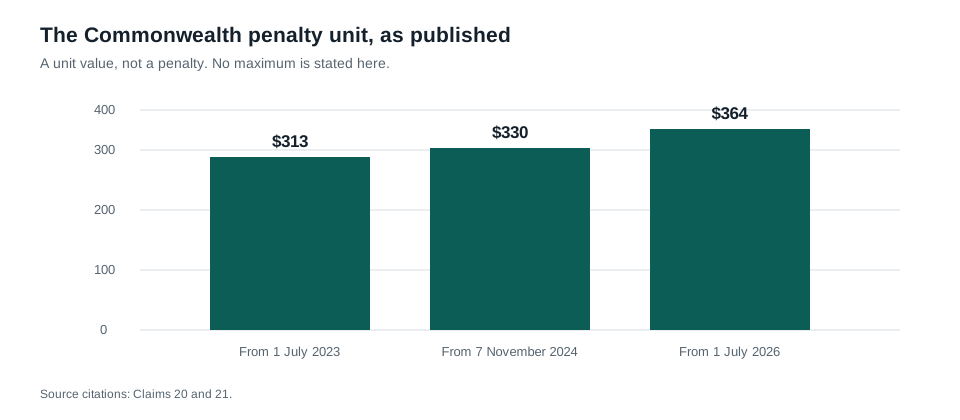
The figure below is not a picture of the cashier. It is a penalty unit drawing used by the costed guides on this build, with a caption copied from Appendix D. It sits here because the contract requires one figure on every costed guide, and because the regulatory comparison in section 4 uses the same statutory unit system when it describes penalties for licensed wagering duties. The caption itself says the figure is a unit value and not a penalty. No maximum is stated here.
Once the figures are sorted, the reader can use the calculator in section 3 with a clear mind. The calculator does not ask for a wallet choice as a legal input. It asks for a deposit, a bonus and a multiple base. It returns turnover and the number of $12.50 units in the deposit. That is the whole job. A wallet mark may tell the reader how the cashier is presented. It does not tell the reader what the bonus costs.
A final reading rule: keep "nothing is published" in its exact scope. Claim 140 is about scheme rules from named card and wallet brands about Australian gambling. Claim 94 is about a Ministerial determination under a statutory list. Claim 95 is about a legal requirement for banks to block gambling transactions. Claim 142 is about deposit, withdrawal and payout figures at offshore casinos. Claim 146 is about how far an AUSTRAC phrase reaches an offshore operator. Claim 147 is about what an offshore casino verifies. Each gap is a fence around one sentence. None is an invitation to fill the surrounding field with guesses.
The margin we assume
The margin we assume is not a house edge, a return to player figure, a hit rate, a volatility rating or a prediction of what any game will do. It is the editorial margin between the figures a buyer can see and the figures a buyer has to derive. On this page the visible figures are $1,000, $40,000 and a cashier label. The derived figure is $40,000 of qualifying stakes at forty times the bonus alone. The small unit is $12.50. AUD throughout. Keeping that boundary clear is the whole point of the calculator: it derives only what follows from the stated assumption.
Use the same assumption as the standfirst. Change one input at a time. AUD throughout.
The calculator is deliberately plain. With bonus alone selected, it multiplies the bonus by the multiple. With deposit plus bonus selected, it adds the two balances first and then multiplies. It does not estimate a game outcome. It does not convert currency. It does not read a live cashier. It does not print a withdrawal time. Claim 142 bars a page from stating a withdrawal time for any operator or the offshore market, and from presenting a minimum deposit figure as anything other than a term an operator has stated for itself. The $12.50 input is therefore labelled a small funding unit, not a minimum deposit.
Work the base case slowly. Deposit $1,000. Bonus $1,000. Multiple 40. Base: bonus alone. Turnover $40,000. Small units in the deposit: 80. The headline ceiling in the standfirst is $40,000, so the model has a pleasing symmetry that is easy to misread. The symmetry is not a promise. It is simply what happens when a $1,000 bonus is multiplied by forty. If the bonus were $500, turnover would be $20,000. If the bonus were $2,000, turnover would be $80,000. The ceiling would still be whatever the offer states. The reader must not let a matching number do the work of a term.
Change only the base. Deposit $1,000. Bonus $1,000. Multiple 40. Base: deposit plus bonus. Turnover $80,000. The deposit has not changed. The bonus has not changed. The wallet has not changed. One clause has doubled the qualifying stakes. This is why "forty times the bonus alone" is written in the standfirst, in this section and in the FAQ. It is the assumption that makes the cost legible.
Change only the deposit. Deposit $500. Bonus $500 on a full match. Multiple 40. Base: bonus alone. Turnover $20,000. Small units in the deposit: 40. The reader has halved the amount of their own money exposed and, under a full match, halved the qualifying stakes. Change the step to $25 and the $500 deposit contains 20 units. The turnover remains $20,000. The unit is a way of seeing funding size, not a lever on the bonus terms.
Change only the multiple. Deposit $1,000. Bonus $1,000. Multiple 30. Base: bonus alone. Turnover $30,000. Multiple 50. Turnover $50,000. On a fixed bonus, turnover moves in a straight line with the multiple. That is the margin a buyer can calculate before any play takes place. It is not a prediction of how long play takes and not a claim about any game title. Claim 175 bars a page from stating an RTP, hit rate, volatility or maximum win for any named game title or studio, and the calculator states none.
Change only the bonus. Deposit $1,000. Bonus $250. Multiple 40. Base: bonus alone. Turnover $10,000. Deposit $1,000. Bonus $1,000. Multiple 40. Turnover $40,000. A smaller promotional balance reduces the turnover under a bonus alone term. It also reduces the amount of promotional money the reader is trying to convert. A buyer who compares only headline ceilings can miss this. The useful comparison is not "which ceiling is larger" but "what balance does the multiple attach to".
The model does not include a fee, a cashier charge, a currency spread, a withdrawal window or a document check. Those would be operator terms or institutional facts, and this build does not invent them. Claim 142 covers the first three as gaps for deposits, withdrawal times and payout speeds. Claims 146 and 147 cover verification as a gap about how far an AUSTRAC phrase reaches and what an offshore casino does or does not verify. Claim 95 covers a bank block as a gap about a legal requirement. Each omission is deliberate.
There is also no comparison row layer on this build. The prose does not mention that, and the reader is not asked to interpret a missing operator grid. The only paid layer is the advertising block above the contents. The only editorial layer that produces a number is this calculator. That separation keeps the maths clean. A supplier can change its copy; the calculator still derives turnover from whatever deposit, bonus, multiple and base the reader types in.
One subtle point about AUD throughout: the calculator's inputs are numbers, and the labels say AUD. It does not print "A$", "AU$", "USDT" or any other currency mark, because the model is not taken from a supplier's offer line. It does not convert $40,000 into another currency. It does not treat a ceiling written in another currency as if it were AUD. If an offer publishes its figures in another currency, the reader needs that operator's own stated term and a separate decision about currency. This page makes no conversion and states no such term.
The calculator also avoids two promises that payment pages often drift into. It does not say a wallet deposit is faster. It does not say a wallet deposit is safer. Claim 140 says no scheme rule from Apple Pay about Australian gambling was located, and the required form is "nothing is published". Claim 141 permits a quote from BetStop about voluntary bank blocks but bars naming a bank, stating a block's terms or saying anything about how a block behaves. Section 6 uses that quote without adding to it. The calculator uses no block input at all.
By the end of this section the reader should have a small set of sentences they can carry into any cashier: what is the deposit, what is the bonus, what is the multiple, what does the multiple apply to, what is the ceiling, and what currency are the figures written in. The wallet mark answers none of those questions. It may tell the reader which button to press. The cost of the offer lives in the other six answers.
That is the margin we assume: not an advantage, not a predicted return, not a special property of Apple Pay, not a statement about a bank, and not a legal classification. It is the space between marketing copy and arithmetic. The page fills that space with one worked example, one small unit and one calculator, then leaves the rest to the terms the reader is actually considering.
The wagering comparison
This is the one regulatory section on this page. It compares a licensed Australian wagering operator with the casino offer being costed above, and it says at the outset that licensed wagering is a different product and does not reach the offer. The comparison is a way of naming what the reader gives up by taking an offer from outside the Australian system. It is not a rule that the offshore casino offer is breaking, and no sentence below applies a licensed wagering duty to the casino offer without repeating that product boundary.
Part 2B of the Interactive Gambling Act 2001 is headed "Prohibitions relating to credit and digital currency for certain interactive wagering services", covering ss 15B to 15F. Claim 83 states that at source. Claim 84 states that Part 2B was substituted or amended by the Interactive Gambling Amendment (Credit and Other Measures) Act 2023, Act No. 114 of 2023, assented 11 December 2023, with Schedule 1 items 1 to 29 commencing 11 June 2024 and items 30 to 36 on 12 December 2023. Those are commencement facts about a statutory part, not facts about a wallet brand.
Claim 85 quotes the simplified outline in s 15B: "Credit must not be provided to customers of certain interactive wagering services. Such services must also not accept or offer to accept payment using specified methods, including credit cards and digital currency." The word "certain" matters. The duties are not general duties about every payment on the internet. They are duties about interactive wagering services of the regulated kind.
Claim 86 states that s 15C(1A) creates an offence where a person intentionally provides "a regulated interactive gambling service that is a wagering service" and accepts or offers to accept payment using a method in s 15C(4A) from a customer physically present in Australia. The penalty is 500 units, with a civil penalty of 750 under s 15C(3A). Claim 90 states the separate credit prohibition in s 15C(1): providing or offering credit, or facilitating or promoting the provision of credit by a third person, in connection with the service, to a customer physically present in Australia, with 500 units and a civil penalty of 750 under s 15C(3). These are licensed wagering duties, a different product from the casino offer above.
Claim 87 gives the exhaustive list in s 15C(4A): (a) a credit card; (b) an account, service or facility in which payment is made from a credit card linked to it; (c) digital currency; (d) a method of a kind determined by the Minister by legislative instrument. Claim 88 is the fact this key must handle carefully: paragraph (b) is the e-wallet limb, and it catches an account only where payment is made from a credit card linked to it. A digital wallet funded from a debit card or bank account is not caught by (b). That is a statement about the statutory limb for licensed wagering, not a statement that Apple Pay is allowed, prohibited, blocked, faster or safer for Australian gambling. Licensed wagering is a different product and does not reach the casino offer.
Claim 89 states that "digital currency" has the same meaning as in the A New Tax System (Goods and Services Tax) Act 1999 and is not defined afresh. Claim 91 states who is bound: every limb of s 15C is addressed to a person providing "a regulated interactive gambling service that is a wagering service", read with s 8E, which means a licensed Australian betting operator. Section 15C does not bind an offshore online casino. Again, the product boundary is the point. The licensed wagering rule sits on a neighbouring product; the casino offer is outside that regulated class.
Claim 94 records that no instrument made under s 15C(4A)(d) was located, and that a page may not say any method beyond (a), (b) and (c) is covered. Claim 95 records that no primary source states that a bank must block a gambling transaction, and that individual banks offer blocks voluntarily as claim 141 describes. Those two gaps keep this section from turning a statutory list into a brand rule or a bank rule. Nothing is published beyond what the cited claims state, and nothing is published by the named scheme about Australian gambling under claim 140.
Claim 83 through claim 95 are therefore useful to the buyer only as a contrast. A licensed Australian wagering operator has a statutory credit prohibition, a specified payment method list, a credit card linked account limb, a separate credit limb, narrow exceptions and a defined class of provider. A casino offer from outside that system does not carry that bundle for the reader. Claim 92 states the two narrow exceptions in ss 15D and 15E for certain telephone betting and for a customer that is itself a provider of a gambling service. Claim 93 records the older credit lines ban under the National Consumer Protection Framework, implemented 17 February 2018, with the Commonwealth page's wording "Online gambling service providers cannot provide credit to people who gamble on their site or app." All of that belongs to the neighbouring regulated framework, not to the wallet interface on an offshore casino cashier.
BetStop sits inside the same boundary. Claim 54 states that s 61HA(1) requires the ACMA to arrange for a body corporate to keep the National Self-exclusion Register. Claim 55 names Dataworks Group Limited as the Register operator on BetStop's own about page and records the statutory bars in s 61HA(6) and (7). Claim 56 gives the start date 21 August 2023. Claim 57 states that s 61KA(1) creates an offence for "a licensed interactive wagering service provider" who provides a licensed interactive wagering service to "a registered individual", with 500 units and a civil penalty of 750. Claim 58 gives the definition that settles scope: "licensed interactive wagering service" means a regulated interactive gambling service that is a wagering service, has an Australian-customer link, and is not provided in contravention of s 15AA(3).
Claim 59 states the consequence: BetStop's obligations reach only Australian licensed online and phone betting operators. They do not reach a casino game, because it is not a wagering service under paragraph (a) or (b) of the s 4 definition, and they do not reach an offshore operator, because paragraph (c) requires the service not to contravene s 15AA(3). Claim 60 records BetStop's own sentence, quoted in section 6. Licensed wagering is a different product and does not reach the casino offer. The reader's loss is an absent duty, not a present permission.
Claims 61 to 78 describe what sits inside the licensed wagering system: a free and secure way to exclude yourself from all online and phone wagering providers licensed in Australia in one go, no partial exclusion, a minimum of three months up to a lifetime, registration details, provider duties while registered, marketing prohibitions, account closure, pending bets, checking powers, no fixed timing for checks, a due diligence defence, promotion of BetStop, early cancellation, separate State and Territory schemes, self registration, support people and the 30 June 2025 statistics. Those are AT SOURCE claims about the neighbouring product. They are not transferred to the casino offer. Section 6 uses only the narrow parts that shape the buyer's understanding of absence, and it uses claim 81 and claim 82 to stop that absence becoming a selling point.
Claims 99 to 104 add the inducement and framework boundary. Claim 99 records that inducements are restricted by State and Territory law, not the Commonwealth, as at the sheet's date, with National Consumer Protection Framework measure 4 implemented 26 May 2019 in all jurisdictions except NSW and 26 November 2019 in NSW, and the Commonwealth wording "Online gambling providers cannot offer any incentives to open an account." Claim 100 records the Queensland consumer page about credit, vouchers, rewards, benefits, referral incentives and direct marketing. Claim 101 lists the rest of the framework's measures and implementation dates. Claim 102 records that "The National Framework applies to all licensed online wagering service providers" and does not mention online casinos. Claim 103 records the undated "Last updated" field. Claim 104 records that no State or Territory inducement statute was researched and no provision from any of them is stated. All of that concerns licensed wagering or the limit of this sheet, a different product from the casino offer.
Claims 143 to 147 add identity verification. Claim 143 states AUSTRAC's rule: "From 29 September 2024, all online gambling service providers must complete ACIP", the applicable customer identification procedure, "before creating an online gambling account or commencing to provide any designated service"; the AML/CTF Rules were amended to strengthen those procedures, and special circumstances formerly allowing delayed verification under s 10.4 "have been repealed". Claim 144 records the interim period from 29 September 2023 to 28 September 2024. Claim 145 records the Commonwealth's measure 3 entry. Claim 146 records that AUSTRAC's page says "all online gambling service providers" without qualifying the phrase, and that this sheet does not resolve how far that reaches an offshore operator with no Australian presence. Claim 147 records that no source states what an offshore casino does or does not verify. Those claims are stated here as statement of fact only. They are not advice on avoiding an identity check, and they are not a finding about the behaviour of any operator.
Claims 161 and 162 close the comparison from the complaints side. Claim 161 records that the complaints route that does work works only for licensed operators: Queensland's consumer page tells a consumer to talk to the business first, then if unsatisfactory "lodge a complaint with the government agency that issued the provider's licence", with Queensland complaints going to the Office of Liquor and Gaming Regulation and NT licensed providers pointed to NT Consumer Affairs. Claim 162 records that Australian Consumer Law is stated to apply to gambling businesses on that Queensland page, and that "Australian online wagering providers must honour your consumer rights and meet their gaming licence requirements." Those are statements about Australian providers and licensed wagering. They are not used here to say a reader has or has not got Australian Consumer Law rights against an offshore casino. Claim 163 bars either assertion.
The comparison therefore ends where it began, with an absence. A licensed Australian wagering operator has credit rules, a specified method list, BetStop duties, a National Consumer Protection Framework, verification timing, a licensing regulator and a complaints route through the business and the licence issuer. The offshore casino offer costed above does not bring those Australian protections with it. Claim 91 says s 15C does not bind an offshore online casino. Claim 59 says BetStop does not reach a casino game or an offshore operator. Claim 102 says the framework applies to licensed online wagering service providers and does not mention online casinos. Claim 104 says the inducement rules are State and Territory rules binding licensed operators and therefore not rules an offshore casino is within. Licensed wagering is a different product and does not reach the offer. That is the whole comparator.
Nothing in this section says Apple Pay is permitted, prohibited, blocked, faster or safer. Claim 140 says no scheme rule from Visa, Mastercard, Apple Pay or Google Pay about Australian gambling was located, and the required statement is "nothing is published". Claim 88 says a wallet funded from a debit card or bank account is not caught by paragraph (b), while a credit card linked account is caught by paragraph (b); that is the statutory e-wallet limb for licensed wagering only. Claim 95 says no primary source states that a bank must block a gambling transaction. Claim 141 permits only BetStop's own sentence about voluntary bank blocks, quoted without bank names in section 6. The buyer's decision still rests on $1,000, $40,000, forty times the bonus alone, $12.50 and AUD throughout.
What Apple Pay does not settle
Apple Pay does not settle the bonus base. It does not settle the multiple. It does not settle the ceiling. It does not settle the currency. It does not settle whether the reader is inside BetStop's scope, whether an identity procedure applies, whether a complaint can go to a licensing regulator, or whether any Australian protection attaches to the transaction. Those questions are answered by terms and by the statutory material cited in the one regulatory section above. The cashier label is not an answer to any of them.
Claim 140 is the central gap for this key. No scheme rule from Visa, Mastercard, Apple Pay or Google Pay about Australian gambling was located. What is sourced is the statutory limb at claim 87, which catches a credit card and a credit card linked account for licensed wagering and says nothing about any brand. The required wording is "nothing is published". It is not "allowed", not "prohibited", not "blocked", not "faster" and not "safer". A page that turns the gap into one of those words has invented the very fact the claim says is absent.
Claim 88 is the statutory detail most often misread. Paragraph (b) of s 15C(4A) catches an account, service or facility in which payment is made from a credit card linked to it. A digital wallet funded from a debit card or bank account is not caught by (b). That is a carefully bounded statement about licensed wagering, a different product that does not reach the casino offer. It is not a brand rule. It is not a statement about a device. It is not a statement about a bank account in general. It is not a statement about Apple Pay for Australian gambling. Nothing is published by the scheme about Australian gambling, and the statutory list says only what claim 87 says.
Claim 94 adds a second fence. No instrument made under s 15C(4A)(d) was located, so a page may not say any method beyond the credit card, credit card linked account and digital currency limbs is covered. Claim 89 says digital currency takes its meaning from the GST Act and is not defined afresh. Claim 90 keeps the separate credit prohibition distinct from the payment method offence. Claim 91 says who is bound. Those claims can be stated, but they cannot be stretched into a published treatment of a wallet brand.
Claim 95 adds a third fence. No primary source states that a bank must block a gambling transaction. Individual banks offer blocks voluntarily as claim 141 describes. Claim 141 permits BetStop's sentence: "Many major banks let you block gambling transactions on your bank accounts. Contact your bank and ask them how they can help you." That quote appears in section 6 with no bank names. No page may state a block's terms or say anything about how a block behaves. No page may describe getting round a bank block. The consequence is stated; no procedure is described.
Claims 138 and 139 are neighbouring gaps. Nothing authoritative is published about PayID as a gambling payment method, and nothing authoritative is published about Neosurf as a gambling payment method. A page may state only those absences, and claim 138 also permits the ACMA risk statement at claim 133 about "significant risks to consumers through the use of high-volume, small-value transactions to illegal services". That is a risk statement about illegal services, not a permission or a speed claim for a rail. For this Apple Pay key, the corresponding line is claim 140: nothing is published.
Claim 142 is the gap readers feel most sharply when they ask about cashier speed. No published figure for Australian deposits, withdrawal times or payout speeds at offshore casinos exists on this sheet. No page may state a withdrawal time for any operator or the offshore market, nor present a minimum deposit figure as anything other than a term an operator has stated for itself. The $12.50 step on this page is a fraction of the $1,000 assumption, not a deposit minimum. The $1,000 deposit is an editorial assumption, not an operator term. AUD throughout.
Claims 146 and 147 are gaps about verification. AUSTRAC's page says "all online gambling service providers" without qualifying the phrase, and this sheet does not resolve how far that reaches an offshore operator with no Australian presence. No source states what an offshore casino does or does not verify. Stated as fact, the Australian verification rule is a rule about when an account may be opened under claim 143, and a reader taking an offer from outside the Australian system has no Australian body to hold to it. Nothing here is written as advice on avoiding an identity check. No mirrors, no proxies, no second accounts, no registering without documents, and no procedure of any kind appears on this page or elsewhere in this fragment.
Claims 103 and 104 are gaps about dating and statutory detail. The Commonwealth gambling reforms page carries a "Last updated" field with no date in it, so this sheet cannot date the measures beyond their stated implementation dates. The State and Territory inducement statutes were not researched, so no provision from any of them is stated. What may be said is that the rules are State and Territory rules binding licensed operators under claims 99 and 100, and therefore not rules an offshore casino is within. Those are statements of fact, not a compliance verdict.
Claims 138, 139, 140 and 142 also stop a page from borrowing a figure from an affiliate review. The source discipline in this build permits the statute, a regulator's own page, an official register, a government department's own publication and a regulator's own compliance report. A search snippet, an affiliate site, a casino's own marketing, a law firm note and a trade publication are not citable. On payment rails, searching returns affiliate marketing almost exclusively. The page states the gap rather than importing a plausible figure.
What Apple Pay does not settle can be put as a short list. It does not publish an Australian gambling rule. It does not set the forty times phrase. It does not set the $40,000 ceiling. It does not set the $1,000 deposit. It does not set the $12.50 step. It does not set AUD throughout. It does not make BetStop reach a casino game. It does not make a licensed wagering credit rule bind an offshore casino. It does not create a bank duty. It does not create a withdrawal window. It does not create a verification outcome. It does not create a complaints route to a licensing regulator.
What the reader can settle from this page is narrower and more useful. The reader can cost the bonus on a stated assumption. The reader can see how one clause doubles the turnover. The reader can see that a small funding unit changes the number of payments in the worked example but not the turnover. The reader can see that the licensed wagering comparator names protections that are absent from an offer outside the Australian system. The reader can see that "nothing is published" is the answer where the claim says nothing is published.
That is why this section does not end with a recommendation to use or avoid a wallet button. A buying guide helps the reader choose an offer, but it does so by exposing cost and absence, not by inventing a legal status for a cashier label. The choice remains with the reader. The figures remain $1,000, $40,000, forty times the bonus alone, $12.50 and AUD throughout. The legal facts remain the cited claims, each in its own fence.
For anyone arriving from a neighbouring payment key, the shape is the same. Google Pay casino has claim 140 as its governing gap. Neosurf casinos has claim 139. PayID casino has claim 138. Visa casino and Mastercard casino have claim 140 alongside the statutory list at claims 86 to 91. Skrill casino and e-wallet pokies have the paragraph (b) detail at claim 88 and the same absence of a brand rule. No page in this family turns an absence into permission, prohibition, a block, a speed claim or a safety claim. The absence is the published finding.
The final line of this section is therefore a restraint. Apple Pay is the title of the page because that is the search phrase the reader used. It is not a source of law, not a source of terms, not a source of operator behaviour and not a source of a figure in the calculator. The calculator derives from the standfirst. The regulator material is cited by claim number. The wallet is left where it belongs: at the edge of the cashier, outside the arithmetic.
Knowing when to stop
Knowing when to stop begins before the first deposit in this model. The standfirst asks the reader to accept a $1,000 deposit, a $40,000 ceiling, forty times the bonus alone, a $12.50 step and AUD throughout. If those figures do not fit the reader's own limit, the calculation is already finished. There is no need to press a cashier button, compare a wallet mark or read another promotional line. The cheapest decision in a buying guide is the decision not to buy.
The calculator can help here because it makes the size of the commitment visible. A $1,000 bonus at forty times the bonus alone means $40,000 of qualifying stakes before the promotional balance is treated as withdrawable under the assumption. Changing the base to deposit plus bonus means $80,000. Those are not small numbers next to the deposit. A reader who wants a smaller exposure can reduce the deposit and, under a full match, reduce the bonus and turnover with it. A reader who does not want a turnover condition at all can decline the bonus. The page does not instruct the reader which choice to make. It shows the cost of each input.
BetStop is part of the licensed wagering comparison, not a feature of an offshore casino offer. Claim 60 records BetStop's own sentence: "BetStop - the National Self-Exclusion Register does not apply to online casino games or other gambling services that are illegally provided in Australia. You can make a complaint about these services to the ACMA". That quote is given here without any addition about operator behaviour. Claim 59 states the statutory scope consequence. Claims 57 and 58 identify the licensed wagering provider and the definition that settles scope. Claim 81 says no primary source quantifies how many offshore casinos accept registered individuals and bars a page from saying an offshore casino will accept a registered individual or that any of them checks. Claim 82 says nothing here describes, and no page may describe, how a registered individual could gamble. The framing is a consequence, not a route.
Claim 141 permits one more sentence from BetStop, quoted without any bank names: "Many major banks let you block gambling transactions on your bank accounts. Contact your bank and ask them how they can help you." BetStop describes bank gambling blocks as voluntary and bank by bank, and no list of banks offering them was located. This page quotes the sentence and adds nothing about a block's terms, how a block behaves, or any way past it. Sources describing how to get round a bank block were found during the build and nothing from them appears here. Claim 95 separately records that no primary source states that a bank must block a gambling transaction.
Claim 73 records BetStop's early cancellation wording: "You can apply to cancel your self-exclusion early after at least 3 months of self-exclusion. To cancel, you must complete a Commonwealth statutory declaration to confirm you have seen a counsellor or a general practitioner to discuss your decision to cancel your self-exclusion. If your application is valid and has been completed correctly, you will be removed from the register after 7 days. You can withdraw your application to cancel at any time during this period if you change your mind." The sheet quotes it so a reader can see what the commitment costs to unwind. It is not presented as a way out, a loophole or a route to gambling while registered. Claim 74 records that State and Territory schemes are separate, and claim 75 records that other exclusion programs exist for venues. Claim 76 records that a person needs to register themselves. Claim 77 records support people. Those are statements of fact about the register, not instructions for this offer.
Claim 62 records BetStop's FAQ answer: "No. Signing up for BetStop - the National Self-Exclusion Register excludes you from all licensed online and phone wagering companies in Australia." Claim 63 records the minimum of three months up to a lifetime. Claim 65 records provider duties while registered: "should not: open a wagering account for you; allow you to place bets, or; send you marketing material. Providers should also close any accounts you have and refund any credit to you." Claim 67 records that accounts are not reactivated afterwards. Those duties belong to licensed wagering providers, a different product from the casino offer on this page. They are stated here as part of knowing what the register does, not as a protection that attaches to the offer being costed.
Help and support facts on this sheet are quoted as their publishers state them. Claim 176 states that the National Gambling Helpline is 1800 858 858 and that the Commonwealth describes it as "a free and confidential helpline open 24 hours a day, 7 days a week". Claim 177 records Gambling Help Online's name "Gambling Helpline", the same number, "This service is available 24 hours a day, 7 days a week", free calls that will not appear on a phone bill, and the support a counsellor provides. Claim 178 records BetStop's own support sentence: "If you would prefer to speak to someone, free and confidential support is available 24 hours a day, every day of the year. You can contact the National Gambling Helpline on 1800 858 858." BetStop adds: "These services are available for anyone affected by a gambling issue, not just the person who is gambling."
Claim 179 records that the Gambling Help Online website "contains self-help material that you can access for free" and "also provides free 24/7 chat and email counselling and support", with the Commonwealth's sentence "For free and confidential support visit the Gambling Help Online website." Claim 180 records BetStop's own number, 1800 238 786, for registration help and identity documents other than the three it lists. Claim 181 records Lifeline as BetStop publishes it: "Lifeline is a national service providing free 24/7 help and crisis support. You can talk to someone on 13 11 14, text 0477 131 114, or chat online". Claim 182 records the National Debt Helpline as BetStop publishes it: "Call the National Debt Helpline on 1800 007 007 for free and confidential advice from professional financial counsellors. The helpline is open from 9:30 am to 4:30 pm, Monday to Friday."
Claim 183 records that Gamblers Anonymous hosts local meetings across Australia, that Reset is "a confidential and free app that helps if you want to quit or cut back on gambling", and that the Australian Government's Moneysmart website "can help you take control of your money with free tools, tips and guidance", including guidance on where to obtain free legal advice. Claim 184 records that the Gambling Helpline can arrange an interpreter, or a caller can contact the "Translating and Interpreting Service on 131 450", and that for hearing or speech impairment the page directs contact through the National Relay Service and gives no number. Claim 185 records that State and territory services differ and the referrer is Gambling Help Online.
Claim 186 is a SOURCES DIFFER claim about the service name. One State badged page publishes 1800 858 858 under "Gambler's Help", while "National Gambling Helpline" and "Gambling Helpline" appear in the other sources. The number is the same across all sources; the service name is not. This sheet does not pick one. A page must quote the name used by the source it cites. Claim 187 records that no source states who operates the National Gambling Helpline, so this page attributes it to no organisation. Claim 188 records that no State or Territory gambling helpline number is on this sheet, so this page states none and does not say the national number is the only one.
Knowing when to stop also means knowing what a complaint is worth. Claim 156 records that a complaint to ACMA is a regulatory complaint, not a claim, and that nothing in Part 3 or Part 8 provides for a complainant to recover money. Claim 157 records that only a person with an Australian connection may complain at all. Claim 158 records that BetStop's own route for an online casino complaint is ACMA and nothing else. Claim 159 records ACMA's wording: "Consumers who access these websites have little or no recourse"; "Winnings may not be honoured, and incentives and pressure tactics are used to target gamblers"; these services "do not have the customer protections we expect in Australia." Claim 164 records that no Australian alternative dispute resolution scheme, ombudsman or arbitration body covering online gambling was located, and this sheet names none.
Claims 163 and 165 are open questions that stay open. No source reached says whether or how Australian Consumer Law is enforced against an offshore gambling operator with no Australian presence, so a page may not say a reader has ACL rights against an offshore casino and may not say they have none. Whether an agreement with an offshore casino is enforceable, and whether civil proceedings lie to recover money, turn on whether regulations under s 69A exist; none was located, so no page may assert either answer. Those are not invitations to speculate. They are reasons to treat the absence of a local dispute route as part of the price before any money is committed.
Claim 160 records the Commonwealth's 2017 statement that many consumers are unaware the offshore sites they use are unlicensed in Australia, and that "there is limited legal recourse if they run into any difficulties obtaining winnings or deposits". The same paper lists what offshore operators do not do: pay Australian taxes or racing and sporting fees, share suspicious betting information with law enforcement or sporting bodies, or provide more than minimal harm minimisation and consumer protection. That is a statement about absence, not a present tense rule invented for the offer to be absent from. It belongs in the buyer's calculation alongside $40,000 of turnover.
Stopping can be a temporary act, a limit on the size of a deposit, a decision to decline a bonus, a decision to close a page, a call to a support service, or a self exclusion decision within the system that actually covers a product. This page does not rank those choices. It does not describe any way past a self exclusion register, an identity check or a bank block. It states the consequence of the statutory scope, quotes the support material as published and leaves the reader with the arithmetic. If the $1,000 deposit is too much, the model ends at the standfirst. If the forty times phrase is too much, the model ends at the calculator. If the absent protections are too much, the model ends at section 4.
The commercial purpose of this guide is to help a reader choose an offer. A guide that hides the cost of stopping is not helping anyone choose. A deposit is not just a payment; it is an entry into a set of terms and a set of absent protections. Seeing both before the cashier is the quietest and most useful form of harm minimisation this page can offer. No statutory warning is used, no exclamation mark appears in the prose, and no invented reader, vote, star or test is used to make the decision look more certain than it is.
Questions readers ask
- What does Apple Pay change about the bonus maths?
- Nothing in the model. The standfirst assumes a $1,000 deposit, a $40,000 ceiling, forty times the bonus alone, a $12.50 step and AUD throughout. On that assumption the $1,000 bonus carries $40,000 of qualifying stakes. Claim 140 says no scheme rule from Apple Pay about Australian gambling was located, so nothing is published about the wallet as a rule for Australian gambling. The cashier label is not an input to the turnover.
- Is a wallet funded from a debit card caught by paragraph (b)?
- Claim 88 says paragraph (b) of s 15C(4A) catches an account only where payment is made from a credit card linked to it, and a digital wallet funded from a debit card or bank account is not caught by (b). That is the licensed Australian wagering rule, a different product that does not reach the casino offer. It is not a brand rule and not a statement about Apple Pay for Australian gambling.
- Has Apple Pay published a rule about Australian gambling?
- Nothing is published. Claim 140 records that no scheme rule from Visa, Mastercard, Apple Pay or Google Pay about Australian gambling was located. What is sourced is the statutory limb at claim 87, which catches a credit card and a credit card linked account for licensed wagering and says nothing about any brand. The page does not say the method is allowed, prohibited, blocked, faster or safer.
- Can I rely on a quick withdrawal or a published deposit minimum?
- No figure is published here. Claim 142 records that no published figure for Australian deposits, withdrawal times or payout speeds at offshore casinos exists on this sheet, and that a minimum deposit figure may be presented only as a term an operator has stated for itself. The $1,000 deposit and $12.50 step are editorial assumptions for a worked example, not operator terms.
- Does BetStop reach this kind of casino offer?
- Claims 59 and 60 say BetStop's obligations reach Australian licensed online and phone wagering operators and do not reach a casino game or an offshore operator. BetStop's own sentence is: "BetStop - the National Self-Exclusion Register does not apply to online casino games or other gambling services that are illegally provided in Australia. You can make a complaint about these services to the ACMA". Claims 81 and 82 bar any statement about offshore acceptance, checking or a route to gambling while registered. The finding is about a duty, not about behaviour.
- What is absent when the offer sits outside the Australian system?
- The licensed wagering bundle described in claims 83 to 95, 54 to 78, 99 to 104, 143 to 147, 161 and 162 does not come with the offer. Those rules concern licensed wagering, a different product that does not reach the casino offer. Claims 156 to 159 describe a regulatory complaint to ACMA rather than a money remedy, and claims 163 to 165 leave the ACL, enforceability and ADR questions open. The buyer's loss is an absence of Australian protections, not a present tense rule invented for the offer.