A $1,000 balance on this kind of offer is costed here as $40,000 of turnover before a withdrawal is even modelled, because the working assumption is forty times the bonus alone, with a $12.50 unit used for the calculator and AUD throughout; the assumption is stated here rather than hidden in the arithmetic, and the cashier ceiling is treated as a figure the offer does not publish.
What sits under this paragraph is advertising. Its order was bought, none of its wording was composed here, and no figure in it has been held against a source cited anywhere on this site. The arrangement behind it is set out at How this site is paid.
The offers in this block are advertising. Placement is paid. Copy is supplied by the operator and is printed unaltered. More at How this site is paid. The arrangement is itemised at How this site is paid.
Money before documents
A search for an online casino no verification withdrawal Australia is usually a search about a moment, not about a statute. The reader is thinking about a balance that has stopped being a game and started being money. A cashier page says a withdrawal can be requested. A bonus page says a bonus was credited. Somewhere between those two statements sits a set of conditions that decide whether the balance is a figure, a pending request, a reversed credit, a document request, a capped amount, a closed promotion or an account review. This page costs that set of conditions in AUD, with the assumption in the opening paragraph, and it keeps the costing separate from the legal material that appears later.
The first number is $1,000. It is not a deposit figure taken from an operator and it is not a withdrawal figure taken from a cashier. It is the headline balance for the model. If that $1,000 is treated as a bonus subject to forty times the bonus alone, the turnover attached to it is $40,000. That is the figure a reader acts on, because it is the figure that sits between a credited amount and a request to withdraw. The second number is $12.50. It is the unit used in the calculator below so that the turnover can be broken into countable stakes without pretending that any operator publishes a stake limit for this product. The third number is the absent one. Nothing is published here as a withdrawal time, and no sentence on this page turns a processing claim into a fact.
Offers of this kind usually ask forty times on the bonus alone, but the phrase "usually" belongs to the class of promotion and not to a measurement of a named cashier. The model on this page is an assumption. It is printed in the standfirst, repeated here, and used again in the calculator. A reader can replace $1,000 with any other bonus figure and the arithmetic still works. What cannot be replaced is the missing ceiling. A cashier at this end of the market rarely publishes the ceiling that matters most to a buyer, which is the maximum that can be withdrawn from bonus-linked play before another condition is applied. Without that ceiling, a balance is not a price. It is a starting point for further conditions.
That is why the first section does not begin with identity. A no verification phrase reads as though the document stage is the whole problem, but the money stage arrives first in the terms. A bonus can be subject to a multiple, a game weighting table, a maximum conversion, a voided spin, a restricted stake, a time limit, a currency conversion, a payment rail condition, a cashier review or a request for further information. None of those needs to be described as a trick for the arithmetic to be useful. The buyer only needs to know that $40,000 of turnover is a large condition before any later question is reached.
The language used here is deliberately narrow. This page does not say what an offshore casino checks. It does not say what an offshore casino does not check. It does not say that a reader will be asked for a document, and it does not say that a reader will not be asked for one. Those are statements about behaviour that are not published in the permitted source set. The honest commercial line is simpler: the promotion is priced on its own terms, and the Australian rule quoted later is a rule about when an account may be opened. A reader taking an offer from outside the Australian system has no Australian body to hold to that rule.
There is also no advice here about registering without documents, getting past an identity check, opening a second account, using a mirror, using a proxy, using a VPN, or getting round a bank block. Those phrases name the line this page will not cross. A consequence can be stated. A procedure cannot be written. The consequence that matters to a buyer is that the protections which would make the document stage predictable are protections attached to a different product, or to a provider within the Australian system. Where those protections do not reach the offer, the buyer is left with the offer's own copy and the offer's own cashier.
So the buying question is not "how quickly can I leave". It is "what has to be true before this balance is mine". On the assumption used here, the first answer is $40,000 of qualifying turnover. The second answer is that the ceiling is unpublished. The third answer is that no published withdrawal time sits on this sheet, so no hour, minute or speed is presented as market fact. The rest of the page expands those three answers rather than replacing them with a rule that belongs to wagering.
The commercial intent is plain. A reader arriving from this search wants to choose an offer. This page helps by giving the reader a way to price the offer before choosing. It does that with money in the first paragraph, a stated assumption in the same paragraph, a calculator that uses the same figures, and a later comparison that says what sitting outside the system costs. It does not do that by promising a result, by claiming a test, by inventing a reader vote, or by attaching a star rating to a cashier. Those devices would make the page louder and less useful.
Australian dollars are used throughout. When the calculator says $12.50, it means AUD. When the standfirst says $1,000, it means AUD. When it says $40,000, it means AUD. No conversion is performed and no other currency is introduced into the model. That matters because a promotion written in one currency and a cashier settled in another can change the apparent size of a condition without changing the underlying multiple. The model avoids that by keeping one currency and one assumption from top to bottom.
The first buyer's test is therefore a quiet one. Take the credited amount. Ask what the multiple applies to. Multiply the bonus alone on the assumption stated here. Then ask whether the terms state a maximum convertible amount. If they do not, write "not published" against that line and stop. Do not fill it from a neighbour, from memory, from a review, or from a marketing page. A page that fills an unpublished figure has stopped costing the offer and started advertising it.
The same discipline applies to time. A cashier may use words that imply immediacy. This page does not repeat them as fact. Claim 142 says nothing is published about Australian deposits, withdrawal times or payout speeds at offshore casinos on this sheet, and a page may not state a withdrawal time for any operator or the offshore market. The line is not "slow" and it is not "fast". The line is "nothing is published". That is a small sentence, but it protects the whole model from being rewritten around an invented clock.
Readers often meet the phrase "no verification" after a withdrawal has already been requested. That is late in the commercial sequence. By then the bonus has been accepted, the turnover has been attempted, the stake size has been chosen, and the cashier's own conditions have been engaged. The earlier a buyer puts $40,000 on the page, the less likely it is that the final document question becomes the only question. The later sections keep returning to this order because it is the order in which the money is actually exposed.
Nothing in this section names an operator. Nothing in this section points at a paid placement. Nothing in this section counts an offer list. The arithmetic works the same way on any offer of this class because it is an arithmetic assumption, not a report on a particular promotion. That is enough for a buying guide to begin. Later sections deal with the narrower material: wagering conditions, the neighbouring Australian wagering product, and the absence of a local holder for the Australian verification rule.
Wagering and the withdrawal gap
Wagering is the word that turns a bonus into a sequence. On this page it has two meanings and they are kept apart. The first is the promotion's wagering requirement: forty times the bonus alone, on the stated assumption. The second is the Australian licensed wagering product, which is a different product and appears only in the one regulatory section below. Confusing the two would let a statutory duty attached to betting accounts silently become a promise about a casino cashier. That transfer is the main error this page is built to avoid.
The promotion's wagering requirement is modelled as $1,000 multiplied by forty, giving $40,000. If the unit stake is $12.50, the turnover is 3,200 stakes. That figure is arithmetic, not a claim about any operator's minimum or maximum stake. It is included because a large multiple is easier to assess when it is expressed as a countable sequence. A buyer who sees 3,200 stakes understands that a balance with a withdrawal button is not the same thing as a balance ready to leave.
The gap appears when one part of the sequence is not published. A multiple can be printed in large type. A maximum conversion from bonus-linked play often is not. A withdrawal time may be described with an adjective rather than a term. A document stage may be described after the request has been made rather than before the account is opened. A payment rail may be named in a logo strip without a rule about its use. Each of those gaps shifts work to the buyer, and each one has to be written down as a gap rather than filled with a plausible value.
Offers of this kind usually ask forty times, and the cashier at this end of the market rarely publishes the ceiling. Those are class statements, not measurements. The source discipline behind this page permits a page to state nothing is published and to state nothing else where the sheet records a gap. It does not permit a page to turn affiliate marketing into a primary source. Search results for payment rails and bonus terms produce plausible figures that contradict one another in the same week. A model that takes one of those figures has invented it.
The commercial cost of the gap is not only delay. It is uncertainty about the value of the offer at the moment of choice. A reader comparing two promotions needs a common unit. If one promotion publishes a multiple and another publishes a headline amount, the comparison is not yet possible. If one cashier publishes a ceiling and another does not, the comparison is still not possible. The buyer has to decide whether an unpublished term is acceptable before the money is committed. This page cannot make that decision, but it can make the missing term visible.
The withdrawal gap also changes how a document request is read. In a system where identity obligations attach before an account exists, the document stage has a defined place. Outside that system, on the facts permitted here, no source states what an offshore casino does or does not verify. So the page does not present "no verification" as a feature. It presents the absence of a published Australian protection as a cost. That is a different frame. It does not tell a reader how to avoid a check; it tells a reader what cannot be enforced against a local body when the offer is taken from outside the Australian system.
Claim 142 is the hard boundary on timing. Nothing is published here as a withdrawal time, payout speed or processing window. That includes marketing adjectives. A page may not say an amount arrives in minutes, hours or days as a fact. It may not say the market is instant. It may not say the market is slow. It may not say a request is usually reviewed overnight. The correct sentence is that nothing is published, and that sentence is repeated wherever a reader might otherwise expect a clock.
Claims 138, 139, 140 and 141 are similar boundaries for payment labels. Nothing authoritative is published about PayID as a gambling payment method. Nothing authoritative is published about Neosurf as a gambling payment method. No scheme rule from Visa, Mastercard, Apple Pay or Google Pay about Australian gambling was located. Bank gambling blocks are described by BetStop as voluntary and bank-by-bank, and no list of banks offering them was located. Those claims are stated here as gaps, not as permissions, prohibitions, speeds or safety judgements. A logo beside an offer is not a regulatory fact.
Claim 94 records that no instrument made under s 15C(4A)(d) was located, and a page may not say any method beyond the statutory list is covered. Claim 95 records that no primary source states a bank must block a gambling transaction. Those two lines belong to the licensed wagering comparator and are not applied to a casino offer in this section. They are mentioned only to show why a payment label on a cashier page cannot be borrowed as a legal category. The later regulatory section states the different-product qualification in the same place as the wagering rules.
The calculator below uses no hidden ceiling. It multiplies the bonus by forty, divides by the stake, and prints the resulting sequence. It does not estimate a win rate, a return, a volatility, a hit rate or a maximum win for any game. It does not name a game title or a studio. It does not print a payout time. It does not say a withdrawal will happen. It is a costing instrument for one assumption and nothing more.
Costing assumption: $1,000 bonus, forty times the bonus alone, $12.50 stake, AUD throughout.
Bonus $1,000
Multiple 40
Turnover $40,000
Stake unit $12.50
Stake count in the model 3,200
Maximum convertible amount nothing is published
Withdrawal time nothing is published
The calculator models the stated assumption only. It is not an operator term, a test result, a game parameter or a promise about a cashier.
The absence of a ceiling is the most expensive unpublished field. If a buyer knows the multiple but not the maximum convertible amount, the buyer cannot price the upper bound of the bonus. If the buyer knows the headline amount but not what the multiple applies to, the buyer cannot price the lower bound of the turnover. If the buyer knows neither the ceiling nor the withdrawal time, the apparent value of the promotion is mostly a headline. That is why this section keeps returning to "nothing is published" rather than offering a comforting substitute.
The figure on this page belongs to a different subject. It shows the Commonwealth penalty unit, not a withdrawal clock and not a promotion term. It is included because every costed guide carries one figure from the store, and because a unit value is a useful reminder that law often publishes a unit while commercial copy publishes a promise. The caption is copied exactly and is not rewritten here.
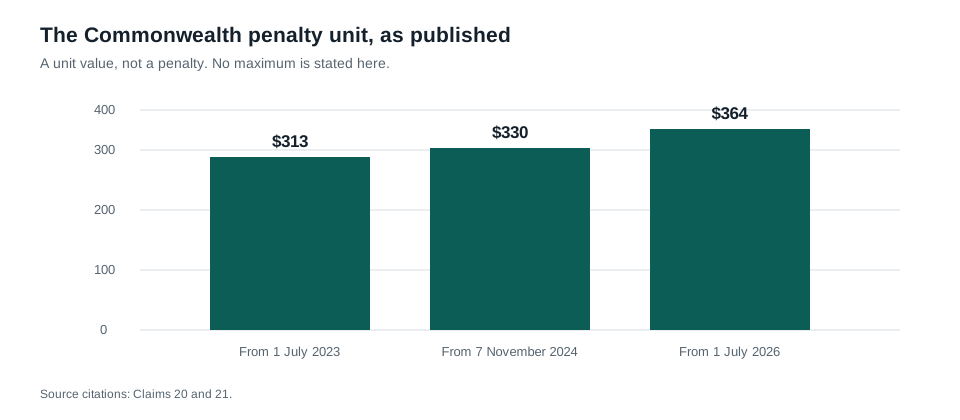
The commercial conclusion of this section is narrow. A no verification withdrawal phrase cannot be priced until the bonus condition is priced. The bonus condition cannot be fully priced until the ceiling is known. The ceiling is not published here. The time is not published here. The Australian statutory material that follows explains why a licensed wagering protection cannot be used to fill those blanks for this product.
What the Australian wagering rules require
This is the one regulatory section on the page, and its comparator is licensed Australian wagering. It is a neighbouring product, not this one. Every rule quoted in this section is a rule about licensed interactive wagering service providers or about the National Consumer Protection Framework as the Commonwealth records it. Those rules do not reach an online casino offer, and that qualification is stated here in the same section rather than left to inference. A licensed wagering duty is not converted into a casino promise anywhere on this page.
Section 61HA(1) of the Interactive Gambling Act 2001 provides that "The ACMA must arrange for a body corporate (the Register operator) to keep, on behalf of the ACMA, a register to be known as the National Self-exclusion Register." Claim 54. BetStop states that Dataworks Group Limited operates BetStop, the National Self-Exclusion Register, on behalf of the ACMA. Claim 55. The start date recorded by the Commonwealth gambling reforms page and the ACMA provider FAQ is 21 August 2023. Claim 56.
Section 61KA(1) creates an offence for "a licensed interactive wagering service provider" who provides a licensed interactive wagering service to "a registered individual". Claim 57. Section 61GB defines a licensed interactive wagering service as a regulated interactive gambling service that is a wagering service, has an Australian-customer link, and is not provided in contravention of subsection 15AA(3). Claim 58. A wagering service is paragraph (a) or (b) of the section 4 definition: placing, making, receiving or accepting bets, or introducing those who want to bet. Claim 58.
Claim 59 states the consequence: BetStop's obligations reach only Australian-licensed online and phone betting operators. They do not reach a casino game, which is not a wagering service under those paragraphs, and they do not reach an offshore operator, because the definition requires the service not to contravene s 15AA(3). BetStop's own sentence is quoted at claim 60: "BetStop - the National Self-Exclusion Register does not apply to online casino games or other gambling services that are illegally provided in Australia. You can make a complaint about these services to the ACMA". That is a scope rule about a duty. It is not a statement about what any offshore casino accepts, checks or declines.
Claim 81 is the boundary that matters for this dangerous page. No primary source quantifies how many offshore casinos accept registered individuals, and nothing supports a claim that any proportion do. A page may say BetStop registration does not, by its own terms, reach an offshore casino. It may not say an offshore casino will accept a registered individual, nor that any of them checks, because no source says either. Claim 82 records that nothing here describes, and no page may describe, how a registered individual could gamble. This page states the consequence and describes no procedure.
Claims 59 and 60 are the only BetStop consequences used here. The page does not turn "not on BetStop" into a feature. It does not present an exclusion register as a product filter. It does not list a route around a self-exclusion register, an identity check or a bank block. It does not mention mirrors, proxies, VPN advice or second accounts as methods. The framing is compliance with the absence: the statutory duty stops at licensed wagering, and the reader is left outside that protection when taking a different product from outside the Australian system.
The National Consumer Protection Framework is also a licensed wagering framework in the Commonwealth record. Claim 101 lists measure 3 customer verification, AUSTRAC under the AML/CTF Rules, implemented 26 February 2019 and updated 2 May 2022 and 29 September 2023. It lists measure 10 BetStop, ACMA, 21 August 2023. Claim 102 records the framework's own stated scope: "The National Framework applies to all licensed online wagering service providers." It does not mention online casinos. That sentence is the reason this section cannot be used as a consumer-protection checklist for a casino cashier.
Claim 103 records that the Commonwealth gambling reforms page carries a "Last updated" field with no date in it, so this sheet cannot date the measures beyond their stated implementation dates. A page quotes an implementation date and does not describe the page as current as at a particular day. Claim 104 records that this sheet did not research the State and Territory inducement statutes and states no provision from any of them. Claims 99 and 100 are a Commonwealth summary and one State consumer page. No section of a State Act on inducements is cited here and no penalty for an inducement breach is stated.
Claim 99 records NCPF measure 4 as regulated by states and territories, implemented 26 May 2019 in all jurisdictions except NSW and 26 November 2019 in NSW, with the Commonwealth summary stating "Online gambling providers cannot offer any incentives to open an account." Claim 100 records the Queensland consumer page: online providers and on-course bookmakers cannot offer credit or a voucher, reward or benefit to try to get someone to open a betting account, nor incentives to refer someone else; direct marketing is limited to customers who expressly opt in, with easy unsubscribe. These are rules stated for licensed operators, and claim 104 says they are therefore not rules an offshore casino is within. They are not applied to this offer.
Part 2B is another licensed wagering boundary. Claim 83 identifies ss 15B to 15F as prohibitions relating to credit and digital currency for certain interactive wagering services. Claim 85 quotes the section 15B simplified outline: "Credit must not be provided to customers of certain interactive wagering services. Such services must also not accept or offer to accept payment using specified methods, including credit cards and digital currency." Claim 86 states that s 15C(1A) is an offence where a person intentionally provides "a regulated interactive gambling service that is a wagering service" and accepts or offers to accept payment using a method in s 15C(4A) from a customer physically present in Australia.
Claim 87 gives the exhaustive list in s 15C(4A): a credit card; an account, service or facility in which payment is made from a credit card linked to it; digital currency; and a method of a kind determined by the Minister by legislative instrument. Claim 88 explains the e-wallet limb: it catches an account only where payment is made from a credit card linked to it. Claim 89 states that digital currency has the same meaning as in the A New Tax System (Goods and Services Tax) Act 1999. Claim 90 states the separate credit prohibition in s 15C(1). Claim 91 is the point that matters most: every limb of s 15C is addressed to a person providing "a regulated interactive gambling service that is a wagering service", read with s 8E that means a licensed Australian betting operator, and s 15C does not bind an offshore online casino.
Claims 94 and 95 are NOT PUBLISHED lines attached to that same different product. No instrument made under s 15C(4A)(d) was located, and a page may not say any method beyond the statutory list is covered. No primary source states that a bank must block a gambling transaction, and a page may not state a card block is a legal requirement or that any named bank does or does not offer one. Those are statements of fact only. They are not a payment guide for the casino offer on this key.
Claims 161 and 162 are the complaints contrast, and they also belong to licensed operators. Queensland's consumer page tells a consumer to talk to the business first, then if unsatisfactory "lodge a complaint with the government agency that issued the provider's licence", which should be displayed on the provider's website. Queensland complaints go to the Office of Liquor and Gaming Regulation; for NT-licensed providers the page points to NT Consumer Affairs. Claim 161. The same page states that Australian Consumer Law applies to gambling businesses and that "Australian online wagering providers must honour your consumer rights and meet their gaming licence requirements." Claim 162. This is a route that works for licensed operators, which is why it is a contrast rather than a promise for this product.
The section therefore earns its comparator and stops. It does not add a second regulatory section. It does not generalise a wagering duty into a casino duty. It does not say the casino offer is breaking a wagering rule. It says what is absent: no licensed wagering account framework, no BetStop duty, no NCPF scope, no s 15C payment duty and no Queensland licence-complaint route attach to the offer by reason of those provisions. The buyer's cost is the absence of those protections, not the presence of a rule the offer has failed.
That absence is also why the rest of the page keeps the phrase "outside the Australian system" rather than a legal conclusion about a particular operator. A statement about a duty can be sourced. A statement about what a distant cashier does at three in the morning cannot. The source set records that distinction and this page keeps it. The next section turns to the verification rule itself, still as a rule about when an account may be opened, and still without a single sentence of procedure.
Verification cost without a local holder
Identity verification is the subject the search phrase names, and it is also the subject on which this page is most constrained. The permitted source set says what the Australian rule requires, says what is not published about offshore behaviour, and says what a page may not write as advice. It does not supply a method. It does not supply a behaviour claim. It does not supply a market statistic. The commercial treatment here is therefore a treatment of cost: what a reader gives up when the rule exists but there is no Australian body to hold to it for the offer being considered.
Claim 143 is quoted exactly as AUSTRAC states it: "From 29 September 2024, all online gambling service providers must complete ACIP", the applicable customer identification procedure, "before creating an online gambling account or commencing to provide any designated service"; "the AML/CTF Rules have been amended to strengthen the applicable customer identification procedures"; special circumstances formerly allowing delayed verification under s 10.4 "have been repealed". That is an AML obligation, not an interactive gambling obligation, and it bites before the account exists.
Claim 144 records the interim period: "Interim arrangements will be in place from 29 September 2023 to 28 September 2024", allowing some delay in special circumstances. The dates are stated as published and nothing is inferred from the gap between the interim period and the 29 September 2024 rule. The point for a buyer is chronological: the current AUSTRAC statement places ACIP before account creation or before commencing to provide a designated service. It is a rule about when an account may be opened, not a promise about a withdrawal.
Claim 145 records the Commonwealth's version of the same measure: NCPF measure 3, AUSTRAC under the AML/CTF Rules, implemented 26 February 2019 and updated 2 May 2022 and 29 September 2023. Those dates are stated as the Commonwealth records them. Claim 103 prevents this page from describing the reforms page as current as at a particular day, because its "Last updated" field carries no date in it. The implementation and update dates are quoted, and nothing is added to them.
Claim 146 is the limit that stops the sentence a writer reaches for first. AUSTRAC's page says "all online gambling service providers" without qualifying the phrase, and this sheet does not resolve how far that reaches an offshore operator with no Australian presence. A page may state the rule as AUSTRAC states it, quoted and attributed; it may not state that an offshore casino is or is not bound by it. This page therefore quotes AUSTRAC as it is and makes no assertion that an offshore operator is linked to that rule or outside it. It does not decide the reach question. It leaves the regulator's words standing.
Claim 147 is the second limit. No source states what an offshore casino does or does not verify. The honest line, as the sheet gives it, is that the Australian verification rule is a rule about when an account may be opened, and a reader taking an offer from outside the Australian system has no Australian body to hold to it. Nothing here may be written as advice on avoiding an identity check. That line is reproduced in substance here because it is the only honest commercial line available. It says what is absent: a local holder against whom the rule can be insisted upon by the reader in this market.
The phrase "no verification" is not used on this page as a product description. It is not used as a promise. It is not used as a filter. It is not used as a reason to prefer one cashier over another. A page that lets it read as a feature has written an advertisement for circumvention. The consequence, repeated in plain terms, is that the Australian system has a before-account rule, while the reader considering this offer is outside the Australian system and has no Australian body to hold to that rule. That is a loss of protection, not an instruction.
This is where §5 of the build controls the framing rather than only the sentence list. There is no advice on registering without documents. There is no advice on bypassing an identity check. There is no advice on a second account. There is no VPN advice. There is no mirror advice. There is no proxy advice. There is no advice on getting round a bank block. There is no description of how a registered individual could gamble. There is no step list, no sequence of clicks, no "if this then try that", and no wording that could be followed as a procedure. The reader is told the consequence of the scope rule and nothing else.
Claims 59 and 60 were used in the regulatory section for the BetStop scope rule. They are not reused here as a behavioural claim. Claim 81 is not used to imply acceptance, checking or non-checking by any offshore casino. The sheet bars claim 81 from that use, and this page does not cite it as a feature. Claims 82 and 147 together form the safety boundary: an omission is recorded, and the omission is not filled with a method.
The buyer's cost can be described without crossing that boundary. Inside a regulated product, a document stage has a defined statutory place before the account exists. Outside the Australian system, the reader cannot point to an Australian holder of that duty for the offer. The cashier's own terms therefore become the only operating text the reader can see, and the cashier's own terms are the same text that contains the wagering multiple and the unpublished ceiling. The document question and the money question converge on the same unknown: the offer's own copy.
That convergence is commercially important. A buyer who expects a predictable document stage may also expect a predictable withdrawal stage, but neither predictability is supplied by the Australian wagering rules for this product. The buyer has $40,000 of modelled turnover, an unpublished ceiling, an unpublished withdrawal time and no Australian body to hold to the before-account rule. Those four lines are the whole cost. They are not a scandal narrative and they are not a legal verdict. They are the items a reader gives up by taking the offer from outside the system.
The organisation publishing this guide is Lucky Aussie Reels, and the name appears here only as the publisher of the costing method. It is not a licence holder, not a complaints body, not a regulator and not a party to the offer. No sentence on this page asks the reader to treat a commercial guide as a substitute for a statutory protection. The licence aside later in the page states the product position in one line and cites the structural claims that support it.
Claim 142 continues to govern timing. The fact that identity is an AML obligation before account creation does not produce a withdrawal clock. Nothing is published on this sheet about Australian deposits, withdrawal times or payout speeds at offshore casinos. A page may not state a withdrawal time for any operator or the offshore market, nor present a minimum deposit figure as anything other than a term an operator has stated for itself. No such operator term is used here, so no such figure appears.
Payment labels receive the same treatment. Claims 138 to 141 are only statements of fact in this build. Nothing authoritative is published about PayID as a gambling payment method. Nothing authoritative is published about Neosurf as a gambling payment method. No scheme rule from Visa, Mastercard, Apple Pay or Google Pay about Australian gambling was located. Bank gambling blocks are described by BetStop as voluntary and bank-by-bank, and no list of banks offering them was located. This section does not say a rail is permitted, prohibited, blocked, faster, safer or instant for gambling. It does not name a bank. It does not describe how a block behaves.
The result is a narrow but useful commercial statement. The rule quoted by AUSTRAC is clear about timing for the providers it addresses. The reach question is not resolved by this sheet. Offshore verification behaviour is not published. The reader outside the Australian system has no Australian body to hold to the rule. No procedure follows from any of that. What follows is a costing decision: whether an offer with an unpublished ceiling, no published withdrawal time and no local holder is worth $40,000 of modelled turnover.
That decision is left with the reader. This page does not make it easier by turning absence into a feature. It makes it easier by refusing to fill the absence. The next section collects the other unpublished fields in one place, so that a buyer can see how many blanks would have to be accepted before the offer was fully priced.
What is not published
The most useful part of the source set on this key is the set of gaps. A gap is not an invitation to estimate. It is a line that stops the page from inventing. This section states only what the sheet records as NOT PUBLISHED or as a boundary claim, and it states nothing else against those numbers. Where a claim permits a statement of fact, the statement of fact is kept short. Where a claim bars a behaviour statement, no behaviour statement is written.
Claim 142: no published figure for Australian deposits, withdrawal times or payout speeds at offshore casinos exists on this sheet. No page may state a withdrawal time for any operator or the offshore market, nor present a minimum deposit figure as anything other than a term an operator has stated for itself. On this page the line is "nothing is published". No hours, minutes, days, speed adjective or processing window is presented as fact. The calculator repeats that line against the withdrawal time field.
Claim 138: nothing authoritative is published about PayID as a gambling payment method. Claim 139: nothing authoritative is published about Neosurf as a gambling payment method. Claim 140: no scheme rule from Visa, Mastercard, Apple Pay or Google Pay about Australian gambling was located. Those claims are stated here as gaps. This page does not state that any of those labels is permitted, prohibited, blocked, faster, safer or instant for gambling. It does not state availability, limits, fees or treatment by any Australian institution.
Claim 141: bank gambling blocks are described by BetStop as voluntary and bank-by-bank, and no list of banks offering them was located. BetStop's sentence is quoted at source in the sheet: "Many major banks let you block gambling transactions on your bank accounts. Contact your bank and ask them how they can help you." A page may quote that sentence; it may not name a bank, state a block's terms, or say anything about how a block behaves. This page adds no bank name, no block term and no behaviour description.
Claim 94: no instrument made under s 15C(4A)(d) was located, and a page may not say any method beyond the statutory list is covered. Claim 95: no primary source states that a bank must block a gambling transaction, and a page may not state a card block is a legal requirement or that any named bank does or does not offer one. These lines belong to the licensed wagering comparator already qualified in its own section. They are statements of fact here, not a payment rule for this offer.
Claim 103: the Commonwealth gambling reforms page carries a "Last updated" field with no date in it, so this sheet cannot date the measures beyond their stated implementation dates. This page quotes implementation dates where needed and does not describe that page as current as at a particular day. Claim 104: this sheet did not research the State and Territory inducement statutes and states no provision from any of them. This page cites no section of a State Act on inducements and states no penalty for an inducement breach.
Claim 146: AUSTRAC's page says "all online gambling service providers" without qualifying the phrase, and this sheet does not resolve how far that reaches an offshore operator with no Australian presence. The rule is quoted as AUSTRAC states it, and this page neither says an offshore casino is bound by it nor says it is not bound by it. The regulator's words are left intact. No reach conclusion is added by Lucky Aussie Reels.
Claim 147: no source states what an offshore casino does or does not verify. The Australian verification rule is a rule about when an account may be opened, and a reader taking an offer from outside the Australian system has no Australian body to hold to it. Nothing here is written as advice on avoiding an identity check. No statement about checking, not checking, accepting or declining appears on this page.
Claims 59 and 60 were used for the scope consequence in the one regulatory section, and claim 81 was not used as a behaviour claim. Claim 81 records that no primary source quantifies how many offshore casinos accept registered individuals and that nothing supports a claim that any proportion do. Claim 82 records that nothing here describes, and no page may describe, how a registered individual could gamble. The consequence is stated; the procedure is absent. That is the whole §5 treatment on this dangerous page.
Claims 161 and 162 were used for the licensed complaints contrast. Claim 163 records that no source reached says whether or how Australian Consumer Law is enforced against an offshore gambling operator with no Australian presence, so a page may not say a reader has ACL rights against an offshore casino and may not say they have none. Claim 164 records that no Australian alternative dispute resolution scheme, ombudsman or arbitration body covering online gambling was located, and this sheet names none. Claim 165 records that whether an agreement with an offshore casino is enforceable, and whether civil proceedings lie to recover money, stays open. This page asserts neither answer and names no Australian body that will hear a dispute against an offshore casino.
Those last three claims are not part of the `wagering` comparator allow-list and are not built into a second regulatory argument here. They are named only as boundaries the source set places on this subject. The page does not say a reader has or lacks rights, does not name a dispute body and does not resolve enforceability. The buying guide stays with the cost model and the one wagering comparator section.
The commercial effect of a long gap list is not confusion. It is a clearer choice. A buyer can see that the offer's headline is supported by a multiple assumption, while the ceiling, the clock, the payment treatment, the bank treatment, the offshore verification behaviour and the local complaints route are not supplied by primary sources on this sheet. Each of those blanks would normally be filled by marketing copy. This page leaves them blank.
That restraint also protects the arithmetic. If a writer invents a fast withdrawal time, the $40,000 turnover looks smaller. If a writer invents a generous ceiling, the bonus looks larger. If a writer says an identity check is absent as a feature, the absence of a local holder looks like an advantage. Each invented sentence changes the price. The gap list is therefore part of the costing method, not a legal appendix.
Nothing in this section uses an em dash, an en dash, a double hyphen, an exclamation mark, a star rating, a vote count, a review count, a testing claim, a guarantee, a currency conversion or a hex value. Australian English is used throughout: licence as the noun, organisation, authorised, analyse, practise as the verb and practice as the noun where those words appear. The text is ASCII where punctuation is concerned, and AUD remains the only currency of the model.
The next section turns the gap list into a reading order. It does not tell a reader how to register, how to withdraw, how to avoid a check or how to choose a payment rail. It tells a reader how to read an offer before money is committed, using the fields that are published and the blanks that are not. That is a buying guide, and it stays within the source set.
Reading the offer as an Australian buyer
A buying guide earns its place by giving the reader an order of operations that does not become a procedure for circumvention. The order here is textual. Read the headline. Find what the multiple applies to. Put the assumption in AUD. Mark the ceiling as published or not published. Mark the withdrawal time as published or not published. Then read the account-opening rule as a rule about timing, not as a promise about a cashier. That is all. No click path, no document workaround, no second account, no VPN, no mirror, no proxy and no bank-block method follows from it.
Start with the headline amount. If the promotion says a bonus is credited, the buyer needs to know whether the multiple applies to the bonus alone, the deposit plus bonus, or some other base. This page assumes forty times the bonus alone and says so in the standfirst. On $1,000 that produces $40,000. If an offer uses a different base, the reader can change the input. The method does not depend on a particular offer line and does not quote a paid placement.
Then check the ceiling. A multiple without a maximum convertible amount does not give the buyer an upper bound. The calculator prints "nothing is published" for that field. That is not a criticism of a named operator. It is a statement about the source set and about the kind of term a cashier at this end of the market rarely publishes. A buyer can still choose the offer, but the choice is made with a visible blank.
Then check the clock. Claim 142 permits no published withdrawal time on this sheet, so the line remains "nothing is published". A marketing adjective does not become a processing term by being repeated in editorial prose. No hours, minutes, speed or same-day phrasing is used here as fact. The reader should apply the same discipline to any offer copy: if no term is published, the clock is a blank.
Then check the payment labels. PayID, Neosurf, Visa, Mastercard, Apple Pay, Google Pay and other labels may appear in search phrases or in advertising, but claims 138 to 141 permit only statement of fact on this sheet. A logo is not a scheme rule. A rail is not a legal category. A bank block is not stated as a requirement, and no bank is named. The reader's payment question is left with the operator's own stated term, and no such term is imported into this guide.
Then read the identity material in its proper place. AUSTRAC's sentence at claim 143 is about ACIP before creating an online gambling account or commencing to provide any designated service, with special circumstances under s 10.4 repealed and interim arrangements recorded at claim 144 for 29 September 2023 to 28 September 2024. The Commonwealth's NCPF measure 3 dates are recorded at claim 145. The buyer does not need a procedure from those sentences. The buyer needs to know that the rule is a before-account rule and that claim 147 leaves the reader outside the Australian system with no Australian body to hold to it.
Then read the comparator once. The licensed Australian wagering rules in the one regulatory section are a different product and do not reach this offer. BetStop's obligations reach licensed wagering, not a casino game. The NCPF's own stated scope is licensed online wagering service providers. Section 15C is addressed to a regulated interactive gambling service that is a wagering service. The Queensland complaints route works for licensed operators. None of that becomes a casino promise. The cost is the absence of those protections for this product.
Then stop before advice. The reader does not need a page to explain how to get past an identity check, a self-exclusion register or a bank block. The source set bars that content and the framing test in §5 bars anything that could be followed as an instruction. A page may say BetStop registration does not, by its own terms, reach an offshore casino, and this page has said that consequence in the regulatory section. It may not say an offshore casino will accept a registered individual, nor that any of them checks. It has not said either.
The licence position is structural and short. No Australian licence exists for this product. That is not a comparison between a domestic licensee and an offshore licensee, because there is no domestic licensee for an online casino served to a person at home. Claims 5, 14 and 15 are the structural claims cited in the aside below. The sentence is not expanded into a "licensed here versus licensed offshore" argument anywhere on this page.
The aside is a product note, not a scoring badge. It does not sit beside an operator name, a bonus figure, a statutory provision in the same cell, or a brand claim. It is one line with three structural citations. The FAQ that follows uses the same discipline: each answer states a consequence, an assumption or a published gap, and no answer becomes a set of instructions.
A buyer who wants a single number can keep the single number from the standfirst: $40,000. A buyer who wants a unit can keep $12.50. A buyer who wants a clock will not find one here, because nothing is published. A buyer who wants a promise about documents will not find one here, because no source states what an offshore casino does or does not verify. Those are not evasions. They are the exact limits of the permitted record.
The commercial choice is therefore made on a thinner file than the advertising suggests. Headline, multiple, base, ceiling, clock, account-opening rule, local holder. Three of those are supplied by the model or by AUSTRAC. The rest are blanks or absences. A reader who understands that before committing money has a better buying guide than a page that fills every line with a plausible adjective.
Lucky Aussie Reels publishes the method, not the offer terms. It does not play, test, verify first hand, rate by players, count votes, award stars or guarantee an outcome. It calculates from a stated assumption and cites numbered claims. Where the claim says nothing is published, the page says nothing is published. Where the claim says a rule belongs to a different product, the page says it belongs to a different product. Where the claim records an omission, the page leaves the omission intact.
That is the whole reading order. It ends before any action that §5 bars. The final section answers the questions a reader commonly brings to the phrase, with the same boundaries and the same AUD figures.
Questions readers ask
- What does the $40,000 figure mean?
- It is the turnover produced by the stated assumption: a $1,000 bonus multiplied by forty times the bonus alone, in AUD. It is a costing figure, not an operator term and not a withdrawal amount.
- Is a withdrawal time published here?
- Nothing is published. Claim 142 records no published figure for Australian deposits, withdrawal times or payout speeds at offshore casinos on this sheet, so no hours, minutes, days or speed is stated as fact.
- Does this page say what an offshore casino verifies?
- No. Claim 147 records that no source states what an offshore casino does or does not verify. The page quotes the Australian before-account rule as AUSTRAC states it and says the reader outside the Australian system has no Australian body to hold to it.
- Does BetStop reach this offer?
- BetStop's obligations reach licensed Australian wagering, a different product that does not reach this offer. Claims 59 and 60 state the scope consequence. The page does not say what any offshore casino accepts, checks or declines.
- Are PayID, Neosurf or card labels treated as gambling rules here?
- No. Claims 138, 139, 140 and 141 are stated only as gaps. The page does not say a rail is permitted, prohibited, blocked, faster, safer or instant for gambling, and it names no bank.
- Does this page give advice on avoiding an identity check?
- No. It states consequences and omissions only. There is no advice on registering without documents, bypassing an identity check, second accounts, VPNs, mirrors, proxies, bank blocks or any similar procedure.