A $1,000 headline offer can turn into $40,000 of stated turnover when the promotion is costed at forty times the bonus alone, and the small print can leave a $12.50 cash balance looking much larger than the amount a reader can actually treat as spendable. This page assumes AUD throughout, assumes a bonus-only wagering multiple, assumes the cashier does not publish a withdrawal ceiling in the offer copy, and assumes no conversion from another currency. Under that assumption, the reader's first decision is not the size of the headline. It is whether the terms can be read, whether the money can be followed, and what protections are missing when the offer sits outside the Australian system.
What sits under this paragraph is advertising. Its order was bought, none of its wording was composed here, and no figure in it has been held against a source cited anywhere on this site. The arrangement behind it is set out at How this site is paid.
The offers in this block are advertising. Placement is paid. Copy is supplied by the operator and is printed unaltered. More at How this site is paid. The arrangement is itemised at How this site is paid.
Money first, Neosurf casinos as a buying question
The search phrase Neosurf casinos arrives as a payment question, but the decision in front of the reader is still an offer decision. It is a decision about a bonus, a turnover requirement, a cash balance, and the point at which a promotion stops being a reason to choose one offer over another. The payment label sits beside those numbers and can make them feel simpler than they are. A reader who sees $1,000 on an offer headline is not looking at $1,000 of disposable money. The reader is looking at a promotional balance with conditions attached. When the model used here applies forty times the bonus alone, the stated turnover is $40,000. When the model leaves a $12.50 starting balance after a small deposit, the same multiple decides how far that balance can travel in the terms. AUD throughout is the assumption that keeps those figures comparable. No other currency is introduced, no conversion is performed, and no operator figure is borrowed to fill a gap.
Offers of this kind often ask the reader to accept several numbers at once. One number is the headline amount. One number is the percentage or match that produces it. One number is the multiple. One number is the base to which the multiple applies. One number is the time allowed. One number is the maximum bet while the promotion is active. One number is the maximum withdrawal from bonus play. One number is the minimum deposit. A careful reader separates those numbers before thinking about a payment method. That separation is the buying skill this page is built around. A large headline attached to a multiple applied to deposit plus bonus is not the same cost as a smaller headline attached to forty times the bonus alone. A promotion with a published cashout ceiling is not the same cost as one with a ceiling the cashier does not publish. A term that says the bonus is stakeable is not the same as a term that says the bonus is deducted before withdrawal. The arithmetic changes even when the branding does not.
The assumption stated in the opening paragraph matters because it is stated before any calculation. This page does not say that every offer in the market uses forty times the bonus alone. It says that this is the cost model used here, on offers of this kind, to show the shape of the decision. A model is not a promise about a cashier. It is a way of making a reader ask the right question before clicking. The question is not "how large is the bonus" in the abstract. The question is "what must be turned over, on what base, before the balance is treated as withdrawable". With $1,000 and forty times the bonus alone, the answer is $40,000 of turnover under the model. With $12.50 and the same model, the answer is $500 of turnover under the model. Both products are arithmetic on an assumption. Neither is a published term of any operator. That distinction is the difference between costing an offer and inventing one.
The commercial part of the page is plain. A reader arrives from a search for an offer and wants to choose one. The page helps by putting the money first and by treating uncertainty as a cost. If a term is not stated, the reader cannot price the friction attached to it. If a ceiling is not published, the reader cannot price the cap. If a bonus base is not clear, the reader cannot price the multiple. If a withdrawal condition is described only in promotional language, the reader cannot price the wait. The absence of a number is not a small number, and it is not a generous number. It is an unpriced condition. A buying guide earns its place by saying that plainly, then giving the reader a method for reading the terms that are present.
Neosurf casinos as a phrase can also misdirect the reader toward a payment story. The safer editorial method is to keep the payment token as a search phrase and keep the cost model attached to the offer. A reader does not pay a wagering multiple to a payment method. The reader accepts the multiple in the bonus terms. The payment label may affect convenience, but the multiple affects the amount of play required under the promotion. The ceiling affects the amount that can be taken out under the promotion. The game weighting affects which games move the multiple. The cashout rule affects what happens to the bonus component. Those are offer terms. They are the terms a reader can compare, question, and decline. They are also the terms that can be obscured when the page becomes a story about a rail rather than a story about money.
The first section therefore sets a discipline. Read the headline. Read the match. Read the multiple. Read the base. Read the ceiling. Read the game weighting. Read the time limit. Read the maximum bet. Then read the payment page only after those items have been written down. This order is not a legal judgement and it is not a consumer-law analysis. It is a practical buying order. A reader who reverses it can end up choosing an offer because the cashier looks familiar while the bonus terms carry a turnover figure that dominates the whole transaction. A reader who keeps the order can compare two offers on the same assumptions, even when one promotion uses a bold cash figure and the other uses a smaller one. The page's job is to keep that comparison visible.
The model used here can be expressed without drama. Take the bonus figure. Multiply it by the stated multiple. If the terms apply the multiple to the bonus alone, do not add the deposit. If the terms apply it to deposit plus bonus, add them before multiplying. Keep AUD throughout. Keep the ceiling separate. Keep the cash balance separate. Keep any free-spin winnings separate if the terms put them under their own multiple. That is enough to reveal why a $1,000 headline can become a $40,000 turnover question. It is also enough to reveal why $12.50 can be either a small real-money start or a tightly constrained promotional balance, depending on the base chosen by the terms. The number that decides is not always the largest number on the page.
Offers of this kind also change. A cashier can drop a method, a promotion can be replaced, and a multiple can be rewritten. The method below keeps working because it does not depend on one live promotion. It depends on the reader's ability to identify the numbers that would have to be true before a bonus is worth taking. That is a durable buying skill. It is more useful than a frozen list of terms, and it keeps the discussion anchored to money rather than to a label that may be here today and gone tomorrow. A reader can use the same sequence on a welcome package, a reload offer, a free-spin bundle, or a cashback promotion. In each case, the first question is what must be done before the advertised benefit becomes money the reader can treat as their own.
There is a second reason to begin with the offer. The regulatory comparison later on this page is about a neighbouring product, licensed Australian wagering, and it does not reach a casino offer. That rule belongs in its own section, with its own qualification, and it should not be used to price a bonus. If the page begins with law, the reader can mistake a duty on a betting operator for a protection attached to a casino promotion. If the page begins with the $40,000 turnover figure, the reader sees the actual cost first. The absent protections are then costed as absent protections, not as rules the casino offer is failing. The commercial frame stays intact: choose the offer with open eyes, including the cost of what is not there.
The margin we assume is not a hidden fee. It is the distance between a headline and the turnover that the headline can require. With $1,000 at forty times the bonus alone, that distance is $40,000 under the model. With $12.50, it is $500 under the model. The reader should treat any term that changes the base as a term that changes the price. A multiple applied to deposit plus bonus pushes the turnover upward. A ceiling the cashier does not publish leaves the upper bound unpriced. A bonus removed at withdrawal changes the final cash figure. A game weighting table changes how much of each wager counts. Each of those is an offer term, and each belongs in the reader's calculation before any payment label is allowed to make the offer feel easy.
Finally, the first section keeps the currency promise simple. AUD throughout means every illustrative figure on this page is read as Australian dollars. No figure is converted from US dollars, euros, USDT, or any other unit. No operator's own stated term is imported into the model. No deposit minimum is asserted as a market fact. No withdrawal time is asserted as a market fact. No payout speed is asserted as a market fact. Those omissions are deliberate. They let the reader see the arithmetic clearly without the page pretending that an unread term has become a sourced number. The page models, calculates and cites. It does not play, and it does not fill a blank with an estimate.
Bonus turnover under the stated assumption
Stated turnover: 40000.00 AUD
This is arithmetic on the page's assumption. It is not an operator term and it is not a promise about a cashier.
What is published and what is not published
The most important Neosurf finding on this page is a gap. Nothing authoritative is published about Neosurf as a gambling payment method. Claim 139. That is the whole finding. Nothing is published about availability, limits, fees, or the treatment of Neosurf by any Australian institution. Nothing is published here about those points because the source base does not publish them. A reader who wants a number, a permission, a refusal, a speed, or an institutional attitude has reached a blank. The correct way to write a blank is to say that nothing is published, then stop. An invented value would be worse than an absent one, because it would look like a term the reader could rely on.
This is not a small stylistic choice. Payment keys attract a great deal of material, and most of it is not citable for this build. Search results for voucher or wallet names as gambling methods tend to return affiliate marketing, promotional reviews, and pages written to capture the same search phrase. Those pages may carry plausible figures and confident sentences. They are not primary sources for the legal or institutional treatment of the method. The source base for this page permits statute, a regulator's own page, an official register, a government department's own publication, or a regulator's own compliance report. It does not permit a search snippet, an affiliate site, a casino's marketing, a law firm note, or a trade publication as the source of a fact. On Neosurf as a gambling payment method, the primary source gap is the result of the research, not a failure to repeat what the marketing pages say.
Claim 139 sits beside other published gaps in the same part of the sheet, but it must not be blended into them. Nothing authoritative is published about PayID as a gambling payment method. Claim 138. No scheme rule from Visa, Mastercard, Apple Pay or Google Pay about Australian gambling was located. Claim 140. No published figure for Australian deposits, withdrawal times or payout speeds at offshore casinos exists on this sheet. Claim 142. Bank gambling blocks are described by BetStop as voluntary and bank-by-bank, and no list of banks offering them was located. Claim 141. AUSTRAC's page says "all online gambling service providers" without qualifying the phrase, and the sheet does not resolve how far that reaches an offshore operator with no Australian presence. Claim 146. No source states what an offshore casino does or does not verify. Claim 147. Those are separate findings, and each is stated only as far as its own claim allows. None of them supplies a missing Neosurf fact.
There are authoritative statements nearby, but they are about different things and they must stay in their own sentences. ACMA's 2024-25 compliance report states that there are "significant risks to consumers through the use of high-volume, small-value transactions to illegal services". Claim 133. That is a risk statement by ACMA about illegal services. It is not a statement about Neosurf, and it is not a statement about PayID as a permitted, prohibited, blocked, faster, safer or instant gambling method. ACMA's payment work is directed at the services, not the schemes: its 2020-21 report records contacting "the providers of local payment services used by the targeted casinos" alongside 52 software providers. Claim 134. That is a record of regulator work, not a scheme rule. The narrow statutory position on cards and wallets is claim 136, and it is narrower than most pages assume. It concerns licensed Australian wagering, a different product, and it does not reach a casino offer.
A news report also belongs here with a date and a label, but not as a fact about the method. itnews, 13 July 2023, reports Australia Post decided to close the POLi business in Australia and quotes a merchant status notification: "Australia Post has made the difficult decision to close the POLi business in Australia", "we wind down operations by September 30 2023". Claim 137. The same report says NZ operations passed into local ownership. No Australia Post or POLi primary page stating the closure was located. That is a news report with a date. It is not a sourced statement that POLi is unavailable in Australia, and it is not a fact about Neosurf. A page that turns a dated report into a market fact has changed the label of the claim. A page that uses the report to imply something about a different voucher has changed the subject as well.
The statutory position on cards, wallets and digital currency is also a published fact, but it is not a Neosurf fact. Section 15C(1A) is an offence where a person intentionally provides "a regulated interactive gambling service that is a wagering service" and accepts or offers to accept payment using a method in s 15C(4A) from a customer physically present in Australia. Claim 86. The exhaustive list in s 15C(4A) is a credit card, an account or service or facility in which payment is made from a credit card linked to it, digital currency, and a method of a kind determined by the Minister by legislative instrument. Claim 87. Paragraph (b) catches an account only where payment is made from a credit card linked to it, so a digital wallet funded from a debit card or bank account is not caught by (b). Claim 88. No instrument made under s 15C(4A)(d) was located, so no page may say any method beyond (a), (b), (c) is covered. Claim 94. Those are provisions about licensed wagering, and the next regulatory section on this page states the product boundary explicitly.
Two more narrow published limits need to be kept in view. No primary source states that a bank must block a gambling transaction. Claim 95. BetStop's own wording is that "Many major banks let you block gambling transactions on your bank accounts. Contact your bank and ask them how they can help you." Claim 141. That sentence may be quoted; the page may not name a bank, state a block's terms, or say anything about how a block behaves. The Commonwealth gambling reforms page carries a "Last updated" field with no date in it, so this sheet cannot date the measures beyond their stated implementation dates. Claim 103. This sheet did not research the State and Territory inducement statutes and states no provision from any of them. Claim 104. Each is a boundary on what may be written. Each is useful precisely because it prevents a confident sentence where the source base has no support.
The buying consequence of this section is practical. A reader who sees a payment token in an offer should not treat the token as a protection, a permission, a speed, a fee schedule, or an institutional endorsement. For Neosurf, nothing authoritative is published as a gambling payment method. Claim 139. The reader can still compare the offer on its bonus terms, but the payment label cannot be used to fill in the missing parts of the cost model. It cannot supply a deposit minimum. It cannot supply a withdrawal time. It cannot supply a fee. It cannot supply a limit. It cannot supply the attitude of an Australian institution. Those are exactly the subjects on which the source base says nothing. The honest treatment of a blank is to leave it blank and price the uncertainty.
That discipline also protects the rest of the page from a common error. A writer who finds a gap often reaches for a neighbouring rule to make the paragraph feel complete. The neighbouring rule here is the licensed wagering regime. It has real content: BetStop, credit card restrictions, customer identification, State and Territory inducement summaries, and complaint routes for licensed providers. None of that content becomes a Neosurf fact. None of it becomes a casino offer term. It is a different product with its own duties. The comparison belongs in one section, with one explicit qualification, and it must say that licensed Australian wagering is a different product and that the norm does not reach the casino offer. That is the only safe way to use the comparator, and it is why the next sections keep the published, the not published, and the neighbouring rules apart.
The gap belongs to the sources, not to the reader. A reader is not expected to produce an authoritative publication that regulators, schemes, departments and the statute do not provide. The reader is expected to notice that an offer page may be asking them to rely on a label that has no sourced treatment here. That is a cost. It is not a hidden benefit and it is not a hidden prohibition. It is an unpriced part of choosing an offer from outside the Australian system. A careful page states the gap once, attributes it by claim number, and then returns to the numbers that can be read: $1,000, $40,000, $12.50, AUD throughout, and the assumption that the multiple is forty times the bonus alone.
Reading the terms before the payment label
The reading method starts with the base of the multiple. If the terms say forty times the bonus alone, the model used here multiplies the bonus by forty. If the terms say forty times deposit plus bonus, the deposit is added first. That single word "alone" can decide whether the $1,000 example is a $40,000 turnover question or a larger one. A reader who skips it has not compared two offers. The same issue appears with free spins, where winnings may be given their own multiple, and with cashback, where the cashback amount may be treated as a bonus rather than as cash. In each case, the advertised figure is not the figure that determines the work required. The base determines it.
The second item is the ceiling. A promotion can advertise a large match while placing a cap on what can be withdrawn from bonus play. A cashier can publish a cap in one place and leave it out of the banner. A cashier can also fail to publish a ceiling in the offer copy at all. The model used here assumes a ceiling the cashier does not publish, because that is the condition that exposes the cost of uncertainty. A published cap is a number the reader can compare. An unpublished cap is an unpriced condition. It should not be treated as unlimited, and it should not be treated as small. It should be written down as unknown. If the offer cannot be read without asking a later question, that question is part of the offer's cost.
The third item is game weighting. A multiple can be arithmetically simple and practically uneven if some games count in full, some count at a smaller fraction, and some do not count at all. This page states no return, hit rate, volatility or maximum win for any named game title or studio, because no such figure is on the sheet. Claim 175. It also states no RTP, spin speed, stake cap or loss limit binding any online casino serving Australia, because the structural reason is an absence of any Australian rule rather than an assertion that an operator's own figures are false or absent. Claim 174. The reader's task is narrower: find whether the terms contain a weighting table, and if they do, read it as part of the turnover calculation. A $40,000 turnover figure under a full-count table is not the same workload as $40,000 under a table where preferred games count partly or not at all.
The fourth item is the time limit. A turnover requirement that must be completed in a short window changes the practical meaning of the figure. A long window leaves more room to stop. A short window can turn a bonus into pressure to keep playing when the reader would otherwise pause. This page does not publish a particular time limit as a market term, because no such figure is supplied here. It says only that the time limit, where published, belongs in the same written list as the multiple, the base, the ceiling and the maximum bet. A reader who writes down the numbers before opening an account can see whether the promotion asks for more play than they wanted. A reader who discovers the clock after claiming the bonus has lost that comparison.
The fifth item is the maximum bet. A term can allow a large turnover figure but cap each wager while the promotion is active. That cap does not reduce the total turnover. It changes the pace at which the turnover can be completed. It can also interact with game weighting and the time limit. A reader should not treat a maximum bet as a safety feature unless the terms say what it is for. It is a promotion condition. Like the other conditions, it should be read as part of the price. The same applies to excluded games, excluded bet sizes, voided winnings, and any clause that allows the bonus to be removed. Those clauses do not sit outside the offer. They define it.
The sixth item is the withdrawal condition. A reader wants to know whether the bonus remains in the balance, whether it is deducted, whether winnings from the bonus are capped, whether a deposit must be turned over before a withdrawal, and whether a payment method used for the deposit is also required for the withdrawal. The page states no published figure for Australian deposits, withdrawal times or payout speeds at offshore casinos. Claim 142. That means the reader cannot rely on a market claim about speed on this page. The reader can still ask whether the operator states a term for itself. If a figure is not an operator's own stated term, it is not used here. If an operator's term cannot be read from the offer copy, it remains unpriced. The safe sentence is about the shape of the condition, not an invented number.
The seventh item is the place of the payment label. Neosurf in the search phrase is a token, not a term that resolves the six items above. For Neosurf as a gambling payment method, nothing authoritative is published. Claim 139. That finding does not make the label irrelevant to the reader's convenience, but it does prevent the page from attaching a sourced property to the label. No availability statement, no limit, no fee, no speed, no institutional treatment. The label can be read as the subject of the search. It cannot be read as a substitute for the bonus terms. A reader who keeps that order is less likely to accept a $40,000 turnover requirement because the cashier looks familiar.
The eighth item is the currency. AUD throughout is stated once at the top and governs the examples. No conversion is performed. If an offer is written in another currency, the reader should keep it in that currency when comparing it with its own terms, because a converted figure can hide the original cap, the original multiple, or the original minimum. This page does not convert because it does not import an operator's stated figures. It uses $1,000, $40,000 and $12.50 as model numbers in Australian dollars. The discipline is simple: do not mix a model figure with a marketing figure, and do not mix a currency conversion with a wagering calculation. Each belongs to a different layer of the decision.
The ninth item is what the reader writes down. A useful note has seven short lines: headline, multiple, base, ceiling, weighting, time limit, maximum bet. If a line cannot be filled from the terms, write "not stated in the offer copy". Do not fill it from memory, from an affiliate review, or from another offer that looks similar. That is where the source discipline becomes a buying tool. The page does not need to know a live promotion to teach the note. It needs the reader to see that a blank line is still part of the price. A $12.50 balance with four blank lines can be harder to evaluate than a larger bonus with every line published.
The tenth item is the decision to decline. A buying guide should leave room for "no". If the multiple applies to deposit plus bonus, if the ceiling is unreadable, if the weighting table is missing, if the time limit is short, or if the withdrawal condition depends on a later explanation, the reader can decide that the offer is not worth the uncertainty. That is not a legal conclusion. It is a consumer calculation on stated assumptions. The reader came to choose an offer, and choosing none of the offers in front of them is still a choice. The page's commercial purpose is to help the reader choose well, not to make every headline look acceptable.
A worked note under this page's assumption might read: bonus $1,000, multiple 40, base bonus alone, turnover $40,000, ceiling not published in the model, weighting to be read from the terms, time limit to be read from the terms, maximum bet to be read from the terms, AUD throughout. A second note might read: starting balance $12.50, multiple 40, base bonus alone, turnover $500, same blanks. The first note is not forty times more attractive than the second. It is forty times the bonus alone in both cases. The difference is the size of the bonus. The similarity is the method. That is what the reader carries from one offer to the next.
The same note can be used after a promotion changes. A new headline appears, a percentage moves, a spin bundle is added, or a cashier changes its copy. The reader still asks for the base and the ceiling. The reader still treats an unpublished condition as unpriced. The reader still keeps AUD throughout for the model. The method survives changes in supply because it is not a claim about today's offer. It is a way to read the terms that are in front of the reader at the moment of choice. That is the kind of guidance that remains useful on a page whose commercial block can be updated underneath it.
One more boundary keeps this section clean. It does not say that a licensed Australian wagering operator must do any of these things. It does not say that a casino offer has failed a wagering rule. It does not say the reader has or has not got Australian Consumer Law rights against an offshore casino. Claim 163. It does not say an agreement is enforceable or unenforceable. Claim 165. It does not say an Australian body will hear a dispute against an offshore casino. Claim 164. Those questions are outside this section. This section is about reading offer terms, with a stated cost model, before a payment label makes the decision feel simpler than it is.
The neighbouring wagering rules and why they stop
Regulatory boundary, stated once on this page: licensed Australian wagering is a different product from an online casino offer. The duties described in this section are duties attached to licensed Australian wagering, and the norm does not reach the casino offer. The comparison is here to show what the reader gives up by taking an offer from outside that system, not to invent a present-tense rule for the casino offer to be absent from. No sentence in this section applies a licensed wagering rule to a casino offer without that qualification. The section is the only regulatory comparator section on this page.
BetStop is the clearest example of the product boundary. Section 61GB defines "licensed interactive wagering service" as a regulated interactive gambling service that is a wagering service, has an Australian-customer link, and is not provided in contravention of subsection 15AA(3). Claim 58. A wagering service is paragraph (a) or (b) of the s 4 definition: placing, making, receiving or accepting bets, or introducing those who want to bet. Claim 58. Section 61KA(1) creates an offence for "a licensed interactive wagering service provider" who provides a licensed interactive wagering service to "a registered individual". Claim 57. The consequence is that BetStop's obligations reach only Australian-licensed online and phone betting operators; they do not reach a casino game, and they do not reach an offshore operator. Claim 59. BetStop states the point in its own words: "BetStop - the National Self-Exclusion Register does not apply to online casino games or other gambling services that are illegally provided in Australia. You can make a complaint about these services to the ACMA". Claim 60. Licensed Australian wagering is a different product, and that norm does not reach the casino offer.
The page may say that BetStop registration does not, by its own terms, reach an offshore casino. It may not say that an offshore casino will accept a registered person, nor that any of them checks, nor that any of them does not. Claim 81. That is a statement about a duty, not about behaviour. No primary source quantifies how many offshore casinos accept registered individuals, and nothing supports a claim that any proportion do. Claim 81. Nothing here describes, and no page may describe, how a registered individual could gamble. Claim 82. The framing matters. A scope gap is not a feature. It is an absent protection, and it is costed here as an absent protection. There is zero circumvention content on this page, and no sentence can be followed as an instruction past a self-exclusion register, an identity check, or a bank block.
What BetStop does cover is published. It is "a free and secure way to exclude yourself from all online and phone wagering providers licensed in Australia in one go". Claim 61. Its FAQ says "No. Signing up for BetStop - the National Self-Exclusion Register excludes you from all licensed online and phone wagering companies in Australia." Claim 62. Duration is "a minimum of 3 months, up to a lifetime", with the statute providing months, years or life at ss 61JF(1), (3), (5). Claim 63. Registration needs a mobile number, an email address and one of an Australian driver licence, Australian passport or Medicare card; others call 1800 238 786. Claim 64. Provider duties while registered include not opening a wagering account, not allowing bets, not sending marketing material, closing accounts, and refunding credit. Claim 65. Those duties sit on the licensed wagering side of the line. They are not conditions of a casino promotion.
There is no partial exclusion under BetStop. Claim 62. Accounts are not reactivated afterwards, and a person who wants to start gambling again needs to open a new account. Claim 67. Pending bets are the one carve-out in ACMA's provider FAQ, while new bets must stop. Claim 68. A provider may request the Register operator to inform it whether specified individuals are registered, and s 61NC(6) requires all reasonable steps to have a computer system and continuous internet carriage service enabling requests at any time of the day or night. Claim 69. The checking obligation has no fixed timing, and ACMA's provider FAQ says legislation and Register rules do not specify when a provider must check. Claim 70. Those details show how a duty works inside the licensed wagering product. They do not migrate to a casino offer.
Credit and digital currency restrictions are another neighbouring set of rules. Part 2B is headed "Prohibitions relating to credit and digital currency for certain interactive wagering services". Claim 83. Section 15B's simplified outline says "Credit must not be provided to customers of certain interactive wagering services. Such services must also not accept or offer to accept payment using specified methods, including credit cards and digital currency." Claim 85. Section 15C(1A) is addressed to a person providing "a regulated interactive gambling service that is a wagering service" and accepting or offering to accept payment using a listed method from a customer physically present in Australia. Claim 86. Every limb of s 15C is addressed to a person providing "a regulated interactive gambling service that is a wagering service"; read with s 8E that means a licensed Australian betting operator. Claim 91. Section 15C is already about credit card restrictions for licensed wagering, not about Neosurf. Licensed Australian wagering is a different product, and the norm does not reach the casino offer.
The list in s 15C(4A) is exhaustive for that licensed wagering rule: a credit card; an account, service or facility in which payment is made from a credit card linked to it; digital currency; and a method of a kind determined by the Minister by legislative instrument. Claim 87. "Digital currency" has the same meaning as in the A New Tax System (Goods and Services Tax) Act 1999 and is not defined afresh. Claim 89. There is a separate credit prohibition in s 15C(1), also in connection with the service and a customer physically present in Australia. Claim 90. Two narrow exceptions exist for certain telephone betting and where the customer is itself a provider of a gambling service. Claim 92. A credit line ban is older, recorded by the Commonwealth as National Consumer Protection Framework measure 1, implemented 17 February 2018. Claim 93. None of these statements is a Neosurf statement. None is a casino cashier rule. Each belongs to licensed wagering.
No instrument made under s 15C(4A)(d) was located, so no method beyond the listed credit card, credit-card-linked account, digital currency, and a Ministerial determination may be said to be covered. Claim 94. No primary source states that a bank must block a gambling transaction. Claim 95. BetStop's bank sentence is quoted without bank names: "Many major banks let you block gambling transactions on your bank accounts. Contact your bank and ask them how they can help you." Claim 141. No list of banks offering them was located. Claim 141. The page names no bank, states no block's terms, and says nothing about how a block behaves. It also says nothing that could be read as a procedure around a bank block. The consequence is an absent duty or a voluntary support outside the casino offer, not an instruction.
Inducements and verification supply the same lesson. The Commonwealth records NCPF measure 4 as regulated by states and territories, implemented 26 May 2019 in all jurisdictions except NSW and 26 November 2019 in NSW, with the line "Online gambling providers cannot offer any incentives to open an account." Claim 99. Queensland's consumer page says online providers and on-course bookmakers "can't offer credit or a voucher, reward or benefit to try to get someone to open a betting account", with direct marketing limited to customers who expressly opt in and easy unsubscribe. Claim 100. The framework's own stated scope is licensed wagering: "The National Framework applies to all licensed online wagering service providers." Claim 102. This sheet did not research the State and Territory inducement statutes and states no provision from any of them; the rules are State or Territory rules binding licensed operators and therefore not rules an offshore casino is within. Claim 104. Again, different product, and the norm does not reach the casino offer.
Identity verification is an AML obligation, not an interactive gambling obligation, and bites before the account exists. AUSTRAC states "From 29 September 2024, all online gambling service providers must complete ACIP", the applicable customer identification procedure, "before creating an online gambling account or commencing to provide any designated service"; it also states "the AML/CTF Rules have been amended to strengthen the applicable customer identification procedures" and that special circumstances formerly allowing delayed verification under s 10.4 "have been repealed". Claim 143. Interim arrangements ran from 29 September 2023 to 28 September 2024. Claim 144. The Commonwealth records the same as NCPF measure 3, implemented 26 February 2019 and updated 2 May 2022 and 29 September 2023. Claim 145. AUSTRAC's page says "all online gambling service providers" without qualifying the phrase, and the sheet does not resolve how far that reaches an offshore operator with no Australian presence. Claim 146. No source states what an offshore casino does or does not verify. Claim 147. This is not advice on avoiding an identity check, and no procedure is described.
The complaints route that does work for licensed operators is also product-specific. Queensland's consumer page tells a consumer to talk to the business first, then if unsatisfactory "lodge a complaint with the government agency that issued the provider's licence", which should be displayed on the provider's website; Queensland complaints go to the Office of Liquor and Gaming Regulation, and for NT-licensed providers the page points to NT Consumer Affairs. Claim 161. Australian Consumer Law is stated by Queensland to apply to gambling businesses, and "Australian online wagering providers must honour your consumer rights and meet their gaming licence requirements." Claim 162. No source reached says whether or how Australian Consumer Law is enforced against an offshore gambling operator with no Australian presence, so the page may not say a reader has such rights against an offshore casino, and may not say they have none. Claim 163. The licensed wagering route is a contrast, not a transferable protection.
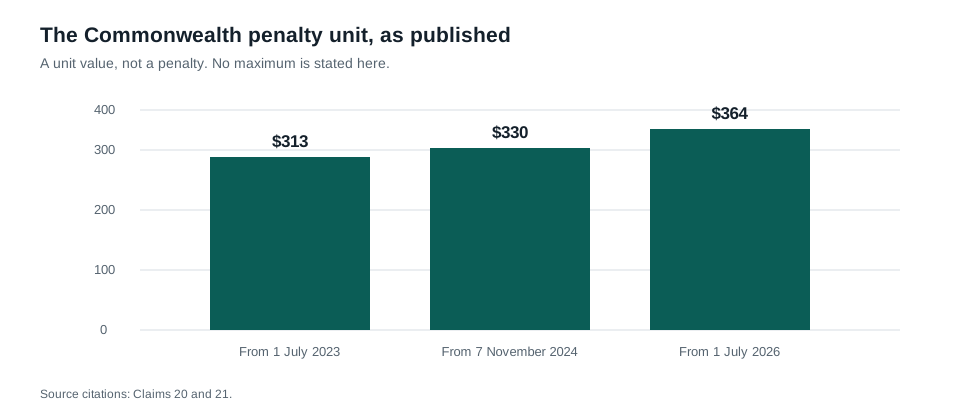
One further statutory note belongs in this section and nowhere else. The Commonwealth penalty unit figure is published, and the figure token below carries its byte-for-byte caption. The unit value is not a maximum penalty and no maximum dollar penalty is stated here. The comparison is included because this is the page's one regulatory section and because the figure store requires one figure token on a costed guide. It sits beside the wagering comparator without turning into a Neosurf fact or a casino offer term. The section's single point remains that licensed Australian wagering is a different product, and the norm does not reach the casino offer.
Protections that are absent, stated as absence
The comparison is best read as a list of things that are not there for the reader who takes a casino offer from outside the Australian system. It is not a list of rules the casino offer is breaking. No Australian online casino licence exists for this product. Claims 5, 14, 15. That means there is no domestic licensee whose obligations an offshore offer can be held against, and there is no "licensed in Australia versus licensed offshore" sentence to write. The absence is structural. It is not a gap in one operator's paperwork. It is the shape of the market as the source sheet records it.
First, the BetStop duty is absent. BetStop's own about page says it "does not apply to online casino games or other gambling services that are illegally provided in Australia". Claim 60. The page may state that BetStop registration does not, by its own terms, reach an offshore casino. Claims 59, 60. It may not say that an offshore casino will accept a registered person, nor that any of them checks, nor that any of them does not. Claim 81. That is the line the page holds. It is a line about the scope of a duty, not a description of behaviour. The absence is a missing protection, and it is left as a missing protection. No workaround, no mirror, no second account, no document advice, no framing of "not on BetStop" as a benefit.
Second, the licensed wagering credit rule is absent from the casino offer because it was never a rule for that product. Section 15C is already about credit card restrictions for licensed wagering, not about Neosurf. Claims 86, 87, 91, 136. No instrument under s 15C(4A)(d) was located. Claim 94. No primary source states that a bank must block a gambling transaction. Claim 95. BetStop's bank sentence is quoted without bank names. Claim 141. The reader should not convert those statements into a claim about what a casino cashier accepts, what a bank will do, or how a card behaves. The sheet does not publish those facts, and this page does not supply them. The absence is the absence of a statutory boundary that applies to a neighbouring product.
Third, the published inducement restrictions are State and Territory rules for licensed operators, and the framework's own stated scope is licensed wagering. Claims 99, 100, 102, 104. The Commonwealth gambling reforms page carries a "Last updated" field with no date in it. Claim 103. The sheet states no provision from any State or Territory inducement statute and no penalty for an inducement breach. Claim 104. For the reader, the consequence is not that a casino offer has broken an inducement section. The consequence is that the licensed-operator framework is not a set of terms the reader can call up against the casino offer. A bonus headline is therefore read on its own terms, including the multiple, the base and the ceiling, rather than against a local licence condition.
Fourth, the Australian verification rule is stated by AUSTRAC as a rule about when an account may be opened, but the sheet does not resolve how far that reaches an offshore operator with no Australian presence. Claim 146. No source states what an offshore casino does or does not verify. Claim 147. The honest line is that a reader taking an offer from outside the Australian system has no Australian body to hold to it. Claim 147. That sentence is not advice on avoiding an identity check. It is a statement about an absent avenue of complaint. No page describes a route around verification, and no page says an operator does or does not run a check. The gap stays a gap.
Fifth, the complaints route that works for licensed wagering providers does not become a route for the casino offer. Queensland's page points to the government agency that issued the provider's licence. Claim 161. The page does not name an Australian alternative dispute resolution scheme, ombudsman or arbitration body covering online gambling, because none was located. Claim 164. A complaint to ACMA is a regulatory complaint, not a claim, and nothing in Part 3 or Part 8 provides for a complainant to recover money. Claim 156. BetStop's own route for an online casino complaint is ACMA and nothing else. Claim 60. ACMA describes the consumer position in plain terms: "Consumers who access these websites have little or no recourse"; "Winnings may not be honoured, and incentives and pressure tactics are used to target gamblers"; these services "do not have the customer protections we expect in Australia." Claim 159. Those are regulator statements, not promises about a particular outcome.
Sixth, no Australian licence condition or technical standard attaches to an online casino offer, because no Australian licence exists for online casino. Claim 174. This is an absence of any Australian rule, not an assertion that an operator's own figures are false or absent. Claim 174. No minimum return to player percentage for Australia is stated here. Claim 171. No minimum game cycle time, spin duration or spin speed figure was found. Claim 172. No maximum bet per game and no loss limit was found. Claim 173. No RTP, hit rate, volatility or maximum win for any named game title or studio is stated. Claim 175. The buyer's conclusion is not that a number is bad. It is that no Australian licence condition supplies the number, so the reader is left with the offer's own terms and the source gaps recorded on this page.
Seventh, no page may say winnings from an offshore casino are tax-free in Australia. Claim 154. No ATO source addresses winnings from a gambling service unlawful to provide in Australia. Claim 154. No ATO source on the deductibility of gambling losses for an individual was located. Claim 155. Those omissions are not invitations to guess. They are further examples of the method: state the gap, attribute it by claim number, and do not turn a gap into a reassuring conclusion. The same applies to agreements and consumer rights. No page may assert that an agreement with an offshore casino is enforceable or unenforceable. Claim 165. No page may say a reader has Australian Consumer Law rights against an offshore casino, or that they have none. Claim 163.
Eighth, the payment-method gaps from the earlier section return here as absent protections rather than as facts about the rail. Nothing authoritative is published about Neosurf as a gambling payment method. Claim 139. Nothing authoritative is published about PayID as a gambling payment method. Claim 138. No scheme rule from Visa, Mastercard, Apple Pay or Google Pay about Australian gambling was located. Claim 140. No published figure for Australian deposits, withdrawal times or payout speeds at offshore casinos exists on this sheet. Claim 142. The 2024-25 report states "significant risks to consumers through the use of high-volume, small-value transactions to illegal services". Claim 133. ACMA contacted "the providers of local payment services used by the targeted casinos" alongside 52 software providers. Claim 134. Those are regulator statements about risk and regulator work. They are not a payment-method permission, refusal, speed, limit or fee.
Taken together, the absent protections change how a buyer should read the $1,000 to $40,000 model. The turnover figure is a term the reader can calculate. The absent protections are not terms at all. They are the missing background that a licensed product would supply in this market. A reader cannot add them to the offer as a bonus, and a page cannot subtract them as a rule the offer has failed. They sit outside the arithmetic, which is why the arithmetic must be strong enough to stand on its own. If the terms are unclear, the reader has no local licence condition to fall back on. If a figure is unpublished, the reader has no local standard that fills it. If a complaint arises, the regulator route is enforcement rather than recovery. That is the cost of stepping outside the system, stated item by item.
The citation method is part of the protection against overstatement. Each published sentence is attributed to the provision or publisher named in the claim. Each NOT PUBLISHED sentence says only that nothing is published. Each SOURCES DIFFER sentence keeps the date and the label. Claim 137 stays a news report dated 13 July 2023. Claims 59 and 60 stay scope statements about BetStop. Claims 94, 95, 103, 104, 138, 139, 140, 142, 146 and 147 stay gaps. Claims 161 and 162 stay statements about licensed providers. Claims 5, 14 and 15 stay the structural reason no Australian licence exists for this product. The reader is not asked to trust a tone. The reader is shown the boundary of each sentence.
The commercial effect is not anti-offer. It is anti-confusion. A reader can still choose a promotion, but the choice is made with the absent protections priced in. That means reading the bonus terms before the payment label, treating an unpublished ceiling as unpriced, treating a missing weighting table as a question, and treating a familiar cashier word as a search phrase rather than as a sourced institutional fact. It also means noticing when a page tries to turn an absence into a selling point. This page does not. It says what is absent, says what is not published, and leaves the reader with the numbers that can be calculated under a stated assumption.
There is no second regulatory section on this page and no second comparator hiding in the language. The neighbouring wagering rules appear once, with the explicit qualification that licensed Australian wagering is a different product and the norm does not reach the casino offer. Every later reference to those rules is a statement of absence, framed by that boundary. No claim outside the permitted comparator slice is used as a regulatory fact. The aside below states the licence position once. The FAQ answers repeat it only where a reader asks directly, and they do not add a new rule, a new figure, or a new institution.
Knowing when to stop
Knowing when to stop begins before the first deposit. A reader who has written down the multiple, the base, the ceiling, the weighting, the time limit and the maximum bet can set a stopping point in the same note. It might be a turnover figure that feels too high. It might be a blank line that cannot be filled from the offer copy. It might be a clause that removes the bonus at withdrawal. It might be the moment a $1,000 headline becomes $40,000 of stated turnover under the page's assumption. Any of those is enough to pause. A pause is not a failure to finish a promotion. It is the point of reading the terms first.
The page does not publish a statutory warning, because none exists in this market. It does not use an exclamation mark to manufacture urgency. It does not offer a procedure for getting past a self-exclusion register, an identity check or a bank block. It states consequences and leaves procedures out. BetStop's own support page says "Many major banks let you block gambling transactions on your bank accounts. Contact your bank and ask them how they can help you." Claim 141. That sentence is quoted as published and does not name a bank. It is not expanded into advice about how a block behaves. The safety test is whether a reader could follow a sentence as an instruction around a control. The answer here is no.
Support numbers and support wording are reproduced as their publishers state them. The National Gambling Helpline is 1800 858 858, and the Commonwealth says "This is a free and confidential helpline open 24 hours a day, 7 days a week." Claim 176. Gambling Help Online publishes the same number under the name "Gambling Helpline" and says "This service is available 24 hours a day, 7 days a week." Claim 177. BetStop says "If you would prefer to speak to someone, free and confidential support is available 24 hours a day, every day of the year. You can contact the National Gambling Helpline on 1800 858 858." Claim 178. BetStop also says "These services are available for anyone affected by a gambling issue, not just the person who is gambling." Claim 178. The names differ across sources, and the sheet does not pick one; a page quotes the name used by the source it cites. Claim 186. No source states who operates the National Gambling Helpline, so this page attributes it to no organisation. Claim 187.
Gambling Help Online says its website "contains self-help material that you can access for free" and "also provides free 24/7 chat and email counselling and support". Claim 179. The Commonwealth says "For free and confidential support visit the Gambling Help Online website." Claim 179. BetStop's own number for registration help and for identity documents other than the three it lists is 1800 238 786. Claim 180. Lifeline is published by BetStop as "a national service providing free 24/7 help and crisis support. You can talk to someone on 13 11 14, text 0477 131 114, or chat online". Claim 181. National Debt Helpline is published as "Call the National Debt Helpline on 1800 007 007 for free and confidential advice from professional financial counsellors. The helpline is open from 9:30 am to 4:30 pm, Monday to Friday." Claim 182. These are quoted support statements, not instructions about gambling while registered.
BetStop publishes that "Gamblers Anonymous hosts local meetings across Australia." Claim 183. It publishes that "Reset is a confidential and free app that helps if you want to quit or cut back on gambling." Claim 183. It publishes that the Australian Government's Moneysmart website "can help you take control of your money with free tools, tips and guidance", including guidance on where to obtain free legal advice. Claim 183. Gambling Help Online's telephone page says the Gambling Helpline can arrange an interpreter, or a caller can contact the "Translating and Interpreting Service on 131 450"; for hearing or speech impairment the page directs contact through the National Relay Service and gives no number. Claim 184. State and territory services differ, and BetStop says "There are different services available in different states and territories. You can find out more about the services available in your area at Gambling Help Online". Claim 185. No State or Territory gambling helpline number is on the sheet, so none is stated here. Claim 188.
Early cancellation from BetStop is quoted in the source sheet so a reader can see what the commitment costs to unwind, but it is not framed as a way out. Claim 73. The sheet says no page may present it as a loophole, describe it as a route to gambling while registered, or turn it into a procedure. Claim 73. This page therefore does not reproduce a step-by-step route. It says only that the source records a minimum period, a statutory declaration, a counselling or general practitioner discussion, a seven day removal period, and a right to withdraw the application during that period. Claim 73. The point is that self-exclusion is a serious commitment, not a control to be worked around. That framing is part of the safety rule, not an afterthought.
Stopping also belongs beside the money model. If a reader begins with $12.50 and the terms ask forty times the bonus alone, the turnover under the model is $500. If the reader begins with a $1,000 bonus, the turnover under the model is $40,000. Neither figure should be allowed to create a feeling that the reader "has to" continue. A wagering requirement is a condition of a promotion, not an obligation to keep playing. A time limit is a condition, not a command. A bonus balance is not a debt. The reader can leave the offer, leave the page, or use a support service. The buying guide's commercial purpose does not override that. Choosing well includes stopping when the terms stop making sense.
There is also a stopping point for research. If an authoritative source cannot be reached, record that and stop. Claim 139 is the result of that discipline for Neosurf as a gambling payment method. Claim 137 keeps its date and news label because no primary closure page was located. Claims 94, 95, 103, 104, 138, 140, 142, 146 and 147 stop at the edge of what is published. A writer who keeps going past that edge produces a fluent sentence with no source behind it. A reader who keeps going past a personal stopping point does so without a protection the Australian licensed wagering system would have supplied. Both are reasons to pause.
The section's last boundary is the same as the page's first. No sentence says it is legal or illegal for an Australian player to use an offshore casino. No sentence says an agreement is enforceable or unenforceable. No sentence says the reader has or has not got Australian Consumer Law rights against an offshore casino. No sentence says winnings from an offshore casino are tax-free. No sentence names an Australian body that will hear a dispute against an offshore casino. No sentence says a bank must block a gambling transaction. Each of those would be a confident answer to a question the source sheet leaves open or bars. The page leaves them open or barred, and keeps the reader's decision where it belongs: on the published terms, the stated assumption, and the cost of what is absent.
Questions readers ask before they click
- How is the $40,000 figure calculated?
- It is $1,000 multiplied by forty under this page's assumption of forty times the bonus alone, with AUD throughout. It is a model figure, not an operator term and not a promise about a cashier.
- What does the $12.50 figure represent?
- It is a small illustrative cash balance in AUD used to show the same method at a smaller scale. With forty times the bonus alone under the model, the stated turnover would be $500.
- What is published about Neosurf as a gambling payment method?
- Nothing is published. Claim 139. No authoritative source about Neosurf as a gambling payment method is available here, so availability, limits, fees and treatment by any Australian institution are not stated.
- Does BetStop reach a casino offer?
- BetStop registration does not, by its own terms, reach an offshore casino. Claims 59 and 60. The page does not say an offshore casino will accept a registered person, checks, or does not check. Claim 81.
- Is section 15C a Neosurf rule?
- No. Section 15C is already about credit card restrictions for licensed wagering, not about Neosurf. Claims 86, 87, 91 and 136. Licensed Australian wagering is a different product and the norm does not reach the casino offer.
- Is there an Australian licence for this product?
- No Australian licence exists for this product. Claims 5, 14 and 15. That is an absence of any Australian licence for an online casino served to a person at home, not a statement about one operator's paperwork.