In this model, cashback is a separate conditional balance, not a bonus: a $1,000 net loss position is modelled against a $40,000 play requirement at forty times the bonus alone, leaving $12.50 of cashback value per $1,000 of modelled turnover once the condition is met, with the assumption that the qualifying figure is $1,000, the credited conditional balance is $25, the multiple attaches to that balance alone, and AUD throughout.
What sits under this paragraph is advertising. Its order was bought, none of its wording was composed here, and no figure in it has been held against a source cited anywhere on this site. The arrangement behind it is set out at How this site is paid.
The offers in this block are advertising. Placement is paid. Copy is supplied by the operator and is printed unaltered. More at How this site is paid. The arrangement is itemised at How this site is paid.
Cashback as a conditional balance
Lucky Aussie Reels treats cashback on this page as an arithmetic model for a class H casino offer. The word "cashback" can appear in marketing copy as though it were money already held by the reader. In this model it is not money already held. It is a conditional balance that may be created after a settlement event, then held inside a separate condition. That distinction decides the price of the offer. A bonus is usually described as an amount added to play with. Cashback, in this model, is a balance that arises after a measured loss and remains subject to a play requirement of its own. It is not a rebate sitting in a wallet, not a refund, not a correction of the loss, and not a smaller version of a welcome bonus.
The opening figure is deliberately narrow. A $1,000 qualifying position produces a $25 conditional balance in this model. Forty times the bonus alone means $25 multiplied by forty, or $1,000 of further play. The larger $40,000 figure comes from scaling that same relationship to a $1,000 conditional balance, where forty times the bonus alone becomes $40,000. The $12.50 figure is the model's per unit expression of the smaller balance: $25 divided by two, or $12.50 for each $500 of the qualifying position used in the illustration. These are model numbers, not operator terms from a cashier, not a published ceiling, and not a statement of what any particular site will do. In this model, AUD throughout.
Readers often search for cashback because the word sounds retrospective. A purchase cashback offer in another setting can mean that a proportion of spend returns after the spend is complete. A casino cashback offer of the kind costed here does not behave like that. The reader first has a settlement position. The operator's terms then decide whether a conditional balance is created, what amount is created, when it is created, which games count toward any further condition, and whether the balance can be withdrawn after the condition is met. The arithmetic on this page holds those decisions inside one small model so that the sequence does not collapse into a single friendly word.
In this model, the qualifying position is $1,000. The cashback rate is 2.5 per cent. The conditional balance is $25. The wagering condition is forty times the bonus alone. The resulting play requirement is $1,000. If the conditional balance were $1,000, the same forty times condition would be $40,000. The model does not assume that a $1,000 cashback balance is common, nor that $1,000 of net loss is common, nor that a cashier will publish any ceiling. It uses the two figures supplied for this page so that the reader can see how a rate, a balance and a multiple interact. AUD throughout.
The phrase "conditional balance" is doing more work than a label. A balance in an account can usually be described by three questions: who holds it, whether it can be withdrawn, and what must happen before withdrawal. Cashback in this model fails the ordinary meaning of "cash" at the third question. It is held inside a condition. The condition is not a fee, not a tax, not a delay in banking, and not a processing window. It is a play requirement. That is why the page keeps the cashback balance separate from the deposit, separate from the bonus, and separate from any winnings that might arise while the condition is being worked through.
Class H prose is written for a reader comparing casino offers, not for a reader comparing regulated product categories. The commercial question is whether cashback changes the effective cost of taking the offer. The honest answer from the model is that it changes the shape of the cost rather than removing it. The reader gives up $1,000 in the qualifying position, receives a $25 conditional balance in the model, and then faces $1,000 of further play before that balance is treated as withdrawable. If the model is scaled to a $1,000 conditional balance, the further play is $40,000. The scale is linear, and that linearity is the useful part. It lets a reader substitute a different qualifying figure without needing a new story.
Because cashback is being modelled as a separate balance, the page does not treat it as a bonus. A bonus can be quoted as a headline amount and compared with a deposit. A cashback balance cannot be read that way, because its size depends on a prior settlement event. If the event is a net loss, a higher cashback percentage applies to a worse outcome for the reader. If the event is turnover, the percentage applies to volume rather than loss. If the event is a weekly statement, the timing of the statement matters. In this model, the event is a $1,000 qualifying position, and the percentage is 2.5 per cent. That is all the model needs. It does not need an operator name, a cashier screenshot, a game list, or a promise about payment speed.
The model also separates "credited" from "available". A conditional balance can be credited to a bonus ledger and still not be available as cash. That distinction explains why the same phrase can produce two very different numbers in a search result. One page may print the cashback rate. Another may print a headline amount. Another may print a withdrawal figure. Another may print a maximum cashback amount that a cashier does not publish in the terms the reader can read before taking the offer. In this model, the credited amount is $25 after a $1,000 qualifying position, and the available amount is left unresolved until the forty times condition is met. The unresolved part is not a missing fact. It is the condition being modelled.
There is a second reason to keep the balance separate. If cashback were folded into the definition of bonus, the forty times phrase would become ambiguous. Forty times the bonus alone could then be read as forty times the original welcome package, forty times the deposit plus bonus, or forty times the cashback credit. The standfirst fixes the phrase to the cashback balance alone in this model. A $25 balance carries a $1,000 requirement. A $1,000 balance carries a $40,000 requirement. Any other basis would need to be stated as a different assumption. The model does not drift between bases.
The first commercial consequence is that a small cashback percentage can look harmless while still creating a meaningful play requirement. The second is that a large cashback headline can be less informative than the rate and the base. The third is that the moment of settlement matters. If a cashback balance is calculated after losses but before the reader has stopped, the balance can function as an instruction to continue. The page does not advise a reader to continue or stop. It prices the condition. A reader who wants the conditional balance treated as withdrawable has to account for the further play attached to it in this model.
Readers who arrive from a search phrase often want a quick yes or no. The model refuses that shape. A cashback offer of this kind is neither a simple discount nor a simple bonus. It is a sequence: qualifying position, calculated balance, credit to a conditional ledger, play requirement, and then a withdrawal question. Each step can change the effective price. The arithmetic here holds the steps in order. It does not assume a game weighting, because no such figure is being sourced. It does not assume a win rate, a hit rate, a volatility measure or a maximum win, because those are not part of this model. It does not assume a withdrawal time, because the model is about a condition attached to a balance, not about a payment rail.
The word "separate" also keeps the licence aside honest later on this page. The regulatory discussion is about licensed Australian wagering, a neighbouring product. The offer being costed is a casino offer. If the two were blended, the reader could be told that a wagering rule polices a casino cashback balance. That would be wrong. The model is kept in editorial money terms, the regulatory section is kept in its own section, and the aside states the licence position for this product. No operator's own term is being quoted as cashback, and no regulator's rule is being used as a price.
Finally, the standfirst says "in this model" because the site models, calculates and cites. It does not play, test or verify a cashier first hand. The figure the reader acts on is the effective cost of the condition, not the friendly label. On that basis, $1,000, $40,000, forty times the bonus alone, $12.50 and AUD throughout are the anchors for every later section. When a later paragraph uses a smaller or larger number, it is derived from those anchors rather than introduced as a new market fact.
The arithmetic behind the figure
The cleanest way to price cashback as a conditional balance is to write the sequence as four lines. Line one: qualifying position. Line two: cashback rate. Line three: conditional balance. Line four: play requirement. In this model, line one is $1,000, line two is 2.5 per cent, line three is $25, and line four is $1,000 because forty times the bonus alone means forty times $25. The same four lines scaled to a $1,000 conditional balance give $40,000 on line four. AUD throughout.
The $12.50 figure is a way of expressing the smaller balance against half of the qualifying position. If $1,000 produces $25 in this model, $500 produces $12.50 at the same rate. That does not mean a $500 qualifying position is an operator term. It means the model is linear. Readers can use the line to see that a cashback rate does not become more generous merely because it is printed beside a larger headline. The rate, the base and the condition have to be read together.
Consider the alternative basis that the standfirst excludes. If the multiple attached to deposit plus bonus, the play requirement would be calculated from two amounts rather than from the conditional balance alone. If it attached to the qualifying loss rather than the cashback credit, the requirement would be larger even before the rate is applied. If it attached to a headline maximum rather than a credited amount, the requirement could be larger again. The model does not price those bases. It states one basis, forty times the bonus alone, and keeps it fixed. That is why the $40,000 figure is not a market average. It is forty multiplied by $1,000.
A reader can test the model with a substitution. Replace the $25 conditional balance with $50 and the requirement becomes $2,000. Replace it with $100 and the requirement becomes $4,000. Replace it with $1,000 and the requirement becomes $40,000. The relationship does not depend on a game, a brand, a licence label or a payment method. It depends only on the base to which the multiple attaches. The commercial lesson is that a cashback percentage and a wagering multiple are not two independent perks. They are linked by the credited balance.
Use the model inputs below. The result is arithmetic for this page, AUD throughout, and not an operator's own stated term.
Conditional balance:
Play requirement:
Half position value at the same rate:
In this model, the conditional balance equals the qualifying position multiplied by the cashback rate. The play requirement equals that balance multiplied by the multiple. Forty times the bonus alone is the assumption, not a term copied from a cashier.
The calculator is deliberately small. It does not ask for a deposit, because a deposit plus bonus basis is excluded. It does not ask for a game weighting, because no weighting is sourced. It does not ask for a win target, because the page is not predicting a result. It does not ask for a payout window, because no published figure for Australian deposits, withdrawal times or payout speeds at offshore casinos exists on this sheet, claim 142. It asks only for the three inputs that produce the standfirst figures: position, rate and multiple.
Claim 142 is a useful boundary here. A costed guide can model a condition without pretending to know a cashier's speed. A reader may care about when funds arrive, but a speed figure would need an operator's own stated term, read from that operator's own site with its date and address. This build does not print such a figure. The calculator's output is therefore labelled as arithmetic, not as a withdrawal time. That distinction protects the page from turning a model into a promise.
The $40,000 figure can be misread as a ceiling. It is not. It is the scaled play requirement when the conditional balance is $1,000 and the multiple is forty. A ceiling in a cashier would be a term about the maximum cashback or maximum convertible balance. No such ceiling is assumed here. The model leaves the ceiling aside because the reader's first decision is usually about the rate and the base. If a ceiling is published in an offer's own terms, it would sit beside line three and would need to be read as that offer's stated term. It would not change the arithmetic of line four unless the credited balance itself changed.
The same care applies to the word "loss". The qualifying position in this model is a $1,000 net loss position. It is not a statement about what any reader will lose, and it is not advice to reach a figure. It is the input that makes the rate meaningful. A cashback offer that uses turnover rather than loss would need a different first line. A cashback offer that uses a weekly statement would need a timing line. A cashback offer that credits in instalments would need a schedule. The model has none of those because it is not reconstructing an operator's terms. It is showing what the supplied phrase does to money.
Readers sometimes divide a headline cashback amount by a wagering number and call the result a value. That shortcut fails because the base is missing. Divide $40,000 by forty and the result is $1,000, but that is a conditional balance, not a withdrawal. Divide $1,000 by forty and the result is $25, but that is the small balance in this model, not the qualifying position. Divide $12.50 by 2.5 per cent and the result is $500, but that is half of the qualifying position at the same rate. Each division is valid inside its own line and misleading across lines. The four line structure prevents that.
The price of the offer, within the model, is the further play attached to the conditional balance. It is not the cashback rate alone. A 2.5 per cent rate attached to forty times the balance alone produces a requirement equal to the qualifying position in the opening example. If the rate rises, the credited balance rises and the requirement rises with it, even though the percentage looks more generous. If the multiple rises, the requirement rises without the credited balance rising. A reader comparing two cashback offers should therefore compare line three and line four, not just line two.
That comparison is why the phrase "forty times the bonus alone" remains in the standfirst. It is the hinge. If a reader changes it, every later number changes. The page does not hide that dependency behind a general statement about offers of this kind. It prints the assumption in the same paragraph as the money, then repeats it in the calculator note. The repetition is not a disclaimer. It is the cost model.
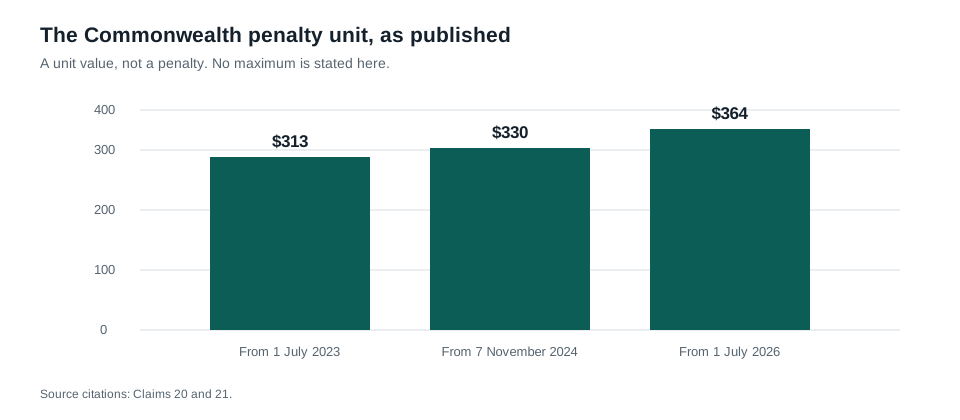
The figure sits beside the arithmetic section because its caption makes the same distinction the calculator makes. A unit value is not a maximum penalty, and a model output is not an operator's stated term. Both are arithmetic boundaries. The caption is reproduced from the figure store and is not used to price the cashback offer. Claims 20 and 21 are cited in the caption itself, and no dollar figure from the caption is carried into the cashback calculation.
What cashback is not
Cashback is not a bonus in this model. A bonus is an amount presented at the front of an offer, often against a deposit, and often with a headline maximum. Cashback is calculated after an event. That event can be a loss, a turnover measure, a statement period or another condition set in the terms. Once calculated, the credit can still be held as a conditional balance. Calling it a bonus would invite the reader to compare it with a deposit match, which would be the wrong comparison. The right comparison is between the credited conditional balance and the play requirement attached to it.
Cashback is not a refund. A refund reverses a payment. Cashback in this model does not reverse the qualifying position. The $1,000 remains the opening position. The $25 conditional balance is a new credit inside the model, with a condition attached. If the reader meets the condition, the model then reaches a withdrawal question. It does not go back and rewrite the first line. That is why the page says "conditional balance" rather than "returned money".
Cashback is not a guaranteed outcome. A guarantee would require a present promise about payment, crediting, conversion or withdrawal. The model makes no such promise. It states a rate, a balance and a multiple. The word "conditional" carries the uncertainty that a guarantee would remove. The page also does not say that an operator will honour a balance, because that would be a claim about behaviour rather than arithmetic. No invented testing appears here, and no first hand play is described.
Cashback is not the same as rakeback, reload credit, free spins, a chip, a matched deposit or a loyalty point, even where marketing copy groups those phrases together. Those labels describe different credits and different conditions. In this model, none of them is used as an input. The calculator asks for a qualifying position, a rate and a multiple because those are enough to produce the page's figures. Adding another label would blur the base of the forty times condition.
Cashback is not a consumer protection. The word can sound protective because it appears after a loss. A conditional balance can still require further play. A reader who treats the credit as harm minimisation has confused a commercial term with a safeguard. The page's later aside states that no Australian licence exists for this product, and the regulatory section explains that licensed Australian wagering is a different product. Neither turns cashback into a protection.
Cashback is not a dispute outcome. If a reader complains about an offer, a regulator's complaint process is not a money claim. On this comparator slice, claim 161 records that Queensland's consumer page tells a consumer to talk to the business first and then, if unsatisfactory, lodge a complaint with the government agency that issued the provider's licence, which should be displayed on the provider's website. Claim 162 records that Australian Consumer Law is stated to apply to gambling businesses on that Queensland page, with Australian online wagering providers named. Those claims are about licensed operators and a State consumer page. They are not a statement that a cashback credit will be paid, and they are not a statement about Australian Consumer Law rights against an offshore casino. Claim 163 is a NOT PUBLISHED claim and permits neither side of that assertion.
Cashback is not an identity check, and this page gives no advice about identity checks. Claim 143 states AUSTRAC's rule as published: from 29 September 2024, all online gambling service providers must complete the applicable customer identification procedure before creating an online gambling account or commencing to provide any designated service, and the special circumstances formerly allowing delayed verification under s 10.4 have been repealed. Claim 144 records the interim period from 29 September 2023 to 28 September 2024. Claim 145 records the Commonwealth's NCPF measure 3 entry, implemented 26 February 2019 and updated 2 May 2022 and 29 September 2023. Claim 146 says AUSTRAC's page uses "all online gambling service providers" without qualifying the phrase, and this sheet does not resolve how far that reaches an offshore operator with no Australian presence. Claim 147 says no source states what an offshore casino does or does not verify. Those claims are stated only as published limits. No method for avoiding a check is described, and the reader is not invited to treat an absence of Australian oversight as a feature.
Cashback is not a bank block, a card rule or a payment speed. Claim 95 is a NOT PUBLISHED claim: no primary source states that a bank must block a gambling transaction. Claim 141, also NOT PUBLISHED in the wider sheet, is not used here to name a bank or describe how a block behaves. Claim 142 says no published figure for Australian deposits, withdrawal times or payout speeds at offshore casinos exists on this sheet. The model therefore says nothing about rails, processing windows or deposit minimums. It stays with AUD figures and a play requirement.
Cashback is not a wagering operator's inducement rule. The National Consumer Protection Framework material cited later in this page is about licensed online wagering service providers, a neighbouring product. The cashback balance in this model is a casino offer construct. The regulatory section will say so in the same section where the comparison is made. That is the single comparator section on the page, and no licensed wagering rule is applied to the casino offer as though it governed it.
Cashback is not a current law from the 2026 Act. Claims 116 and 117 describe new Part 7D, new s 62ZL and new s 62ZM, but this page cites them only with the commencement statement from claim 106: the relevant Schedules commence 1 January 2027. Claim 122 is a SOURCES DIFFER claim about the compilation and the amending Act, and it bars treating a Schedule as current law before that date. Those provisions concern licensed interactive wagering, not this casino cashback balance. They do not set a present rule for the offer.
Cashback is not a claim that a reader has or has not got Australian Consumer Law rights against an offshore casino. Claim 163 bars both assertions. It is not a claim that an agreement is enforceable or unenforceable; claim 165, in the wider sheet, leaves that open. It is not a claim about tax treatment of winnings; claims 148 to 155 are not used to make a tax statement. It is not a claim about return to player, spin speed, stake caps or loss limits; claims 166 to 175 are not used to invent a technical figure for an online game.
Cashback is not a licence label. The aside will cite claims 5, 14 and 15 for the proposition printed on it. Those claims explain why no Australian licence exists for this product. A cashback balance does not create a licence, does not borrow one from a sports bookmaker, and does not turn a casino offer into a wagering service. Keeping the money model separate from the licence position is the simplest way to avoid that error.
The wagering comparison
This is the page's one regulatory section, and the comparator is wagering. Licensed Australian wagering is a different product from the casino offer costed here, and the licensed wagering norm discussed in this section does not reach the casino offer. The comparison is therefore about what sits outside the system, not about a rule the cashback balance is breaking. The reader gets a model price in AUD; the Australian framework cited here governs licensed operators in a neighbouring market. It is not a price list for offshore casino cashback, and it is not a present tenancy rule for the offer.
The National Consumer Protection Framework material is the centre of the comparison. Claim 99 states, at source on the Commonwealth gambling reforms page, that inducements are restricted by State and Territory law, not the Commonwealth, as at the sheet's date. It records NCPF measure 4 as "Regulated by states and territories", implemented 26 May 2019 in all jurisdictions except NSW and 26 November 2019 in NSW, with the line "Online gambling providers cannot offer any incentives to open an account." Those are implementation dates and a Commonwealth summary, not a description of the page as current on a particular day. Claim 103 is a NOT PUBLISHED claim: the Commonwealth gambling reforms page carries a "Last updated" field with no date in it, so this page quotes the implementation dates and does not call the page current as at a particular day.
Claim 100 records a Queensland consumer page: online providers and on-course bookmakers "can't offer credit or a voucher, reward or benefit to try to get someone to open a betting account", nor incentives to refer someone else, and direct marketing is limited to customers who expressly opt in, with easy unsubscribe. Claim 101 records the rest of the NCPF as the Commonwealth lists it, including customer verification, account closure, voluntary opt out deposit limits, monthly activity statements, consistent gambling messaging, staff training and BetStop. Claim 102 states the framework's own scope: "The National Framework applies to all licensed online wagering service providers." It does not mention online casinos. That scope sentence is the reason the norm does not reach a casino cashback offer.
Claim 104 is a NOT PUBLISHED claim and sets the boundary for any legal detail. This sheet did not research the State and Territory inducement statutes and states no provision from any of them. Claims 99 and 100 are a Commonwealth summary and one State consumer page. No section of a State Act on inducements is cited here, and no penalty for an inducement breach is named. What may be said is narrower: the rules are State/Territory rules binding licensed operators, and therefore not rules an offshore casino is within. In this section, that sentence is doing the comparator's required work. Licensed Australian wagering is the regulated neighbouring product; the casino offer is outside that product and outside those rules.
The BetStop material belongs to the same neighbouring product. Claim 54 states that ACMA must arrange for a body corporate to keep the National Self-exclusion Register. Claim 55 records BetStop's own statement that Dataworks Group Limited operates the register on behalf of ACMA, with the statutory restrictions in s 61HA. Claim 56 records the start date 21 August 2023. Claim 57 states that s 61KA(1) creates an offence for a licensed interactive wagering service provider providing a licensed interactive wagering service to a registered individual, with 500 units and a civil penalty of 750 units under s 61KA(3). Claim 58 gives the definition: a licensed interactive wagering service is a regulated interactive gambling service that is a wagering service, has an Australian customer link, and is not provided in contravention of s 15AA(3).
Claim 59 states the consequence: BetStop's obligations reach only Australian licensed online and phone betting operators, do not reach a casino game because it is not a wagering service under the relevant paragraphs, and do not reach an offshore operator. Claim 60 gives BetStop's own wording: "BetStop - the National Self-Exclusion Register does not apply to online casino games or other gambling services that are illegally provided in Australia. You can make a complaint about these services to the ACMA". Claims 59 and 60 are used here only as a scope statement about a duty. Claim 81 is NOT PUBLISHED and is not used to say that an offshore casino will accept a registered person, that any of them checks, or that any of them does not. Nothing on this page describes how a registered individual could gamble. Section 5's safety line is left intact: the page states a consequence and describes no procedure.
Claims 61 to 78 describe what BetStop does cover for licensed wagering: all online and phone wagering providers licensed in Australia in one process, no partial exclusion, a minimum of three months up to a lifetime, registration details, provider duties while registered, marketing prohibitions, account closure after self exclusion, pending bets, checking requests, due diligence, promotion of the register, early cancellation formalities, separate State and Territory schemes, support people and published statistics. Those claims are not applied to the casino offer. They are listed here as the content of the neighbouring system so that the reader can see what is absent when the product is outside it. No number of licensed wagering operators is stated, because claim 53 is NOT PUBLISHED on that point, and claim 80 says no source states how many operators are connected to BetStop.
Claim 79 is a SOURCES DIFFER claim and is not resolved here. The Department of Social Services page describes the tenth NCPF measure as allowing consumers to exclude themselves from all interactive gambling services in Australia; BetStop's own about page says it does not apply to online casino games or other gambling services illegally provided in Australia, and describes coverage as all online and phone wagering providers licensed in Australia; s 61GB is a third reading. This page quotes BetStop's wording at claim 60 and cites the statutory definition at claim 58. It does not rest on the department's phrasing alone and does not present the readings as saying the same thing.
The credit and digital currency provisions are another licensed wagering comparison. Claim 83 identifies Part 2B, ss 15B to 15F. Claim 84 records the 2023 amending Act and its commencement dates. Claim 85 quotes the simplified outline: credit must not be provided to customers of certain interactive wagering services, and such services must also not accept or offer to accept payment using specified methods, including credit cards and digital currency. Claim 86 states the offence where a person intentionally provides a regulated interactive gambling service that is a wagering service and accepts or offers to accept a listed payment method from a customer physically present in Australia. Claim 87 gives the exhaustive list in s 15C(4A): a credit card, an account or facility in which payment is made from a credit card linked to it, digital currency, and a method determined by the Minister by legislative instrument. Claim 88 explains the e wallet limb. Claim 89 says digital currency has the same meaning as in the GST Act. Claim 90 states the separate credit prohibition. Claim 91 is the point that matters most: every limb of s 15C is addressed to a person providing a regulated interactive gambling service that is a wagering service, read with s 8E that means a licensed Australian betting operator, and s 15C does not bind an offshore online casino.
Claim 92 records two narrow exceptions for certain telephone betting and for a customer that is itself a provider of a gambling service. Claim 93 records the older credit lines ban, NCPF measure 1, implemented 17 February 2018. Claim 94 is NOT PUBLISHED: no instrument made under s 15C(4A)(d) was located, so this page does not say any method beyond the listed paragraphs is covered. Claim 95 is NOT PUBLISHED: no primary source states that a bank must block a gambling transaction, so this page does not state that a card block is a legal requirement and does not name a bank's block. None of those provisions is used to price the cashback model. They show a licensed operator's obligations that a casino offer does not sit within.
Advertising needs the same care. Claim 96 states that advertising a prohibited or unlicensed service is prohibited and that Part 7A reaches offshore casinos through the definition of designated interactive gambling service. Claims 19 and 96 already reach the advertising of this product. Claim 97 lists Part 7A exceptions a writer should know exist. Claim 98 records ACMA action on the advertising limb against affiliate sites. Those claims are not a new s 62C rule. Claim 114 says Schedule 1's new s 62C(1) defines wagering advertising content by reference to a licensed interactive wagering service, and the new advertising restrictions do not reach an offshore casino. Part 7A at claims 19 and 96 is what reaches it, and already does. Claim 114 is cited here only as a 2026 Act provision, with the commencement discipline below.
Claims 116 and 117 concern new Part 7D, new s 62ZK, new ss 62ZL and 62ZM. New s 62ZM(1) defines an inducement as any payment or other benefit that could reasonably be expected to induce a person to wager or gamble, and s 62ZM(2) deems credit, a gift, a rebate, a reward, a token and a voucher each to be a payment or other benefit. New s 62ZL defines commission to include commission, incentive, bonus, referral fee, revenue share, profit share, performance payment, variable remuneration or other benefit, and customer activity to include creating or reactivating an account, depositing, placing a bet, and removing gambling minimisation measures applied to a licensed interactive wagering service account. The Part 7D outline is about licensed interactive wagering service providers. These provisions are cited only with claim 106: the commencement table says all Schedules except Schedule 5 commence 1 January 2027. They are not current law before that date, and they are not applied to this casino cashback balance. Claim 122 bars blending the 14 October 2024 compilation with the amending Act or describing any Schedule as current law before 1 January 2027.
Claims 161 and 162 complete the contrast. The Queensland consumer page tells a consumer to talk to the business first and then, if unsatisfactory, lodge a complaint with the government agency that issued the provider's licence, which should be displayed on the provider's website. It also states that consumers have protections when using online gambling services and that Australian online wagering providers must honour consumer rights and meet gaming licence requirements. Those are State consumer page statements about Australian providers. Claim 163 is NOT PUBLISHED: no source reached says whether or how Australian Consumer Law is enforced against an offshore gambling operator with no Australian presence, and this page does not say a reader has such rights against an offshore casino or that they have none. Claim 164 is not used to name a dispute body. The comparison is therefore kept as a comparison of systems, not a transfer of remedies.
Claims 143 to 147 are stated above as published identity verification limits and omissions. Claims 143, 144 and 145 are AUSTRAC and Commonwealth entries; claims 146 and 147 are NOT PUBLISHED limits. This section does not state that an offshore casino is or is not bound by AUSTRAC's rule, and it does not state what an offshore casino verifies. Claim 147 is also a safety boundary: nothing here is written as advice on avoiding an identity check. The commercial point is only that a reader taking an offer from outside the Australian system has no Australian body to hold to that timing rule for the casino offer as such. That is an absence, not a licence to bypass a check.
Claims 95, 103, 104, 142, 146 and 147 are used here only as statements of fact of what is not published, what cannot be dated beyond an implementation date, what was not researched, what no figure exists for, and what no source resolves. They are not expanded into a hidden rule. Claim 103 means quote the implementation date, 26 May 2019 and 26 November 2019 where relevant, rather than calling the Commonwealth page current on a particular day. Claim 104 means no State Act section and no penalty. Claim 142 means no withdrawal time. Claim 146 means do not resolve AUSTRAC's unqualified phrase. Claim 147 means no advice about identity checks. Claim 95 means no bank duty and no named bank block.
The single conclusion of this section is the one required by the comparator: licensed Australian wagering is a different product, its rules bind licensed operators in that system, and the norm does not reach the cashback casino offer costed on this page. The page does not invent a present tense rule for the offer to be absent from. It says what is absent: no licensed wagering inducement rule for this casino balance, no BetStop duty reaching the casino product by its own terms, no s 15C payment rule binding an offshore casino, no new s 62C or Part 7D rule for the casino offer, and no State/Territory inducement provision or penalty from this sheet. The cost remains the model's $1,000, $40,000, $12.50, forty times the bonus alone and AUD throughout.
What is absent for the reader
A reader choosing this kind of cashback casino offer is not choosing between two Australian licences. The aside on this page states the licence position for the product. The absence is more practical: the consumer protections that attach to a licensed wagering operator, as described in the comparator section, are protections of a different product. They do not travel with a cashback label. The reader therefore has to price the offer from its own arithmetic and from the terms the offer itself states.
What is absent first is a licensed operator complaint path of the kind described at claim 161. Queensland's consumer page tells a consumer to talk to the business first, then to lodge a complaint with the government agency that issued the provider's licence, which should be displayed on the provider's website. That path depends on a licence issuer and a displayed licence. For this product, the aside cites claims 5, 14 and 15: no Australian licence exists. The page does not turn that into a claim about enforceability, Australian Consumer Law rights or a named dispute body. It says the licensed operator path is not the reader's path for this product.
What is absent second is a BetStop duty reaching the casino product by its own terms. Claims 59 and 60 state the scope rule. Claim 81 is NOT PUBLISHED and bars any statement about offshore behaviour. The reader is not told that a registered person will be accepted, checked or not checked. The only safe line is that registration does not, by its own terms, reach an offshore casino. That is a consequence of the duty's scope, not a feature of the offer and not a procedure. Nothing here tells a reader how to gamble while registered, how to reach a blocked site, how to get round a bank block, or how to deal with an identity check.
What is absent third is a statutory verification outcome that this sheet can state for the offshore casino. Claims 143 to 145 state AUSTRAC's published rule about completing the applicable customer identification procedure before creating an online gambling account or commencing a designated service, the interim period, and the Commonwealth's NCPF measure 3 dates. Claims 146 and 147 state what is not resolved and not known. The page does not say an offshore casino is bound by that rule, nor that it is not, nor what it verifies. It says no advice on avoiding an identity check is given. The test is whether a reader could follow the page as an instruction to get past a check, and the answer here is no.
What is absent fourth is a sourced payment speed. Claim 142 says no published figure for Australian deposits, withdrawal times or payout speeds at offshore casinos exists on this sheet. The calculator therefore prints arithmetic only. It does not print a processing time, a deposit minimum, a payout window or a payment rail. Claim 95 says no primary source states that a bank must block a gambling transaction. The page does not name a bank block or describe how one behaves. Those absences are not invitations to find a workaround. They are gaps in the published record, and the model leaves them empty.
What is absent fifth is a present 2026 Act rule for this offer. Claims 105, 106, 116, 117 and 122 are cited only with "commences 1 January 2027" for the relevant Schedules, and with the statement that they concern licensed interactive wagering. Claim 114's new s 62C does not reach an offshore casino; Part 7A claims 19 and 96 already reach the advertising of this product. No Schedule is described as current law before that commencement date. A reader in the market today prices the conditional balance from the model and from the offer's own terms, not from a future wagering advertising or inducement provision.
What is absent sixth is a cashback term supplied by an operator. The page says "in this model" because it does not quote a cashier, a welcome page, a bonus page or a promotional email as a term. It does not say "we tested", "our team", "we played" or "we verified first hand". It does not invent readers, votes, stars or review counts. It does not name an operator in editorial prose. It models a conditional balance and cites numbered claims where the comparison needs a sourced boundary.
What is absent seventh is a ceiling. The model has no published cashier ceiling because none is sourced. A reader may see a maximum in an offer's own copy, but that figure would be that offer's stated term, not a number from this page. The $40,000 figure is a scaled play requirement at forty times a $1,000 conditional balance. It is not a maximum cashback amount, not a maximum withdrawal, and not a cap on losses. Keeping those meanings separate is part of the cost of the offer.
What is absent eighth is a present State or Territory inducement provision or penalty in this sheet. Claim 104 says the State and Territory inducement statutes were not researched here, claims 99 and 100 are a Commonwealth summary and one State consumer page, no section of a State Act is cited, and no penalty for an inducement breach is named. What is stated is that the rules are State/Territory rules binding licensed operators and therefore not rules an offshore casino is within. The absence is of a rule for this offer, not evidence that the offer breaches one.
What is absent ninth is a dated "current" claim for the Commonwealth reforms page. Claim 103 says the "Last updated" field has no date in it. The page quotes implementation dates: 26 May 2019 in all jurisdictions except NSW and 26 November 2019 in NSW for measure 4, and the other dates only where the Commonwealth list is being described. It does not describe that page as current on a particular day. That small discipline keeps a model page from pretending to be a live legal register.
What is absent tenth is a transfer of Australian Consumer Law conclusions. Claim 162 is a Queensland consumer page statement about Australian providers. Claim 163 says no source reached resolves enforcement against an offshore gambling operator with no Australian presence. The page does not say a reader has ACL rights against an offshore casino, and does not say they have none. It also does not say an agreement is enforceable or unenforceable, because claim 165 leaves that open in the wider sheet. The commercial guide stays inside its model and its cited scope rules.
The absences do not make the cashback balance worthless, and they do not make it safe. They remove the external checks a reader might expect from a licensed product. The remaining question is arithmetic: $1,000 qualifying position, 2.5 per cent rate, $25 conditional balance, forty times the bonus alone, $1,000 further play, $12.50 at half the qualifying position, and the scaled $40,000 requirement when the conditional balance is $1,000. AUD throughout. A reader who understands those lines can compare a cashback offer against a matched deposit, a free chip, free spins or a reload credit without treating any of them as the same thing.
The buying decision is therefore narrower than the search phrase suggests. Cashback is not a reason to ignore the condition. It is the reason to read the base of the condition. A reader should look for the qualifying event, the rate, whether the credit is a conditional balance, the multiple, what the multiple attaches to, any ceiling the offer itself publishes, and whether the balance becomes withdrawable after the condition. The model on this page supplies one consistent answer to the arithmetic part, and leaves operator specific terms where they belong: in the offer's own wording, not in a legal comparison and not in an invented test.
Reading a cashback offer
Start with the event. A cashback offer needs something to calculate from. In this model that something is a $1,000 qualifying position. In an offer's own terms it might be described as a net loss, a weekly position, turnover, a statement period or another measure. The reader's first task is to identify the measure, because a rate without a base is only a word. If the terms do not make the base clear, the model on this page cannot be mapped onto them without adding an assumption.
Then read the rate. The model uses 2.5 per cent. At a $1,000 qualifying position that produces $25. At half the position it produces $12.50. A reader should not compare a rate with a headline amount, because the headline amount may be a maximum that is rarely reached, a package total, or a figure printed in another currency. This page uses AUD throughout and does not convert any amount. If an offer publishes in another currency, its own stated currency governs that offer's term; the model here is not a conversion tool.
Then read the nature of the credit. In this model it is a conditional balance, separate from a bonus. That means the credit is not treated as withdrawable cash at the moment it appears. A reader should look for words such as credited, bonus balance, restricted balance, convertible balance, pending, locked or subject to wagering. The exact phrase belongs to the offer's own terms. The model's phrase is "conditional balance" because it describes the arithmetic role without borrowing an operator's label.
Then read the multiple and, more importantly, its base. Forty times the bonus alone is the assumption here. A $25 balance produces $1,000 of further play. A $1,000 balance produces $40,000. If an offer says forty times deposit plus bonus, or forty times the cashback plus winnings, or forty times a package amount, the model changes. The reader should not carry $40,000 into another basis. That figure is the product of one balance and one multiple, not a general cost for cashback offers of this kind.
Then read the ceiling. The model has none because no cashier ceiling is sourced. An offer may publish a maximum cashback amount, a maximum convertible amount, a maximum withdrawal from the cashback balance, or no ceiling in the terms visible before acceptance. Claim 142's boundary is about deposits, withdrawal times and payout speeds, not about a cashback ceiling, but the same discipline applies: a ceiling is an operator's own stated term. This page does not estimate one from a neighbour or from marketing copy supplied to an advertising block.
Then read the sequence after the condition. The model reaches a withdrawal question and stops. It does not assume that the balance is paid, how quickly it is paid, which rail is used, whether further documents are requested, or whether another condition appears. Those would be operator terms or claims about behaviour. Claim 147 says no source states what an offshore casino does or does not verify, and the page gives no identity check advice. Claim 142 says no payout speed is published on this sheet. The honest model stops where sourced arithmetic stops.
Then read the commercial framing. A cashback credit calculated after a loss can encourage further play, because the conditional balance is inside a play requirement. The page does not advise the reader to continue. It prices the requirement. A reader who wants to stop should not treat a conditional balance as money already recovered. A reader who continues should understand that the $25 in this model is not $25 of available cash at the moment it is credited. The $12.50 line is simply the same rate against half the qualifying position.
Then read the regulatory framing without transferring it. The wagering comparison section says licensed Australian wagering is a different product and the norm does not reach the casino offer. Claims 99 to 104 concern NCPF measure 4, a Queensland consumer page, the Commonwealth list of measures, the framework's licensed wagering scope, an undated "Last updated" field, and a limit on State Act sections and penalties. Claims 116, 117 and 114 concern a 2026 Act that commences 1 January 2027 for the relevant Schedules and licensed interactive wagering, while Part 7A claims 19 and 96 already reach advertising of this product. None of those is a cashier term for a cashback balance.
Then read the licence note. The aside cites claims 5, 14 and 15. It does not compare a domestic licence with an offshore one, because no domestic licensed online casino exists. It does not say whether a reader's agreement is enforceable. It does not say whether a reader has Australian Consumer Law rights against an offshore casino. It states one thing needed by a buying guide: no Australian licence exists for this product. That is why the protections described for licensed wagering are absent here rather than merely different.
Then read the support boundary. BetStop's own wording at claim 60 directs complaints about online casino games or other gambling services illegally provided in Australia to ACMA. That is a complaint route, not a money remedy. Claims 156 to 159 in the wider sheet describe ACMA's regulatory toolkit and ACMA's own statement that consumers who access these websites have little or no recourse. Claim 164 says no Australian alternative dispute resolution scheme, ombudsman or arbitration body covering online gambling was located, and this sheet names none. This page does not name a body that will hear a dispute against an offshore casino. It tells the reader what kind of absence sits behind a conditional balance.
Finally, keep the figures in their own columns in your head. $1,000 is the qualifying position. 2.5 per cent is the rate. $25 is the conditional balance. Forty times the bonus alone is the assumption. $1,000 is the resulting play requirement in the small example. $12.50 is the half position expression. $40,000 is the scaled play requirement when the conditional balance is $1,000. AUD throughout. None of these figures is a welcome bonus, a deposit minimum, a withdrawal time, a maximum penalty, a vote count, a score, a licence label or an operator's stated term. They are the cost model for one cashback construct.
That discipline helps a reader choose. If an offer's cashback wording hides the base, the reader can set it aside. If its multiple attaches to a larger base, the reader can recalculate. If its credit is described as cash but sits behind a condition, the reader can treat it as a conditional balance. If its regulatory copy borrows authority from licensed wagering, the reader can see that the product is different. If its advertising sounds like a safeguard, the reader can return to the four lines and price the condition. The model is small enough to use and narrow enough not to overstate.
Questions readers ask
- Is cashback the same as a bonus?
- No. In this model, cashback is a separate conditional balance calculated after a qualifying position, not a bonus added at the front of an offer.
- How does $1,000 become $40,000?
- It does not become it directly. A $1,000 conditional balance multiplied by forty times the bonus alone gives a $40,000 play requirement in the scaled model.
- What is the $12.50 figure?
- It is the cashback amount at the same 2.5 per cent model rate against half of the $1,000 qualifying position, so $500 produces $12.50.
- Is cashback a licensed Australian wagering term?
- No. Licensed Australian wagering is a different product, and the licensed wagering norm does not reach the casino offer costed here.
- Does BetStop registration reach this casino offer?
- BetStop registration does not, by its own terms, reach an offshore casino. Claim 81 is NOT PUBLISHED, so the page says nothing about offshore acceptance or checking.
- Does the 2026 Act set a current cashback rule?
- No. Claims 116 and 117 concern licensed interactive wagering, and the relevant Schedules commence 1 January 2027 under claim 106. They are not current law before that date and do not apply to this casino offer.