Lucky Aussie Reels prices this class D offer at a $200 bonus with 200 spins attached, with $8,000 of turnover required under the stated assumption of forty times the bonus alone, AUD throughout. The bonus and the spins are counted separately: the stated wagering multiple applies to the $200 bonus, not to the 200 spins as a combined package, and the spins may carry their own ceiling that the cashier does not publish. That ceiling sits outside this calculation, because nothing is published about it here. A single spin value of $12.50 is used only as an illustrative bookkeeping figure for the separate spin side, not as cash in hand and not as a stated operator term.
What sits under this paragraph is advertising. Its order was bought, none of its wording was composed here, and no figure in it has been held against a source cited anywhere on this site. The arrangement behind it is set out at How this site is paid.
The offers in this block are advertising. Placement is paid. Copy is supplied by the operator and is printed unaltered. More at How this site is paid. The arrangement is itemised at How this site is paid.
The money in the headline
The phrase that brings a reader to this page carries three numbers that look like one promise. The first is $200 described as a no deposit bonus, the second is 200 described as free spins, and the third is the words real money, which change how the first two are read. Lucky Aussie Reels treats those parts as separate inputs. The $200 is a bonus balance. The 200 spins are a quantity of attempts that may produce a balance of their own, under rules the cashier may or may not print in full. Real money is the label a reader applies to a balance that can be requested as a withdrawal, and that request is where every missing term becomes expensive. AUD is used throughout this page, so $200 means AUD 200, $8,000 means AUD 8,000, and $12.50 means AUD 12.50.
The first calculation is plain multiplication under the assumption stated at the top of the page. Forty times the bonus alone on a $200 bonus gives $8,000 of turnover. The arithmetic is 200 x 40 = 8000, written here as a model and not as a term read from an operator's own site. The multiplication is attached to the bonus balance only. It is not attached to any deposit, because the phrase in the search intent says no deposit. It is not attached to the 200 spins as though each spin were worth $200, because that would turn a quantity of attempts into a money balance with no basis. It is not attached to a combined figure of bonus plus spins, because a combined figure would require a published spin value or a published conversion rule, and this page has neither.
That separation is the main buying decision on a bonus plus spins combo. A reader who treats the whole package as one wallet will read $8,000 as the full cost and stop calculating. A reader who keeps two columns sees that the $8,000 belongs to the bonus side and that the spin side remains unpriced until its own rules are visible. Those rules can include a per spin stake, an eligible game list, a wagering multiple on spin winnings, a cap on what can be withdrawn from spin winnings, an expiry attached to the spins, and a rule about which balance is used first. This page does not invent any of those values. It explains why they need a second column. Claims 142, 138, 139 and 140 are NOT PUBLISHED findings: nothing is published on this sheet about offshore withdrawal times, PayID as a gambling payment method, Neosurf as a gambling payment method, or scheme rules from card and wallet brands about Australian gambling, and this page states nothing further from them.
The phrase real money also needs cooling down before it is used as a buying signal. In accounting terms, a bonus balance is not the same as a withdrawable balance. A spin result is not the same as a settled balance. A settled balance is not the same as a paid withdrawal. Each step can have a condition that changes the number, and a condition that is not printed at the start sits outside the reader's ability to price the offer at the start. The correct question is not whether the headline says real money. The correct question is what has to happen, in order, before the number in the cashier can be treated as money the reader can move.
For this class of offer, a cashier at this end of the market rarely publishes the ceiling on the separate spin side in the same line as the headline. That is a market description, not a term sourced to a named operator. The absence matters because the reader is being asked to value two things at once. One has a clear model: $200 at forty times the bonus alone gives $8,000. The other has a count, 200, and no published ceiling in the material used here. Keeping those facts apart is more useful than forcing them into a single attractive total.
Cost guides sometimes fail by adding a second number that looks generous. If 200 spins are multiplied by an invented cash value, the page has created a figure rather than explained an offer. If the $8,000 is divided by 200 to produce a required result per spin, the page has invented a game rule. If the bonus and the spins are described as one balance with one wagering requirement, the page has erased the feature that makes class D different from a chip or a spins-only key. Each of those shortcuts would make the page easier to read and less able to help a reader choose. The model here deliberately leaves the spin ceiling blank. Nothing is published about it on this sheet, and that blank is a fact about the pricing exercise, not an accusation against any operator.
The reader's first decision is therefore not a chase for a larger headline. It is a choice about which of two unknowns can be carried. The bonus side has a stated multiple and a calculable turnover under the assumption written in the standfirst. The spin side has a known quantity of attempts and a possible ceiling that is not published here. A reader who wants a single number before deciding will not get one from this page, because a single number would have to manufacture the missing rule. A reader who wants to know what to look for in the cashier can use the two column method below.
Commercial intent belongs in the open. This is a buying guide for a reader searching for an offer of this shape, and the practical value of the guide is that it tells the reader which terms decide whether the offer is worth taking. It does not tell the reader to avoid the offer, and it does not promise an outcome. It says that a $200 bonus plus 200 spins should be priced as two promises with two sets of conditions, and that the second set may be incomplete at the point where the headline is displayed. The figure a reader acts on is $200. The figure the model produces is $8,000. The figure that remains outside the model is any ceiling attached to the spin side.
One more boundary keeps the arithmetic honest. AUD throughout means no conversion from a currency printed as A$, au$, USDT, EUR or any other label is performed on this page. If an operator prints a figure in another currency, that figure is the operator's own stated term in the operator's own currency and is not converted here. This page's model uses AUD because the assumption at the top says AUD throughout. That is a modelling currency, not a claim about what any cashier will display. It also means the $12.50 used later is an AUD bookkeeping illustration for separating a spin column from a bonus column, not a value asserted for any particular spin, game, studio or promotion.
The first section can be reduced to a short discipline. Write the bonus in one column. Write the multiples that apply to that bonus in the same column. Write the spins in a second column. Write only the spin rules that are actually published in that second column. Where a ceiling is absent, leave it absent. Where a rule would have to be guessed to complete the column, stop. That discipline will still work when the headline changes, because it prices the structure of the offer rather than the wording of one promotion.
Separate bonus and spins ledger
A ledger is the right instrument for a combo offer because it refuses to merge unlike things. On the left is the bonus. On the right are the spins. The left column can be costed under the page assumption. The right column can be listed but not fully costed from published material here. The reader's job is to keep the columns separate until the terms explicitly join them. This matters with 200 spins because a large count can make an incomplete column feel complete. The number 200 is precise, but precision about a quantity is not precision about value.
Bonus column, step one: the starting bonus is $200. Bonus column, step two: the assumption is forty times the bonus alone. Bonus column, step three: turnover is $200 multiplied by 40, which is $8,000. Bonus column, step four: any withdrawal condition that changes the $200 balance or the $8,000 requirement belongs in the left column and must be read as a term, not inferred. Bonus column, step five: the figure is AUD because this page says AUD throughout. Nothing in the left column is improved by adding the spins.
Spins column, step one: the count is 200. Spins column, step two: the stake per spin is not stated here. Spins column, step three: any wagering requirement attached to spin winnings is not stated here. Spins column, step four: a ceiling on cash out from spin winnings may exist and the cashier does not publish it in the material used for this page. Claim 142 is a NOT PUBLISHED finding and is used only as that: nothing is published. Spins column, step five: no time period is named here for any spin condition. Spins column, step six: no game title and no studio is named, because claim 175 is a NOT PUBLISHED finding and no such figure or property is stated on this sheet. The honest result is a column with one known number and several blanks.
The $12.50 figure belongs beside that ledger as an illustration of separation, not as a hidden valuation. If a reader wants to see why a spin side cannot simply be folded into the bonus side, write 200 x $12.50 = $2,500 as a separate line of arithmetic. That line is not a cash value of the spins. It is not a published stake. It is not a predicted win. It is a demonstration that any multiplication of the spin count by a money figure creates a new number whose meaning depends on a rule that has not been supplied. The moment $12.50 is treated as real money from the spins, the ledger has failed. The moment it is treated as a bookkeeping placeholder, the ledger does its job. Lucky Aussie Reels uses it here only to show the shape of the missing column.
Readers often ask whether the two columns should ever be added together. They can be added only when the terms define both sides in the same unit and the same settlement state. That is rare at the headline stage. A bonus balance subject to forty times the bonus alone is a turnover obligation. A spin result subject to its own conversion rules is a contingent balance. A ceiling that caps one side is a limit on a request to withdraw. These are different accounting states. Adding them is like adding a requirement, a possibility and a limit, then calling the answer a price. The page will not do that.
The separation also changes how a reader compares two offers of this class. Compare the bonus amounts first, then the multiple, then what the multiple applies to. A forty times requirement on the bonus alone is a different cost from a forty times requirement on deposit plus bonus, and a no deposit headline removes the deposit side from this model. Compare the spin count second, but do not let the count outrank the missing rules. Compare the presence or absence of a published spin ceiling third. If a cashier publishes a ceiling, put it in the right column. If it does not, leave a blank and treat the blank as part of the cost of deciding before full information is available. Compare the currency last. If the figures are not AUD, they stay in the currency published by the operator and are not converted here.
AT SOURCE claims are used in this page by number and with the provision or publisher named. They are not blended with brand material. Claim 1, section 4 definition paragraph (e), says a gambling service includes a service for the conduct of a game played for money or value, of chance or mixed chance and skill, where a customer gives or agrees to give consideration. Claim 2, section 5(1), says a prohibited interactive gambling service is a gambling service provided in the course of carrying on a business and provided to customers using, among others, an internet carriage service. Claim 3, section 5(3), states that the exclusions form a closed list. Those claims belong to the regulatory section later, not to the ledger, because a statutory provision and an operator's stated term never share one sentence, one cell or one figure here.
The ledger's practical value is that it gives the reader a way to stop. If the left column is clear and the right column has an unpublished ceiling, the decision is whether to accept an incompletely priced second promise. If both columns are clear, the decision can be made on the figures. If neither column is clear, the headline is doing all the work. That is a buying decision, expressed without a superlative and without a promise. It also avoids the two errors that make combo pages misleading: turning a large spin count into a cash amount, and turning the bonus turnover into a total package cost.
Consider a few common sentences and how the ledger answers them. "The package is worth $200 plus the spins" is incomplete until spin value is defined. "The wagering is $8,000" is correct only for the bonus side under the page assumption. "Each spin has to clear part of the wagering" is unsupported because no such rule is published here. "The spins are real money" is a label, not an accounting state. "There is a cap" is unsupported as a figure, while "spins may have their own ceiling which the cashier does not publish" is the limited statement this page can make. "Nothing is published" is the exact NOT PUBLISHED treatment required for claim 142, with no timing added and no number filled in.
The ledger also explains why this page carries a calculator rather than a comparison grid of operator terms. The calculator can show the one multiplication that is fully specified by the stated assumption. It cannot show a spin ceiling that is not published. A grid of operator terms would require each operator's own stated terms, read from that operator's own site with a date and address recorded, and the build adaptation for Lucky Aussie Reels says those sites are unreachable from this environment. No row is estimated, no placeholder column is printed, and the omission is not reported to the reader as a feature of the page. The calculator therefore stays narrow: it answers the left column and leaves the right column alone.
Class D offers invite a particular kind of optimism because two headline numbers reinforce each other. A $200 figure sounds like a balance; 200 spins sound like repeated chances to turn it into more. The ledger turns that feeling into a set of questions. What does the $200 attach to? What does the multiple attach to? What do the 200 spins attach to? Is there a ceiling on the spin side? Is that ceiling published? Are the bonus and spins settled in the same state? If the answer to any of those is missing, the ledger shows exactly where the missing answer sits. That is more useful than a single total that hides the gap.
In Australian English, the noun is licence and the verb is license. That distinction is kept here even though the ledger is about money, because the site's style is mechanical. The page also keeps practise as the verb and practice as the noun, uses organisation rather than organization in prose, and uses authorised rather than authorized. These choices do not change the arithmetic, but they keep the served fragment consistent with English (Australia). No stars, votes, ratings, claimed tests or reader counts are used to make the ledger look more certain than it is.
At the end of the ledger exercise, the buyer has three figures and one blank. The three figures are $200, $8,000 and 200. The $12.50 is present as a demonstration of why a fourth figure should not be invented. The blank is the spin ceiling. A page that fills the blank with a confident number has left the evidence behind. A page that leaves it blank and says why has kept the reader's decision intact.
What the cashier does not publish
The most important absent item on this page is the ceiling that may apply to the 200 spins. The required wording is narrow: the spins may have their own ceiling which the cashier does not publish, and nothing is published about it here. Claim 142 is a NOT PUBLISHED finding, so this page states that nothing is published and states nothing else from that claim. No withdrawal time is named. No payout speed is named. No deposit minimum is presented as a market figure. No procedure for finding a hidden term is described. Those limits are deliberate, because they stop the page from turning a gap into advice.
An unpublished ceiling is not the same as a zero ceiling, a high ceiling, a low ceiling or no ceiling. It is a missing published value. A reader who wants to price the right column needs to know whether a maximum exists, what it applies to, what currency it is written in, and how it interacts with any wagering on spin winnings. None of those details is available in this fact base. Saying "nothing is published" keeps each of those questions open without answering any of them by implication. It also avoids naming a time period, which would breach the limit attached to claim 142 here.
Other absences sit around the same cashier. Claim 22 is NOT PUBLISHED: no primary source states a dollar maximum penalty under section 15, because the Act states units and the Crimes Act instrument states a unit value. Claim 23 is NOT PUBLISHED: no primary source states in terms that an Australian player commits no offence by using a prohibited service. Claim 24 is NOT PUBLISHED: no regulations under section 69A were located, so this page does not assert that an agreement is enforceable or that it is unenforceable. Claim 25 is NOT PUBLISHED: no count of offshore operators serving Australia is published by any source reached. Each of these is a sentence that prevents an invented fact, and each is used only in that limited way.
Claim 51 is NOT PUBLISHED: no ACMA page reached states that website blocking can be got round, and this page says nothing about how. Claim 52 is NOT PUBLISHED: ACMA publishes no register of offshore operators, no list of "safe" offshore operators and no rating of any operator; its only register in this field is of licensed interactive wagering providers, containing no casinos. Claim 53 is NOT PUBLISHED: ACMA's licensed interactive wagering providers page did not render a list on retrieval and no provider count could be read, so no provider count is stated here. Those absences are relevant to a buying guide because they remove the tempting shortcut of appealing to an official list that does not exist for this product.
Claims 48, 49 and 50 are SOURCES DIFFER findings and this page does not pick a figure from any of them. Claim 48: no cumulative website-blocking total is available from any readable ACMA page; Yogonet on 17 October 2025 reported "Since November 2019, a total of 1,338 illegal gambling and affiliate websites have been restricted", attributed to ACMA in general terms without naming a report, while ACMA quarterly reports at claims 44, 45 and 46 give per-quarter figures. This page does not state a cumulative total as a sourced figure. Claim 49: two ACMA pages give different counts of services that left the market and a third gives a third framing, namely "over 100" on the Act page, "Over 220" on the interactive gambling landing page, and "about 220 ... over eight years" in the 2024-25 report. This page quotes those as what the sources say and presents none as the figure. Claim 50: two offshore-expenditure estimates in one ACMA document differ by about eight times, GBGC US$175 million for 2020 and H2 Gambling Capital A$1,475 million for 2020, ACMA notes the difference and does not reconcile, and the 2017 paper says the Review estimated "could be as high as $400 million annually". This page states no single number for Australian offshore spend.
AT SOURCE material is handled differently. Claim 20, the Crimes (Amount of a Penalty Unit) Instrument 2026 made 15 June 2026 under section 4AA(1A) of the Crimes Act 1914, publishes a penalty unit of $364 for offences committed on or after 1 July 2026. Claim 21, AFSA's penalty units page, publishes $330 from 7 November 2024 and $313 from 1 July 2023 to 6 November 2024. Those are stated with the instrument and publisher named. The figure on this page uses one of those unit values as a drawing, and the caption says it is a unit value and not a penalty. Multiplying a unit by a number of units is arithmetic and not a published figure, so no dollar maximum is asserted here.
Claim 44, the ACMA April to June 2026 quarterly report, says "We issued 18 formal warnings to providers", "We referred 187 websites to internet service providers for blocking" and "We reported 187 URLs to family-friendly filter providers". Claim 45, the January to March 2026 report, says 422 enquiries, 366 valid, 25 investigations into 60 sites, 44 breaches, 13 formal warnings and 109 websites referred for blocking. Claim 46, the July to September 2025 report, says 411 enquiries, 350 valid, 29 investigations into 30 sites, breaches in 28, 44 breaches, 20 formal warnings and 71 websites referred for blocking. Each is attributed to the ACMA report named by claim, and the three bars are not added together as a cumulative sourced total.
Claim 36, the April to June 2026 quarterly report, says website blocking as practised is a request to ISPs, not a statutory direction under the Act, and that the reports describe referring websites to internet service providers for blocking and separately reporting URLs to family-friendly filter providers. Claim 33, ACMA's quarterly reports "Action on interactive gambling", retitled from January to March 2026 as "Action on interactive gambling and gambling advertising", carries claims 42 to 47. Claim 42, the April to June 2026 report, says "We looked into 465 enquiries and complaints", with 417, or 90 per cent, valid, and monthly complaints of 118 in April, 145 in May and 154 in June. Claim 43, the same report, says 30 investigations involved 76 gambling sites, breaches in 27, and 56 breach findings made up of 30 prohibited, 24 unlicensed regulated and 2 advertising. These figures show what a regulator publishes, and they also show why an unpublished operator ceiling cannot be filled in by borrowing a regulatory number.
Claim 47, the two reports, says the gambling advertising stream under the Broadcasting Services Act 1992 was much smaller: April to June 2026 had 32 enquiries, 10 valid, 11 assessments and none led to investigation; January to March 2026 had 21 enquiries, 5 valid, 10 assessments, 0 investigations and 1 finalised with 1 breach against SBS over the Tour de France 2025 under clause 3.4 Appendix 3 Commercial Television Industry Code of Practice 2015. That detail is not a payment term, a spin term or a bonus term. It is included here to keep the source discipline visible: a published regulatory statistic and an unpublished cashier ceiling are different kinds of fact and cannot be used to complete each other.
Claims 138, 139, 140 and 141 are NOT PUBLISHED findings about payment rails and bank blocks. Nothing authoritative is published about PayID as a gambling payment method, nothing authoritative is published about Neosurf as a gambling payment method, no scheme rule from Visa, Mastercard, Apple Pay or Google Pay about Australian gambling was located, and no list of banks offering gambling blocks was located. Claim 141 may be quoted only as BetStop's sentence that many major banks let a person block gambling transactions and that the person should contact the bank and ask how they can help. This page does not name a bank, does not state a block's terms, and says nothing about how a block behaves. Claim 95 is NOT PUBLISHED: no primary source states that a bank must block a gambling transaction.
Claim 133 is AT SOURCE and says ACMA's 2024-25 compliance report states "significant risks to consumers through the use of high-volume, small-value transactions to illegal services". Claim 134 is AT SOURCE and says ACMA's 2020-21 report records contacting "the providers of local payment services used by the targeted casinos" alongside 52 software providers. Claim 135 is AT SOURCE and says the 2024-25 report's contents carry a heading "Financial transaction blocking" with no text beneath it in the retrieved document. Claim 136 is AT SOURCE and says the statutory position on cards and wallets is claims 86 to 91, narrower than most pages assume: a credit card and a credit-card-funded wallet are banned for licensed Australian wagering, while section 15C says nothing about a debit card, a bank transfer, PayID, a voucher or a wallet funded from a bank account, and does not bind an offshore casino at all. Those claims are cited with the provision or publisher named and are kept away from operator figures.
Claim 137 is a SOURCES DIFFER finding labelled as a news report: itnews on 13 July 2023 reports Australia Post decided to close the POLi business in Australia and quotes "Australia Post has made the difficult decision to close the POLi business in Australia" and "we wind down operations by September 30 2023"; the same report says NZ operations passed into local ownership, and no Australia Post or POLi primary page stating the closure was located. This page labels it a news report with the date and does not state that POLi is unavailable in Australia as a sourced fact. Claim 122 is a SOURCES DIFFER finding: the compilation dated 14 October 2024 and the amending Act assented 26 August 2026 with substantive commencement 1 January 2027 are two documents with two dates and do not describe the same law, and no compilation incorporating the 2026 Act was located. Claim 123 is a SOURCES DIFFER finding: the register page for the 2026 Act shows 26 August 2026 beside the citation but did not label it the assent date, while the Act's own text does. This page cites the Act's text for the assent date where it needs one and does not blend the documents.
The cashier gap has a commercial consequence. A reader choosing between a clearly costed bonus side and an incompletely published spin side is carrying an information cost. It is not a fee charged in dollars, and it is not a loss that can be calculated from the published facts. It is the cost of deciding before the second column can be closed. Lucky Aussie Reels states it in that limited way. The figure $8,000 remains the only turnover figure this page can produce from the stated assumption, and the 200 spins remain a count with a possible ceiling that is not published. That is the whole finding.
The Act and the price of a dispute
This is the page's one regulatory section, using the act comparator. It is here because a buying guide that costs an offer also has to say what sitting outside the Australian system costs the reader when something goes wrong. The comparison is framed as what is absent, not as a present-tense rule invented for the offer to be absent from. It does not say it is legal or illegal for a player to use an offshore casino, does not say an agreement is or is not enforceable, and does not say a reader has or has not got Australian Consumer Law rights. Those lines are barred by the comparator and by claims 23, 24 and 163.
AT SOURCE, claim 5 reads sections 4, 5 and 8B together and records the load-bearing fact: an online casino served to a person at home is a gambling service under paragraph (e), provided in the course of a business, over an internet carriage service, therefore prohibited under section 5(1), excluded by nothing in section 5(3), with no exclusion for a licensed online casino because the Act contains no such category. AT SOURCE, claim 14 reads sections 8E and 15AA and says section 15AA is the licence route and online casino is not on it, because "regulated interactive gambling service" is defined by section 8E(1) as a closed list that does not include online casino. AT SOURCE, claim 15 reads sections 15, 15AA, 8E and 69 and says a State or Territory licence cannot authorise an online casino served to a person at home, because the Commonwealth prohibition in section 15 applies regardless of any licence, section 15AA applies to a different closed class, and section 69 preserves concurrent State law without creating a category the Commonwealth has prohibited. Those provisions, not a comparison between two kinds of licence, are the base.
AT SOURCE, claim 9 says section 15 is written about the provider, and so are 15AA, 15A and 15C; the section 3 simplified outline lists duties on providers, ISPs and advertisers, and no offence or civil penalty provision directed at a customer for using a prohibited service was found. The claim permits a page to say the statutory liability falls on the operator, while claim 23 stops the page from turning that into a statement that playing is legal. AT SOURCE, claim 10 says the prohibition reaches an operator wherever it sits: section 8 says an Australian-customer link exists if any customers are physically present in Australia, and section 15(5) applies Criminal Code section 15.4, extended geographical jurisdiction category D. AT SOURCE, claim 6 states section 15(1) makes it an offence to intentionally provide a prohibited interactive gambling service with an Australian-customer link, with a penalty of 5,000 penalty units. AT SOURCE, claim 7 states section 15(2A) sets a civil penalty of 7,500 penalty units. AT SOURCE, claim 8 says both run per day under sections 15(2) and 15(2B).
AT SOURCE, claim 11 states the section 15(3) defence: the person did not know and could not with reasonable diligence have ascertained the Australian-customer link, with the evidential burden on the person. AT SOURCE, claim 12 lists the section 15(4) reasonable diligence factors, including whether prospective customers were told Australian law prohibits provision to persons physically present in Australia, an express condition not to use the service while in Australia, personal details required and what they suggested, network data indicating customers were outside Australia at account opening and throughout, and any other relevant matters. AT SOURCE, claim 13 states section 15AA(1) is a separate offence for services that can be licensed, with penalty 5,000 units and civil penalty 7,500 under section 15AA(3). These are operator-facing provisions, cited with their sections, and they are not used here as a customer warning or as a promise of recovery.
AT SOURCE, claim 16 says ACMA lists banned services as "online casinos", "in-play sports betting", "sports betting services which do not hold an Australian licence" and "betting on the outcome of a lottery" on its About the Interactive Gambling Act page. AT SOURCE, claim 17 says the ACMA compliance report "Online casino services targeting Australians, compliance priority 2020-21" describes "prohibited interactive gambling services, such as online casino services (for example, online slots, poker and roulette)" and says "Online casinos that provide slots, roulette, poker and other casino games are prohibited in Australia." AT SOURCE, claim 18 says the Department of Infrastructure page states "Prohibited interactive gambling services include casino-style games such as online blackjack and roulette", lists pokies and slot machines, and groups services into wagering, lotteries and gaming. Those publisher statements are attributed to ACMA and the department.
AT SOURCE, claim 26 says section 21(1) lets ACMA investigate on its own initiative or on a complaint under Division 1. AT SOURCE, claim 27 says section 19 allows only an individual residing in Australia, a body corporate carrying on activities in Australia, or the Commonwealth, a State or a Territory to complain. AT SOURCE, claim 28 says the Part 8 toolkit is civil and administrative, not compensatory, listing formal warnings under section 64A, civil penalty enforcement under 64B, infringement notices under 64C, injunctions under 64D, enforceable undertakings under 64E, remedial directions under 64F and continuing contraventions under 64G. AT SOURCE, claim 29 says section 59 lets the Federal Court order a person to cease supplying internet carriage services for breach of the online provider rules. This is what a regulator can do, and it is not a payment to a complainant.
AT SOURCE, claim 156 reads Parts 3 and 8 and says a complaint to ACMA is a regulatory complaint, not a claim: claim 26 is the power to investigate, claim 28 is the toolkit, nothing in Part 3 or Part 8 provides for a complainant to recover money, and no provision found gives a complainant any remedy at all. AT SOURCE, claim 157 repeats the Australian connection requirement from section 19. AT SOURCE, claim 158 says BetStop's own route for an online casino complaint is ACMA and nothing else, citing claim 60. AT SOURCE, claim 159 records what ACMA says a consumer's position is: "Consumers who access these websites have little or no recourse"; "Winnings may not be honoured, and incentives and pressure tactics are used to target gamblers"; and these services "do not have the customer protections we expect in Australia." That is the price of a dispute in the regulator's own words.
AT SOURCE, claim 160 says the Commonwealth said the same in the August 2017 paper "Protecting Australians from illegal online gambling services": many consumers are unaware the offshore sites they use are unlicensed in Australia, and "there is limited legal recourse if they run into any difficulties obtaining winnings or deposits". The paper lists what offshore operators do not do: pay Australian taxes or racing and sporting fees, share suspicious-betting information with law enforcement or sporting bodies, or provide more than minimal harm minimisation and consumer protection. AT SOURCE, claim 30 says ACMA states it can refer "the directors and principals of offending companies to the Australian Border Force" and that some operators "are not allowed to offer or enable lines of credit to Australians". AT SOURCE, claim 31 says the 2017 government paper describes the same mechanism as placing directors on the Movement Alert List. These are enforcement consequences, not a consumer compensation path.
AT SOURCE, claim 37 says the ACMA 2020-21 report states "Winnings may not be honoured, and incentives and pressure tactics are used to target gamblers", "Consumers who access these websites have little or no recourse" and "do not have the customer protections we expect in Australia." AT SOURCE, claim 38 says the same report records 52 software providers and providers of local payment services contacted, "Australian traffic to the majority of targeted casinos decreased by at least 90% by June 2021", and 56 illegal offshore online casino services identified as targets. AT SOURCE, claim 39 says the 2024-25 report records 63 software providers contacted, 27 committed to compliance, a further 7 took down or geo-blocked games, and "further disrupted the operations of one of the major players in the illegal offshore gambling market". AT SOURCE, claim 41 says "There was a very high level of compliance with the credit card and crypto ban, with no investigations commenced", and that a March 2025 review found 50 services still referring to credit card or crypto deposits, all removed by 30 June 2025. Each figure belongs to ACMA's own compliance reporting and is attributed as such.
AT SOURCE, claim 161 says the complaints route that does work works only for licensed operators, and that is the contrast: Queensland's consumer page tells a consumer to talk to the business first, then if unsatisfactory "lodge a complaint with the government agency that issued the provider's licence", which should be displayed on the provider's website; Queensland complaints go to the Office of Liquor and Gaming Regulation, and for NT-licensed providers the page points to NT Consumer Affairs. AT SOURCE, claim 162 says Australian Consumer Law is stated to apply to gambling businesses on that Queensland page, which says "You have consumer protections when using online gambling services", that it is illegal for businesses to act misleadingly or deceptively, to act unconscionably, or to claim to offer gifts or prizes and not provide them, and that "Australian online wagering providers must honour your consumer rights and meet their gaming licence requirements." The page addresses Australian providers and licensed wagering, so it is not extended here to the offer class being costed.
NOT PUBLISHED, claim 163 says no source reached says whether or how Australian Consumer Law is enforced against an offshore gambling operator with no Australian presence, claim 162 is a State consumer page addressing Australian providers, and no ACCC source was located. This page therefore does not say a reader has ACL rights against an offshore casino and does not say they have none. NOT PUBLISHED, claim 164 says no Australian alternative dispute resolution scheme, ombudsman or arbitration body covering online gambling was located, and this sheet names none; no Australian body that will hear a dispute against an offshore casino is named here. NOT PUBLISHED, claim 165 says whether an agreement with an offshore casino is enforceable, and whether civil proceedings lie to recover money, turn on whether regulations under section 69A exist, none was located, and no answer is asserted. Those three absences are the spine of this section.
AT SOURCE, claim 19 says Part 7A defines "designated interactive gambling service" in section 4 as a prohibited interactive gambling service or an unlicensed regulated one, and section 61DA prohibits broadcasting or datacasting such an advertisement in Australia while section 61EA prohibits publishing one. AT SOURCE, claim 96 says the advertising limb does reach offshore casinos because Part 7A operates on a designated interactive gambling service, which includes a prohibited one. AT SOURCE, claim 98 says ACMA acts on this limb against affiliate sites and quarterly breach findings count "advertising" separately, with 2 in April to June 2026, 1 in January to March 2026 and 3 in July to September 2025. AT SOURCE, claim 97 lists Part 7A exceptions a writer should know exist, including political communication under 61BB, websites and business documents under 61BC, premises of providers under 61BD, management advertisements under 61BE, products or services sharing a name under 61BF, anti-gambling advertisements under 61BG, regulations under 61BGA, trade communications under 61CC, telephone directories under 61CD, exempt libraries under 61CE, acknowledgments under 61CF, accidental or incidental broadcast under 61DB, publication by a person receiving no benefit under 61EE, and advertisements during flights under 61DC and 61EF. This is the advertising position, not a disputes process.
AT SOURCE, claim 105 says the Interactive Gambling Amendment (Gambling Reform) Act 2026, Act No. 72 of 2026, was assented 26 August 2026 and is shown as in force on the Federal Register. AT SOURCE, claim 106 says the section 2 commencement table has three rows: sections 1 to 4 and anything not elsewhere covered on the day of Royal Assent, 26 August 2026; all Schedules except Schedule 5 on 1 January 2027; Schedule 5 on 27 August 2026; and every substantive change below is not in force on 1 November 2026 and comes into force on 1 January 2027. AT SOURCE, claim 107 says section 4(1) of the 2026 Act is an anti-avoidance provision already live, with a civil penalty of 7,500 units, and section 4(4) applies it whether the scheme is in Australia, outside, or partly in each. Claim 122, a SOURCES DIFFER finding, says the compilation and the amending Act are two documents with two dates and do not describe the same law, no compilation incorporating the 2026 Act was located, and a page must not blend the two or describe any Schedule as current law before 1 January 2027.
AT SOURCE, claim 108 says Schedule 2 Part 1, new section 15J(2), will require banks and payment system participants to "prevent, so far as it is reasonably practicable to do so, a payment from being made, or funds transferred", where that would result in a payment or transfer for, or in connection with, the provision of a designated interactive gambling service, from an account held in Australia, to such a provider or an associated, related or acting person, with a civil penalty of 1,000 units. AT SOURCE, claim 110 says new section 15J bites on a designated interactive gambling service, which includes a prohibited one, which includes an online casino, and unlike section 15C is not limited to licensed wagering. AT SOURCE, claim 112 says Schedule 2 Part 3, new section 15AB, will apply to an ISP, a DNS provider, an app distribution service provider and an internet search engine service provider, with a duty to prevent so far as reasonably practicable the use of infrastructure, facilities and services in connection with provision of or access to a designated interactive gambling service with an Australian-customer link. These are quoted as changes commencing 1 January 2027, not as current law before that date.
AT SOURCE, claim 119 says Schedule 3 changes BetStop but does not extend its scope to online casino: it raises penalties, adds a confirmation step, adds a residency test, transfers the Register operator definition, lets the Minister substitute another Commonwealth body for ACMA by notifiable instrument, and leaves "licensed interactive wagering service" untouched, so claims 57 to 60 survive 1 January 2027. That point belongs here only to keep the date discipline clear. It does not turn a future provision into a present consumer remedy, and it does not change the finding that no Australian alternative dispute resolution body covering online gambling was located in claim 164.
The price of a dispute is therefore not a dollar figure. It is the absence of a compensatory route in the published material. ACMA can investigate, warn, seek civil penalties, issue infringement notices, seek injunctions, accept enforceable undertakings, give remedial directions and refer websites for blocking, all attributed to the provisions and reports above. It does not, in those provisions, recover a complainant's balance. The licensing route that makes a State or Territory licence relevant does not reach this product. No Australian body is named here that will hear a dispute against an offshore casino, because none was found. That is what the reader gives up by taking an offer from outside the system, stated as an absence and kept separate from the $200, $8,000, 200 spins and $12.50 arithmetic.
The margin we assume
The margin on this page is not a house edge, a return to player percentage, a hit rate, volatility, a maximum win or a prediction of what a game will do. It is the distance between the figure that can be calculated and the figure that cannot. Under the assumption of forty times the bonus alone, the calculated margin is $8,000 of turnover against a $200 bonus. The uncalculated margin is whatever the 200 spins would add if their own rules and ceiling were published. That is why the standfirst states the assumption in the same paragraph as the money. A cost model without its assumption looks like a term. A cost model with its assumption stays a model.
AT SOURCE, claim 166 says the only published design standard located is a land-based machine standard binding nothing online: the Australian/New Zealand Gaming Machine National Standard, Revision 12.1, May 2025, published by State regulators for gaming machines in venues, on the VGCCC page. AT SOURCE, claim 167 says clause 4.15 requires a minimum return to player "will be greater than or equal to [MINRTP]", a bracketed parameter which clause 1.3 confirms is defined in Appendix B, and clause 4.16 sets a ceiling at [MAXRTP]. AT SOURCE, claim 168 says clause 4.17 provides that a change in betting options must not change theoretical RTP by more than 0.20 per cent, clause 5.47 caps an in-symbol prize at 150 times the maximum wager or [MAXNPWIN] whichever is lesser, clause 3.9 caps the win from each gamble attempt at [GAMBWIN], clause 4.22 limits awarded free games to 20 per base game, and section 2 defines a substantial win as a prize of at least [LARGEWIN]. Those are venue machine standard clauses, cited with the standard, and they are not imported into an online offer.
NOT PUBLISHED, claim 171 says this sheet has no number for the minimum return to player on an Australian gaming machine: the parameter exists at claim 167 and its value lives in Appendix B, which was not in the retrievable text, along with any jurisdictional appendix, and no page may state a minimum RTP percentage for Australia or for any State. NOT PUBLISHED, claim 172 says no minimum game cycle time, spin duration or spin speed figure was found, and a writer must not import the British 2.5-second slots rule. NOT PUBLISHED, claim 173 says no maximum bet per game and no loss limit was found, because claim 168 gives a prize cap expressed as a multiple of a bracketed maximum wager parameter, not a published maximum bet. NOT PUBLISHED, claim 174 says no RTP, spin speed, stake cap or loss limit binds any online casino serving Australia, and the reason is structural: there is no Australian licence for online casino under claims 5, 14 and 15, so there is no Australian licence condition and no Australian technical standard attaching to one. That is written as an absence of any Australian rule, not as an assertion that an operator's own figures are false or absent.
Those absences explain why this page cannot model a game outcome and should not try. A reader who wants to know what 200 spins are likely to produce needs a return figure, a stake, a game rule and a ceiling. None is published as an online standard here, and no game title or studio is named under claim 175. The site models, calculates and cites. It does not play. No test, no first hand verification, no rating and no reader vote appears anywhere on the page. The margin is a bookkeeping margin, not a performance claim.
The calculator below is deliberately small. It takes the $200 bonus and the multiple of 40 and returns $8,000. It does not take the 200 spins. It does not take $12.50. It does not take a ceiling that is not published. A calculator that accepted a spin value would imply that a value can be supplied from evidence, and it cannot. The one figure token on the page also carries a unit value, not a penalty, and its caption says so. These blocks are part of the costed guide, but they do not widen the fact base.
Bonus turnover under the stated assumption, AUD throughout.
200 x 40 = 8000. The 200 spins are not part of this calculation.
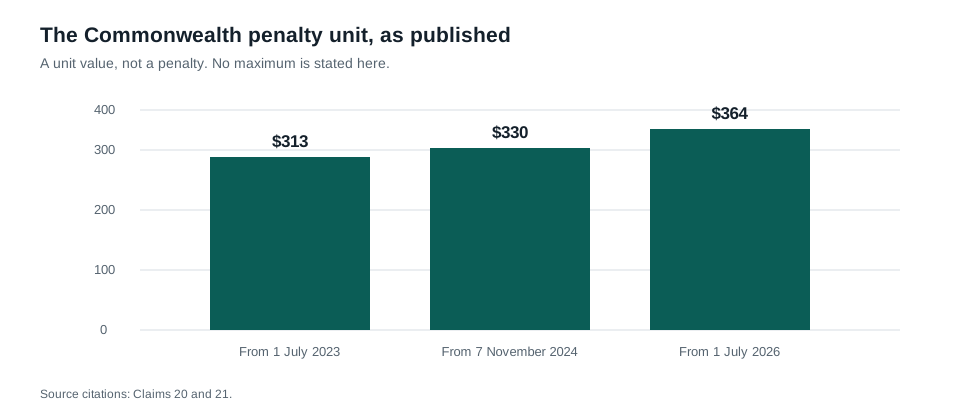
Claim 20 is AT SOURCE from the Crimes (Amount of a Penalty Unit) Instrument 2026 made 15 June 2026 under section 4AA(1A) Crimes Act 1914, on legislation.gov.au, publishing $364 for offences committed on or after 1 July 2026. Claim 21 is AT SOURCE from AFSA's penalty units page, publishing $330 from 7 November 2024 and $313 from 1 July 2023 to 6 November 2024. Claim 22 is NOT PUBLISHED, so the caption's sentence about no maximum is not a hidden dollar calculation. The figure caption is copied byte for byte from the figure store and no path, alt text or image tag is written here.
The $12.50 illustration can be revisited in this light. If a page wanted to force a package value it could multiply 200 by $12.50 and print $2,500. That would be an arithmetic result with no published term behind it. It would also sit awkwardly beside $8,000, because one is a turnover requirement and the other would be a fabricated balance. The margin we assume is the refusal to let those two numbers share a column. The figure stays as a demonstration, the blank stays blank, and the buying decision stays with the reader.
AT SOURCE, claim 148 says IT 2655, "Income tax: betting and gambling: whether taxpayer carrying on business of betting or gambling", was issued 17 October 1991 with immediate effect from an original memorandum dated 10 October 1989, on an ATO page. AT SOURCE, claim 149 quotes "There is no Australian case in which the winnings of a mere punter have been held to be assessable." AT SOURCE, claim 150 says the ruling does not say winnings can never be taxed, because "The Commissioner accepts that it is possible for a mere punter to be carrying on a business of betting or gambling", though rare for a punter with no connection to the racing industry, and whether a punter carries on a business depends on the facts of each case. AT SOURCE, claim 153 says "Income Tax Rulings do not have the force of law", so a page leaning on claim 149 must say it is quoting a 1991 ATO ruling and must not present it as a statutory exemption.
NOT PUBLISHED, claim 154 says no ATO source addresses winnings from a gambling service unlawful to provide in Australia, and no page may state that winnings from an offshore casino are tax-free in Australia; what is available is claim 149 about a mere punter's winnings generally. NOT PUBLISHED, claim 155 says no ATO source on the deductibility of gambling losses for an individual was located. These absences are part of the margin too. A buying guide that quietly adds a tax promise to a bonus calculation has created a fact that is not in the appendices. This page keeps the ATO material attributed, limited and away from the calculator.
AT SOURCE, claim 151 says "The intrusion of chance into the activity as a predominant ingredient" will generally preclude a finding of business, involvement in other racing-industry business activities makes it more likely, and "gambling which involves a significant element of skill is more likely to have tax consequences". AT SOURCE, claim 152 lists factors from Brajkovich including "whether the gambling is conducted in a systematic, organised and businesslike way", "the volume and size of the gambling", whether related to other businesslike activities such as horse breeding, and "whether the gambler appears to engage in his or her activity principally for profit or principally for pleasure", along with Evans and Babka factors such as systematically seeking the most favourable odds and keeping records. Those are IT 2655 statements, not online casino terms, and they do not enter the $8,000 calculation.
The margin is also where the site's commercial arrangement stays separate from the arithmetic. The advertising paragraph above the first section points to How this site is paid, and no figure from that advertising is held against a source cited on this site. No sentence in this section depends on the order of that advertising, names an operator, counts entries, quotes a term from them or explains the method of the page to the reader. The prose simply prices the class of offer. That separation is permanent by design and requires no disclaimer here.
Finally, the margin is a discipline about language. AUD is stated once at the top and kept throughout. Straight ASCII quotes and apostrophes are used. Australian English is used: licence as a noun, organisation, authorised, analyse and practise as the verb. There are no dashes, no exclamation marks, no stars, no votes, no claimed tests and no superlative promise in the body. "Guaranteed", "risk free" and "best casino" as a promise do not appear. The H1 carries the search phrase exactly; the body does not try to outbid it. A reader who finishes this section should know which number is source-backed, which number is modelled, and which number is missing.
Reading the terms before you choose
Reading the terms means reading for the state of each number, not just for its size. A bonus number can be a credited balance, a maximum, a matching rate, a chip, a headline label or a cap. A spin number can be a count, a daily count, a count tied to particular games, or a count whose winnings are treated differently from bonus winnings. A turnover number can apply to a bonus alone, to a deposit plus bonus, or to winnings from spins. A ceiling can apply to a withdrawal request, to a balance, to a conversion from bonus funds, or to one side of a combo. The word real money does not settle any of those states. Only the terms can.
For the offer shape in this H1, the first pass should locate the $200. Is it described as no deposit bonus credit, as a maximum, as a chip, or as a cash balance? Under the model on this page it is a $200 bonus and the multiple is forty times the bonus alone. That is the assumption, stated in the standfirst and repeated wherever the $8,000 appears. If a cashier uses a different basis, the model no longer describes that cashier and the reader should use the cashier's stated basis rather than this page's assumption. This page does not adapt its multiplication to an unread term.
The second pass should locate the multiple and, more importantly, what it applies to. "Forty times the bonus alone" is a different sentence from "forty times deposit plus bonus" and a different sentence again from a multiple applied to spin winnings. In a no deposit headline there is no deposit input in this model, so the left column is $200 x 40. A term that adds a deposit would belong to another offer class. A term that adds spin winnings would have to be published before it can be priced. The reader should not assume that one multiple governs the whole combo.
The third pass should locate the 200 spins and list their rules in the right column only. If a stake is published, write it there. If an eligible game rule is published, write it there without naming a game title or studio on this page. If a wagering requirement on spin winnings is published, write it there. If a ceiling is published, write it there, in the currency printed by the operator. If the ceiling is not published, write nothing further. The required statement on this page is that the spins may have their own ceiling which the cashier does not publish, and that nothing is published about it here under claim 142. That statement does not include a time period and does not include a number.
The fourth pass should check whether the bonus side and the spin side are ever joined by a settlement rule. Some terms may say which balance is used first, how a win is allocated, whether a bonus is removed on withdrawal, or whether spin winnings become bonus funds. This page does not assert that any of those rules applies. It asks the reader to find the sentence that joins the columns before adding them. If there is no joining sentence, the columns stay separate. If there is one, it belongs to the operator's own stated terms and is read as such, not converted here.
The fifth pass should check currency. AUD throughout is this page's modelling rule. An operator's own figures stay in the currency the operator publishes and are never converted here. A figure printed as A$, au$, USDT, EUR or any other label is not silently normalised into dollars. The standfirst says AUD throughout so the reader knows what $200, $8,000 and $12.50 mean on this page. The $12.50 remains an illustration in AUD, not an operator term. The moment a cashier's currency differs from the model, the model's AUD label and the cashier's own label must not be merged in one figure.
The sixth pass should check what is not available. Claim 142 is NOT PUBLISHED for withdrawal times, payout speeds and deposit minima as market figures. Claims 138, 139 and 140 are NOT PUBLISHED for PayID, Neosurf and card or wallet scheme rules about Australian gambling. Claim 141 is NOT PUBLISHED as to any list of banks offering blocks, while BetStop's own sentence may be quoted: "Many major banks let you block gambling transactions on your bank accounts. Contact your bank and ask them how they can help you." Claim 95 is NOT PUBLISHED as to any primary source stating that a bank must block a gambling transaction. None of those gaps is filled with a method, a workaround, a mirror, a proxy, a second account, a document shortcut or a timing claim.
AT SOURCE, claim 143 says AUSTRAC states "From 29 September 2024, all online gambling service providers must complete ACIP", the applicable customer identification procedure, "before creating an online gambling account or commencing to provide any designated service", that "the AML/CTF Rules have been amended to strengthen the applicable customer identification procedures", and that special circumstances formerly allowing delayed verification under section 10.4 "have been repealed". AT SOURCE, claim 144 says "Interim arrangements will be in place from 29 September 2023 to 28 September 2024", allowing some delay in special circumstances. AT SOURCE, claim 145 says the Commonwealth records the same as NCPF measure 3, AUSTRAC under the AML/CTF Rules, implemented 26 February 2019 and updated 2 May 2022 and 29 September 2023. Those are quoted as AUSTRAC and Commonwealth statements.
NOT PUBLISHED, claim 146 says AUSTRAC's page says "all online gambling service providers" without qualifying the phrase, and this sheet does not resolve how far that reaches an offshore operator with no Australian presence, so a page may state the rule as AUSTRAC states it, quoted and attributed, but may not state that an offshore casino is or is not bound by it. NOT PUBLISHED, claim 147 says no source states what an offshore casino does or does not verify, and the honest line is that the Australian verification rule is a rule about when an account may be opened under claim 143 and a reader taking an offer from outside the Australian system has no Australian body to hold to it; nothing here may be written as advice on avoiding an identity check. This page follows that limit exactly and describes no procedure.
AT SOURCE, claim 59 reads sections 4, 15, 15AA and 61GB together and says BetStop's obligations reach only Australian-licensed online and phone betting operators; they do not reach a casino game, which is not a wagering service under paragraph (a) or (b) of the section 4 definition, and they do not reach an offshore operator, because paragraph (c) of section 61GB requires the service not to contravene section 15AA(3), that is, it must be licensed; an online casino is caught by section 15, not section 15AA, and is outside the definition twice over. AT SOURCE, claim 60 quotes BetStop: "BetStop - the National Self-Exclusion Register does not apply to online casino games or other gambling services that are illegally provided in Australia. You can make a complaint about these services to the ACMA". Those claims are cited with their provisions and publisher.
Claim 81 is NOT PUBLISHED: no primary source quantifies how many offshore casinos accept registered individuals, and nothing supports a claim that any proportion do; published is the scope rule at claims 59 and 60, and that is a statement about a duty, not about behaviour. This page says only that BetStop registration does not, by its own terms, reach an offshore casino. It does not say an offshore casino will accept a registered individual, does not say any of them checks, and does not say any of them does not. Claim 82 is NOT PUBLISHED and records that nothing here describes, and no page may describe, how a registered individual could gamble; no method from sources found during the build is reproduced. The framing here is consequence only, never a feature and never an instruction.
AT SOURCE, claim 61 says BetStop describes "a free and secure way to exclude yourself from all online and phone wagering providers licensed in Australia in one go", "Block access to all phone and online gambling providers" and "allows you to block yourself from accessing all Australian licensed online and phone wagering providers in a single process". AT SOURCE, claim 62 says there is no partial exclusion and quotes "No. Signing up for BetStop - the National Self-Exclusion Register excludes you from all licensed online and phone wagering companies in Australia." AT SOURCE, claim 63 says duration is "You can register for a minimum of 3 months, up to a lifetime", with statute providing months, years or life at sections 61JF(1), (3) and (5). AT SOURCE, claim 65 says provider duties while registered are that providers "should not: open a wagering account for you; allow you to place bets, or; send you marketing material. Providers should also close any accounts you have and refund any credit to you." These are BetStop statements about licensed wagering, kept in their own scope.
Claim 79 is SOURCES DIFFER: the Department of Social Services page, describing the tenth National Consumer Protection Framework measure, says the register "allows consumers to exclude themselves from all interactive gambling services in Australia"; BetStop's own about page says it "does not apply to online casino games or other gambling services that are illegally provided in Australia" and describes coverage as "all online and phone wagering providers licensed in Australia"; section 61GB is a third reading. This sheet does not resolve which the department meant, a page must quote BetStop's wording at claim 60 and may cite the statutory definition at claim 58, and must not rest on the department's phrasing alone or present the two as saying the same thing. This page follows that rule and does not pick between them.
AT SOURCE, claim 58 says section 61GB defines "licensed interactive wagering service" as a regulated interactive gambling service that is a wagering service under section 4, has an Australian-customer link under section 8, and is not provided in contravention of subsection 15AA(3); a wagering service is paragraph (a) or (b) of the section 4 definition, namely placing, making, receiving or accepting bets, or introducing those who want to bet. AT SOURCE, claim 57 says section 61KA(1) creates an offence for "a licensed interactive wagering service provider" who provides a licensed interactive wagering service to "a registered individual", with penalty 500 units and civil penalty 750 units under section 61KA(3). AT SOURCE, claim 54 says section 61HA(1) requires ACMA to arrange for a body corporate, the Register operator, to keep the National Self-exclusion Register, in electronic form and not as a legislative instrument. AT SOURCE, claim 55 says BetStop states "Dataworks Group Limited (ABN 85 612 182 368) operates BetStop - the National Self-Exclusion Register on behalf of the ACMA", and sections 61HA(6) and 61HA(7) set the conditions around that arrangement. Those provisions are named, not blended with an operator's bonus terms.
Reading the terms also means knowing when a source is not a source. A law firm summary is a pointer, not a source. A search snippet is not a source. An affiliate site, a casino's marketing and a trade publication are none of them citable here. The appendices allow numbered claims only, with AT SOURCE facts attributed to the provision or publisher, SOURCES DIFFER facts stated as what each source says without choosing one, and NOT PUBLISHED facts stated as nothing published and nothing else. This page cites claim numbers rather than section numbers as its labels, while AT SOURCE passages name the provisions inside the attribution. It never mixes an operator's stated term with a statutory provision in one sentence, one cell or one figure.
The final reading check is practical. Can the reader fill the left column from the assumption? Yes, $200 x 40 gives $8,000. Can the reader fill the right column from published material here? Only the count 200, plus the statement that spins may have their own ceiling which the cashier does not publish and that nothing is published about it under claim 142. Can the reader add the columns? Not on this evidence. Can the reader treat $12.50 as a cash value? No, it is a bookkeeping illustration. Can the reader find a procedure for an identity check, a bank block or a self-exclusion register here? No, and none is described. That is the complete reading method for this offer class.
Knowing when to stop
Knowing when to stop applies to the calculation as much as to the activity. Stop calculating when the evidence stops. On this page that point is the spin ceiling. Stop when a figure would have to be invented. Stop when a wagering multiple would have to be moved from the bonus column to the spins column without a published rule. Stop when a currency would have to be converted. Stop when a time period would have to be attached to claim 142. Stop when an absent operator term would have to be borrowed from another market, another product or another page.
AT SOURCE, claim 176 says the Commonwealth publishes the National Gambling Helpline, 1800 858 858, and states "This is a free and confidential helpline open 24 hours a day, 7 days a week." AT SOURCE, claim 177 says Gambling Help Online publishes it as the "Gambling Helpline", 1800 858 858, and states "This service is available 24 hours a day, 7 days a week." It also says calls are free and will not appear on a phone bill, and that counsellors provide confidential free support, crisis support, a listener, referrals to local ongoing gambling counselling, information, and tips and strategies. AT SOURCE, claim 178 says BetStop states "If you would prefer to speak to someone, free and confidential support is available 24 hours a day, every day of the year. You can contact the National Gambling Helpline on 1800 858 858." and "These services are available for anyone affected by a gambling issue, not just the person who is gambling." Each name is quoted as its own source uses it.
Claim 186 is SOURCES DIFFER and says one State-badged page publishes 1800 858 858 under a different service name again: the former Victorian Responsible Gambling Foundation's page, last updated 1 September 2026, says "For confidential, free, 24/7 support, call Gambler's Help on 1800 858 858." The same page records that "The Victorian Responsible Gambling Foundation ceased operating from 1 July 2024", with functions transferred to the Department of Health, the Department of Justice and Community Safety, and the VGCCC. The number is the same across all sources, while the service name is not: "National Gambling Helpline", "Gambling Helpline" and "Gambler's Help" all appear. This sheet does not pick one, and a page must quote the name used by the source it cites. This page has done that in the paragraph above.
AT SOURCE, claim 179 says Gambling Help Online states the website "contains self-help material that you can access for free" and "also provides free 24/7 chat and email counselling and support", while the Commonwealth states "For free and confidential support visit the Gambling Help Online website." AT SOURCE, claim 180 says BetStop's own number, for registration help and for identity documents other than the three it lists, is 1800 238 786. AT SOURCE, claim 181 says BetStop publishes Lifeline as "a national service providing free 24/7 help and crisis support", with "You can talk to someone on 13 11 14, text 0477 131 114, or chat online". AT SOURCE, claim 182 says BetStop publishes "Call the National Debt Helpline on 1800 007 007 for free and confidential advice from professional financial counsellors. The helpline is open from 9:30 am to 4:30 pm, Monday to Friday." The hours are reproduced as the publisher states them.
AT SOURCE, claim 183 says BetStop publishes that "Gamblers Anonymous hosts local meetings across Australia", that "Reset is a confidential and free app that helps if you want to quit or cut back on gambling", and that the Australian Government's Moneysmart website "can help you take control of your money with free tools, tips and guidance", including guidance on where to obtain free legal advice. AT SOURCE, claim 184 says Gambling Help Online publishes that the Gambling Helpline can arrange an interpreter, or a caller can contact the "Translating and Interpreting Service on 131 450", and that for hearing or speech impairment the page directs contact through the National Relay Service and gives no number. AT SOURCE, claim 185 says BetStop publishes "There are different services available in different states and territories. You can find out more about the services available in your area at Gambling Help Online".
NOT PUBLISHED, claim 187 says no source states who operates the National Gambling Helpline: Gambling Help Online's telephone page does not say and carries no last-updated date, and a page may not attribute the helpline to any organisation. NOT PUBLISHED, claim 188 says no State or Territory gambling helpline number is on this sheet, only the national number was checked, and a page must not state a State number from memory or state that the national number is the only one. This page states no organisation as operator and states no State number.
AT SOURCE, claim 64 says BetStop says registration takes about five minutes and needs a mobile number, an email address and one of an Australian driver licence, Australian passport or Medicare card, with others calling 1800 238 786. AT SOURCE, claim 73 quotes BetStop's early cancellation text: "You can apply to cancel your self-exclusion early after at least 3 months of self-exclusion. To cancel, you must complete a Commonwealth statutory declaration to confirm you have seen a counsellor or a general practitioner to discuss your decision to cancel your self-exclusion. If your application is valid and has been completed correctly, you will be removed from the register after 7 days. You can withdraw your application to cancel at any time during this period if you change your mind." It is quoted so a reader can see what the commitment costs to unwind. No page may present it as a way out, frame it as a loophole, or describe it as a route to gambling while registered. This page does none of those things and gives no procedure beyond the published text.
AT SOURCE, claim 74 says BetStop states "No. You must register with BetStop - the National Self-Exclusion Register even if you are registered with an existing program." AT SOURCE, claim 75 says separate schemes exist for venues and BetStop states "There are other exclusion programs available to help block you from other gambling services. This includes blocking yourself from venues with poker machines and casinos. These programs differ depending on where you live." AT SOURCE, claim 76 says "No. A person needs to register themselves for BetStop - the National Self-Exclusion Register." AT SOURCE, claim 77 says up to five support people may be nominated and they are told when registration changes, including an early-cancellation attempt. AT SOURCE, claim 78 says that as at 30 June 2025 nearly 45,000 Australians had excluded themselves, with more than 30,000 active exclusions, and ACMA "stepped up our compliance and enforcement activities in 2024-25". These are publisher figures, used with the publisher named.
AT SOURCE, claim 32 says ACMA publishes a list of licensed interactive wagering providers and BetStop's about page points to it. AT SOURCE, claim 34 says ACMA publishes BetStop registration statistics and BetStop states "We never release personal information about individuals on the register or their support people, however you can find aggregated statistics on the ACMA website." AT SOURCE, claim 35 says an annual compliance priority report on interactive gambling was published in October 2025 for 2024-25. Claim 53 is NOT PUBLISHED as to provider count, and claim 80 is NOT PUBLISHED as to how many operators are connected to BetStop. No count is supplied here from those gaps.
Stop also means stopping the page at the right place. The buyer has been given the money, the assumption, the separate ledger, the unpublished ceiling, the one regulatory comparison, the margin, the figure, the calculator and the reading method. There is no need for a second title, a second H1, a report, a word count, a generated note, a raw address, a hand written image tag, a comparison grid of operator terms, a scoring claim or a disclaimer about the advertising block. The fragment carries page HTML only. The last blocks are the FAQ, the licence note and onward reading, then the fragment closes.
Frequently asked questions
- What does $200 become under the assumption on this page?
- A $200 bonus at forty times the bonus alone gives $8,000 of turnover. AUD is used throughout. The calculation is 200 x 40 = 8000 and it applies to the bonus side only.
- Are the $200 bonus and the 200 spins counted together?
- No. This page counts them separately. The bonus side has the stated multiple. The 200 spins sit in their own column because their value, any wagering on spin winnings and any ceiling are terms that would have to be published before they could be priced.
- Can the spins have their own ceiling?
- The spins may have their own ceiling which the cashier does not publish. Claim 142 is a NOT PUBLISHED finding, so the only statement made here is that nothing is published. No ceiling figure, withdrawal time or payout speed is supplied.
- What is the $12.50 figure for?
- $12.50 is an AUD bookkeeping illustration used to show why the spin column must stay separate. It is not a cash value for the spins, not a published stake, not a predicted win and not an operator term.
- Does an Australian body hear a dispute about this offer class?
- Claim 164 says no Australian alternative dispute resolution scheme, ombudsman or arbitration body covering online gambling was located, and this sheet names none. ACMA takes regulatory complaints under claims 26 and 28, but claim 156 says a complaint is not a claim and nothing in Parts 3 and 8 provides for a complainant to recover money.
- Does BetStop registration reach an offshore casino?
- BetStop registration does not, by its own terms, reach an offshore casino, under claims 59 and 60. Claim 81 says no primary source quantifies acceptance or checking behaviour, so this page states no such behaviour, describes no method and presents the gap as no feature at all.