A POLi casino Australia search is usually a search for a cashier route first and a bonus second, so this guide costs the offer on the terms usual for offers of this kind: a $1,000 bonus modelled at forty times the bonus alone produces $40,000 of turnover, and a $12.50 cash stake is the small unit that makes the arithmetic visible. The assumption is stated here rather than hidden in a later paragraph: AUD throughout, the multiple applies to the bonus alone, no cashier ceiling is published for this class, and no operator's own stated term is borrowed as if it were a market figure.
What sits under this paragraph is advertising. Its order was bought, none of its wording was composed here, and no figure in it has been held against a source cited anywhere on this site. The arrangement behind it is set out at How this site is paid.
The offers in this block are advertising. Placement is paid. Copy is supplied by the operator and is printed unaltered. More at How this site is paid. The arrangement is itemised at How this site is paid.
The money before the method
The first decision on a page like this is not a legal decision and it is not a payment decision. It is a money decision. A reader arrives with a phrase that names a rail and a country, then sees a headline number attached to a welcome offer. The number that matters is not the headline number. It is the turnover required before a balance can be treated as ordinary money. On the assumption carried in the standfirst, a $1,000 bonus at forty times the bonus alone means $40,000 of qualifying stakes. That is the figure to keep in view when the cashier page is read, because every later term is a term about how that $40,000 is counted, limited, divided or left unfinished.
Offers of this kind usually ask forty times. That is a class statement, not a reading of a particular cashier, and it is the only way this page can put a number on the offer without pretending to have read an operator's own terms that are not published here. The phrase "forty times the bonus alone" does two jobs. It fixes the base at $1,000, rather than at a deposit plus the bonus, and it keeps the calculation in AUD throughout. If a cashier applies the multiple to deposit plus bonus, the turnover is larger. If a cashier publishes a different multiple, the turnover changes with it. If a cashier publishes a maximum bet, a game weighting schedule, a time limit, a maximum convertible win, a withdrawal condition or an identity condition, each of those terms changes the practical value of the same headline. The page does not fill any of those fields with invented values. It holds the one modelled figure steady so the reader can see what each published term would do to it.
The $12.50 stake is useful because it makes the distance between a headline and a requirement easy to picture. At $12.50, $40,000 means 3,200 qualifying stakes under the simple model. That is arithmetic on the assumption, not a playing plan and not a prediction of how any game behaves. It is not a count of spins, because a stake can be placed in more than one kind of game and because game contribution is a cashier term that is not supplied here. It is a way of saying that a $1,000 headline does not sit beside a $1,000 obligation. It sits beside a $40,000 obligation, and the obligation is measured before any question about a rail is answered.
The small stake also exposes why a missing ceiling is a cost. A cashier at this end of the market rarely publishes the ceiling in the same place as the headline. If the ceiling is low, the turnover takes longer and the balance is exposed to more play. If the ceiling is high, the turnover can be worked through faster, but a single large stake carries a larger swing. Neither outcome is a bonus in the ordinary sense. Both are ways the same $40,000 requirement can feel different in use while remaining the same requirement on paper. The reader who sees only "$1,000" has seen the smallest number in the transaction.
Commercial pages often try to settle the reader's nerves by moving quickly from the bonus to the payment method. That order flatters the offer. A payment token is a route, not a valuation. A route can be convenient, familiar, advertised heavily or absent from the cashier on the day the reader looks. It does not change the multiple. It does not decide whether bonus funds are locked. It does not decide whether a win is capped. It does not decide whether a document request comes before a withdrawal. It does not decide whether a complaint about a withheld balance has anywhere to go. The cost model has to stay ahead of the route for the page to be useful as a buying guide.
That is why this section keeps returning to the same three figures. $1,000 is the headline. $40,000 is the modelled turnover. $12.50 is the unit that makes the scale readable. None of them is an operator's own stated term, and none of them is presented as one. AUD throughout is the currency assumption, not a claim about how any cashier labels its balance. When an offer's own terms are eventually read, they should be compared against this model line by line: multiple, base, contribution, ceiling, expiry, cap, identity condition and withdrawal condition. If one of those fields is blank on the cashier, the blank is part of the price. A blank is not a neutral value and it is not a permission to assume the most favourable value.
The reader's practical question is whether the offer is worth the conditions attached to the headline. A page cannot answer that question honestly by naming a rail and then stopping. It can answer it by showing the size of the condition first, then showing which published facts sit around the rail, then showing which facts are not published at all. That is the shape of this page. The commercial intent is plain: it helps a reader choose an offer. The method is also plain: price the offer before describing anything that might make the offer look easy to use.
There is a second reason to lead with money. A search phrase made from a payment token can make the reader think the main uncertainty is technical: will the deposit appear, will the cashier accept it, will the withdrawal use the same path. Those are real questions at the point of use, but they are not the questions that decide whether a bonus has value. A deposit route can work perfectly and still leave the reader with $40,000 of conditions attached to $1,000 of bonus funds. A route can be familiar and still say nothing about the treatment of a balance after the wagering is complete. The money comes first because the money is what the offer is selling.
The final point in this opening section is about absence. Sitting outside the Australian system costs the reader a set of protections, and the honest way to describe that cost is to say what is absent, not to invent a present tense rule for the offer to be absent from. There is no Australian licensed online casino market to use as a comparison shelf. There is no domestic licence condition that can be held up beside an offshore bonus term. There is no Australian technical standard for an online casino licence that does not exist. Those absences are cited later on the page, by claim number, in the one regulatory section. Here they belong in the cost model as a caution against a familiar mistake: do not price this offer as though it were a licensed Australian wagering product with a domestic rule book attached. It is a casino offer, and the wagering rules belong to a different product.
Keep the opening figure in mind as the page moves through the payment material. The most authoritative material available about the rail is thin, and much of what circulates is not citable. Thin material does not make the bonus cheaper. It makes the reader more dependent on the offer's own published terms. When a page cannot source a fact, the correct result is a gap, not a reassuring sentence. The gap has a price, and the price is measured against $40,000.
What is published about the payment token
POLi is a search intent on this page. It is not treated here as a legal category, a scheme rule, a bank policy or an operator feature. The fact base records one news report about the business, one regulator risk statement about a pattern of transactions, one regulator note about its own payment work, one retrieved contents heading without text, and a set of explicit gaps. Those items are not equal in weight, and the page keeps their labels visible. A news report is a news report. A regulator's own report is a regulator's own report. A NOT PUBLISHED entry permits one sentence: nothing is published. It does not permit a confident guess dressed as market practice.
The key claim is claim 137, a SOURCES DIFFER item with a news label. It must be read as a report, not as a primary page. itnews, 13 July 2023, reports that Australia Post decided to close the POLi business in Australia and quotes a merchant status notification: "Australia Post has made the difficult decision to close the POLi business in Australia" and "we wind down operations by September 30 2023". The same news report says NZ operations passed into local ownership. The claim also records that no Australia Post or POLi primary page stating the closure was located. That absence is part of the claim, and it changes what a careful page may say.
Accordingly, this page says only that the dated itnews report of 13 July 2023 contains those quoted words and that a primary Australia Post or POLi page stating the closure was not located. It does not state that POLi is unavailable in Australia as a sourced fact. It does not turn the merchant notification into an operator announcement by this site. It does not treat the wind down date as a current status line. It does not use the NZ ownership sentence to imply anything about a present Australian cashier. Appendix B point 13 bars the unavailable in Australia sentence as a sourced fact, and this page follows that bar. A reader who wants a current cashier answer must read the cashier's own current terms, because the authoritative closure page that would settle this as a sourced fact is not in the record.
The most important consequence for a buying guide is not nostalgia about a payment brand. It is source discipline. A dated news report can explain why a search phrase still circulates. It cannot tell a reader which deposits an offer accepts today. It cannot tell a reader what a cashier's limits are. It cannot tell a reader how a withdrawal will be handled. It cannot supply a minimum deposit, a payout window or a processing time. Claim 142 records that no published figure for Australian deposits, withdrawal times or payout speeds at offshore casinos exists on this sheet, and that no page may state a withdrawal time for any operator or the offshore market. Where an operator states a minimum deposit for itself, that figure can be read as that operator's stated term. No such term is used here.
Claim 133 is the one authoritative thing located about PayID and gambling, and it belongs in this payment discussion because the payid-casino hub sits beside this key in the manifest. ACMA's 2024-25 compliance report states "significant risks to consumers through the use of high-volume, small-value transactions to illegal services". That is a risk statement about a transaction pattern, not a scheme rule about PayID and not a finding about POLi. It is attributed to ACMA and cited as claim 133. It does not say that PayID is permitted, prohibited, blocked, faster, safer or instant for gambling. It does not say anything about POLi. It is a narrow sentence with a narrow use: it explains why a regulator watches payment patterns around illegal services.
Claim 134 records that ACMA's payment work is directed at the services, not the schemes: its 2020-21 report records contacting "the providers of local payment services used by the targeted casinos" alongside 52 software providers. Again, that is a statement about regulator work. It is not a list of rails, not an approval of any rail, and not a comment on a brand's gambling availability. Claim 135 records that the 2024-25 report's contents carry a heading "Financial transaction blocking" with no text beneath it in the retrieved document. This page states that limited fact and stops. It does not fill the empty heading with a policy, a date beyond the record, a bank duty or a consumer instruction.
Claim 136 is a statutory reading, and it is narrower than most pages assume. The statutory position on cards and wallets is claims 86 to 91: a credit card and a credit-card-funded wallet are banned for licensed Australian wagering. Nothing in s 15C speaks to a debit card, a bank transfer, PayID, a voucher or a wallet funded from a bank account, and nothing in s 15C binds an offshore casino at all. That is a statement about the reach of a provision in a different product's rule book. It is reproduced here only because the comparator for this page is wagering and because the one regulatory section later must say that the licensed wagering product does not reach this casino offer. Section 15C is not a POLi rule. It is not an offshore casino rule. It is not a brand rule.
The gap claims are the useful part of the slice. Claim 138: nothing authoritative is published about PayID as a gambling payment method. Claim 139: nothing authoritative is published about Neosurf as a gambling payment method. Claim 140: no scheme rule from Visa, Mastercard, Apple Pay or Google Pay about Australian gambling was located. Each of those claims permits the sentence that nothing is published, and nothing else. Search results in this area return affiliate and marketing pages almost exclusively. Those pages are not citable here. A plausible table of limits, fees, speeds, availability, safety or institutional treatment built from them would be invention, and the measured searches in the source file show why: different pages attach contradictory figures to the same operator in the same week.
Claim 141 is also a gap with one permitted quote. BetStop says: "Many major banks let you block gambling transactions on your bank accounts. Contact your bank and ask them how they can help you." The claim records that bank gambling blocks are described by BetStop as voluntary and bank-by-bank, and that no list of banks offering them was located. This page quotes the sentence without naming a bank, without stating a block's terms, and without saying anything about how a block behaves. Claim 95 records that no primary source states that a bank must block a gambling transaction, and that a page may not state a card block is a legal requirement or name a bank as offering one. The line is drawn at consequence. No procedure is described. No reader is told how to get past a block, an identity check or a self-exclusion register.
Claim 94 records that no instrument made under s 15C(4A)(d) was located, so a page may not say any method beyond the credit card, credit-card-linked account and digital currency limbs is covered by that provision. Claim 87 gives the exhaustive list in s 15C(4A): a credit card; an account, service or facility in which payment is made from a credit card linked to it; digital currency; and a method of a kind determined by the Minister by legislative instrument. Claim 91 says who is bound: every limb of s 15C is addressed to a person providing "a regulated interactive gambling service that is a wagering service", read with s 8E as a licensed Australian betting operator. Section 15C does not bind an offshore online casino. Those claims are cited by number, not by a free-floating section reference, and they are kept inside the comparator discussion where the different-product warning sits.
Claims 143, 146 and 147 sit in the identity verification part of the same wagering slice, and they matter to a cashier guide because identity checks often appear at withdrawal. AUSTRAC says, as claim 143 records, "From 29 September 2024, all online gambling service providers must complete ACIP", the applicable customer identification procedure, "before creating an online gambling account or commencing to provide any designated service"; "the AML/CTF Rules have been amended to strengthen the applicable customer identification procedures"; and special circumstances formerly allowing delayed verification under s 10.4 "have been repealed". Claim 146 records that AUSTRAC's page says "all online gambling service providers" without qualifying the phrase, and that the sheet does not resolve how far that reaches an offshore operator with no Australian presence. A page may state the rule as AUSTRAC states it, quoted and attributed; it may not state that an offshore casino is or is not bound by it. Claim 147 records that no source states what an offshore casino does or does not verify. The honest line is that the Australian verification rule is a rule about when an account may be opened, and a reader taking an offer from outside the Australian system has no Australian body to hold to it. Nothing here is advice on avoiding an identity check.
The practical reading of this payment section is therefore a reading of limits. A dated news report explains a phrase. A primary page stating closure was not located. ACMA has published a risk statement about high-volume, small-value transactions to illegal services. ACMA has published a note about contacting local payment service providers. A retrieved report has an empty financial transaction heading. A statutory provision about credit and digital currency belongs to licensed wagering and does not bind an offshore casino. Nothing authoritative is published about several named tokens as gambling methods. No operator timing, limit or fee is borrowed from affiliate marketing. No bank is named. No behaviour is inferred from an absence. That is the whole payment record, and it is enough to tell a careful reader where to look next: at the offer's own current terms, with the $40,000 model already in hand.
This section has also avoided the sentence the source file singles out as the easy one to write. It has not said POLi unavailable in Australia as a sourced fact. It has not said the reverse as a sourced fact either. It has not converted a 2023 news report into a 2026 cashier status. It has not said a payment token is accepted by this class of offer. It has not said a payment token is rejected by this class of offer. It has not said a bank must do anything about a gambling transaction. It has not described a way around any control. Those are not omissions to be repaired with smoother prose. They are the sourced boundary.
Reading the offers
Reading a bonus offer is a form of arithmetic with a reading task attached to it. The arithmetic is simple: $1,000 at forty times the bonus alone is $40,000. The reading task is harder, because the terms that decide whether the $40,000 can be completed are spread across a cashier, a promotion page, a general terms page, an account page and sometimes a document request made later. A page that quotes only the headline has not read the offer. A page that fills unread fields with class averages has invented the offer. The useful method is to list the fields, say what each would do to the model, and leave every unpublished field unpublished.
Start with the base. "Forty times the bonus alone" means the $1,000 is multiplied. If the offer says forty times deposit plus bonus, the base changes and the turnover rises. That single wording difference can matter more than the size of the headline. A larger headline with a wider base can be dearer than a smaller headline with a narrow base. The reader should write the base down before looking at anything else, because the base is the number the whole model rests on. On this page the base is fixed by assumption so that the rest of the discussion has a stable reference point.
Then read the contribution table. A turnover requirement is rarely a single undifferentiated pool of stakes. Game categories can count at different rates, and some categories can be excluded. Where contribution is less than full, the $40,000 is not $40,000 of nominal stakes but $40,000 of counted stakes. A $12.50 stake that counts at half contributes $6.25 to the requirement. Two such stakes count as one full stake for the model. This is arithmetic on a term, not a claim that any particular cashier uses that rate. The point is that a contribution table changes the number of stakes without changing the headline or the multiple. If the table is not published, the field is blank and the reader cannot price it.
Then read the maximum stake. The phrase "a ceiling the cashier does not publish" is a class statement used on this build, not an invitation to assume there is no ceiling. If a maximum stake exists, it sets the largest step that can count. If it is lower than $12.50, even the small unit in the standfirst is too large for the model. If it is higher, the unit remains usable but the reader still has to decide how much balance swing is acceptable while working through $40,000 of counted stakes. A ceiling is not a minor administrative detail. It is one of the main levers that turns a bonus from a headline into a schedule.
Then read the expiry. A turnover requirement with an expiry is a requirement to complete $40,000 of counted stakes inside a time window. The same number with a short window and the same number with a long window are not the same offer. The time window does not appear in the multiplication, but it appears in the practical meaning of the multiplication. Where no expiry is published, the reader has no sourced way to compare the offer on this field. Where an expiry is published, it belongs beside the $40,000, not in a footnote.
Then read the maximum convertible win. Some bonus terms separate the completion of wagering from the amount that can be withdrawn from bonus play. A cap changes the upside while leaving the turnover requirement intact. It is the reason a reader can finish the $40,000 and still find that the headline did not describe the money available at the end. This page does not supply a cap, because no operator's own stated term is used. It says only that the field exists in the reading method and that a reader should look for it before treating the bonus as cash.
Then read the withdrawal condition. A balance can be subject to a minimum withdrawal, a maximum withdrawal per period, a method condition, a document condition or a review step. Claim 142 bars this page from stating a withdrawal time for any operator or the offshore market. It also says no minimum deposit figure may be presented as anything other than a term an operator has stated for itself. The safe method is therefore: read the operator's own stated term from the operator's own page, keep its currency as written, record the address and date, and do not average it with marketing pages. This fragment does not print such a term. It explains how one would be used if it were read.
Then read the identity condition. Claim 143 gives the AUSTRAC wording about completing ACIP before creating an online gambling account or commencing to provide any designated service. Claim 146 says the sheet does not resolve how far that reaches an offshore operator with no Australian presence. Claim 147 says no source states what an offshore casino does or does not verify. The reader's practical conclusion is narrow: an account condition can appear before withdrawal, and a reader outside the Australian system has no Australian body to hold to the Australian rule. That is a consequence, not a procedure. No page on this build describes how to avoid an identity check, how to register without documents, how to use a second account, or how to deal with a bank block.
Then read the complaint position. Claim 161 records the complaints route that does work for licensed operators: Queensland's consumer page tells a consumer to talk to the business first, then if unsatisfactory "lodge a complaint with the government agency that issued the provider's licence", which should be displayed on the provider's website; Queensland complaints go to the Office of Liquor and Gaming Regulation, and for NT-licensed providers the page points to NT Consumer Affairs. Claim 162 records that Australian Consumer Law is stated to apply to gambling businesses on that State consumer page, with the sentence "Australian online wagering providers must honour your consumer rights and meet their gaming licence requirements." Those are claims about licensed wagering providers, a different product. They are cited in the one regulatory section with the warning required by the comparator. They are not converted into a promise about a casino offer.
The dispute claims that sit just outside the strict comparator allow-list are not used as the page's regulatory comparison, because this page is wagering and the brief limits it to its slice. Within that slice, claim 161 and claim 162 do the work of showing what a licensed route looks like. The contrast is a missing route, not a present-tense rule imposed on the casino offer. The aside later says plainly that no Australian licence exists for this product, citing claims 5, 14 and 15. Those three claims are the licence aside's own permitted citation set in this brief, and they are not used to build a second regulatory section.
One calculator belongs on a costed guide, and it is here to make the reading method mechanical rather than rhetorical. It takes a bonus amount, a multiple and a stake, then prints the turnover and the number of equal stakes under the simple assumption. It does not fetch an offer, does not rank an offer, does not publish a cashier term and does not predict a result. The default values match the standfirst: $1,000, forty times the bonus alone, and $12.50. AUD is the currency of the calculation. If a reader changes the base or the multiple, the output changes. If a cashier publishes a contribution rate or a ceiling, the reader has to apply that published term outside the simple model.
Simple wagering model. AUD throughout. The multiple applies to the bonus alone. The output is turnover and equal stake count, not a prediction of play.
At $1,000 and forty times the bonus alone, turnover is $40,000. At $12.50, that is 3,200 equal stakes under the simple model.
The calculator's output is deliberately plain. It does not say "guaranteed", it does not say "we tested", and it does not attach a star, a vote or a reader count to any result. The site models, calculates and cites; it does not play. That distinction is especially important on a page whose search phrase names a payment route, because a payment route encourages practical claims that sound like first hand experience. None appear here. The output is arithmetic from the three inputs and the assumption printed beside them.
Reading the offers also means noticing when a page is trying to sell by filling gaps. A table that lists a payout window for an operator whose own page was not read is not a comparison. A sentence that says a rail is instant, safe or accepted because affiliate pages repeat it is not a source. A statement that a named bank blocks gambling transactions is not available here. A statement that no bank blocks them is not available either. A statement that a self-exclusion register covers a casino offer is false to the scope rule, and a statement that an offshore operator will accept a registered individual is not published at all. The buying guide has to be useful without converting any of those gaps into a feature.
The best way to use this section is to keep a short written checklist beside the cashier. Base: bonus alone or deposit plus bonus. Multiple: forty on this model, or the cashier's published figure. Turnover: $40,000 on this model, or the recalculated figure. Contribution: published or blank. Ceiling: published or blank. Expiry: published or blank. Cap: published or blank. Identity condition: published or blank. Withdrawal condition: published or blank, and only from the operator's own stated term. Complaint route: what the offer says, and what an Australian body can or cannot do. A checklist with blanks is more honest than a polished comparison with invented entries.
That checklist also explains why the organisation behind this page is named as Lucky Aussie Reels but the offer terms are not written as house knowledge. The organisation publishes a method, a model and citations. It does not publish operator terms it has not read. It does not convert a 2023 news report into a current status. It does not turn a regulator's risk sentence into a scheme rule. It does not turn a State consumer page about licensed wagering into a promise about a casino cashier. The reader is being helped to choose, and the help is the discipline of leaving unsourced fields empty.
The different product beside this one
This is the page's one regulatory section. Its comparator is wagering, and the warning has to be in the same section as every licensed wagering rule: a licensed Australian wagering operator is a different product from an offshore online casino offer, and the wagering rule does not reach the offer. The section exists to show what sitting outside the system costs the reader by naming the protections that belong to the neighbouring product. It does not apply those rules to the casino offer, and it does not invent a present-tense rule for the offer to be absent from. Say what is absent. Do not pretend a domestic casino rule book is being breached.
Claim 83 records Part 2B, "Prohibitions relating to credit and digital currency for certain interactive wagering services", ss 15B-15F. Claim 84 records that Part 2B was substituted or amended by the Interactive Gambling Amendment (Credit and Other Measures) Act 2023, Act No. 114 of 2023, assented 11 December 2023, with Schedule 1 items 1-29 commencing 11 June 2024 and items 30-36 on 12 December 2023. Claim 85 records the simplified outline in s 15B: "Credit must not be provided to customers of certain interactive wagering services. Such services must also not accept or offer to accept payment using specified methods, including credit cards and digital currency." Those are statements about a statutory Part addressed to certain interactive wagering services. They are not statements about POLi, not statements about a casino cashier, and not statements about any brand.
Claim 86 records s 15C(1A): an offence where a person intentionally provides "a regulated interactive gambling service that is a wagering service" and accepts or offers to accept payment using a method in s 15C(4A) from a customer physically present in Australia, with a penalty of 500 units and a civil penalty of 750 under s 15C(3A). Claim 87 gives the exhaustive list: a credit card; an account, service or facility in which payment is made from a credit card linked to it; digital currency; and a method of a kind determined by the Minister by legislative instrument. Claim 88 says paragraph (b) is the e-wallet limb and catches an account only where payment is made from a credit card linked to it; a digital wallet funded from a debit card or bank account is not caught by (b). Claim 89 says "digital currency" has the same meaning as in A New Tax System (Goods and Services Tax) Act 1999 and is not defined afresh. Claim 90 records the separate credit prohibition in s 15C(1), with penalty 500 units and civil penalty 750 under s 15C(3). Each of those claims is about the licensed wagering product.
Claim 91 is the point that matters most. Every limb of s 15C is addressed to a person providing "a regulated interactive gambling service that is a wagering service"; read with s 8E that means a licensed Australian betting operator. Section 15C does not bind an offshore online casino. Such a casino taking a credit card or crypto deposit from an Australian is not contravening s 15C; it is contravening s 15 by providing the service at all. That sentence is quoted here with its limit intact. It is a statement about statutory reach, not advice about a payment choice. It is also the required different-product warning: the rule belongs to wagering, and it does not reach the casino offer.
Claim 94 records that no instrument made under s 15C(4A)(d) was located, so no page may say any method beyond (a), (b) and (c) is covered. Claim 95 records that no primary source states that a bank must block a gambling transaction, that individual banks offer blocks voluntarily as claim 141 says, and that a page may not state a card block is a legal requirement or name a bank as offering one. Claims 103 and 104 are narrow limits: the Commonwealth gambling reforms page carries a "Last updated" field with no date in it, so implementation dates may be quoted but the page may not be described as current as at a particular day; and the sheet did not research State and Territory inducement statutes, states no provision from any of them, and permits only the statement that the rules are State/Territory rules binding licensed operators and therefore not rules an offshore casino is within. Those claims are stated, not expanded.
Claim 99 records that inducements are restricted by State and Territory law, not the Commonwealth, as at the sheet's date: NCPF measure 4, "Regulated by states and territories", implemented 26 May 2019 in all jurisdictions except NSW and 26 November 2019 in NSW, with the line "Online gambling providers cannot offer any incentives to open an account." Claim 100 records the Queensland consumer page: online providers and on-course bookmakers "can't offer credit or a voucher, reward or benefit to try to get someone to open a betting account", nor incentives to refer someone else; direct marketing is limited to customers who expressly opt in, with easy unsubscribe. Claim 101 records the rest of the National Consumer Protection Framework as the Commonwealth records it, including customer verification, account closure, voluntary opt-out deposit limits, monthly activity statements, consistent gambling messaging, staff training and BetStop. Claim 102 records the framework's own stated scope: "The National Framework applies to all licensed online wagering service providers." It does not mention online casinos. Again, different product, different rule book, and no transfer to the casino offer.
BetStop sits in the same slice and makes the contrast concrete. Claim 54 records s 61HA(1): "The ACMA must arrange for a body corporate (the Register operator) to keep, on behalf of the ACMA, a register to be known as the National Self-exclusion Register." Claim 55 records BetStop's own statement that "Dataworks Group Limited (ABN 85 612 182 368) operates BetStop - the National Self-Exclusion Register on behalf of the ACMA." Claim 56 records the start date 21 August 2023 from the Commonwealth gambling reforms page and ACMA provider FAQ, with the statutory mechanism a proclaimed start day under s 61GC(1). Claim 57 records exactly who is bound: s 61KA(1) creates an offence for "a licensed interactive wagering service provider" who provides a licensed interactive wagering service to "a registered individual", with penalty 500 units and civil penalty 750 under s 61KA(3).
Claim 58 records the definition that settles scope: "licensed interactive wagering service means a regulated interactive gambling service that: (a) is a wagering service (see section 4); and (b) has an Australian-customer link (see section 8); and (c) is not provided in contravention of subsection 15AA(3)." A wagering service is paragraph (a) or (b) of the s 4 definition: placing, making, receiving or accepting bets, or introducing those who want to bet. Claim 59 records the consequence: BetStop's obligations reach only Australian-licensed online and phone betting operators; they do not reach a casino game, which is not a wagering service under (a) or (b), and they do not reach an offshore operator, because paragraph (c) requires the service not to contravene s 15AA(3), meaning it must be licensed. An online casino is caught by s 15, not s 15AA, and is outside the definition twice over.
Claim 60 gives BetStop's own sentence to quote: "BetStop - the National Self-Exclusion Register does not apply to online casino games or other gambling services that are illegally provided in Australia. You can make a complaint about these services to the ACMA". This page quotes it and stops at the scope rule. It does not say that an offshore casino will accept a registered individual, nor that any of them checks, nor that any of them does not. Claim 81 bars those behavioural statements, and Appendix B point 5 and point 6 bar the surrounding material about gambling while registered, reaching a blocked site, getting round a bank block or an identity check. Claim 82 records that nothing here describes, and no page may describe, how a registered individual could gamble. The framing of this section is consequence only. No reader can follow it as an instruction past a self-exclusion register, an identity check or a bank block.
Claims 61 to 78 describe what the register does for the product it covers. It is "a free and secure way to exclude yourself from all online and phone wagering providers licensed in Australia in one go" (claim 61). There is no partial exclusion (claim 62). Duration is "a minimum of 3 months, up to a lifetime" (claim 63). Registration takes about five minutes and needs a mobile number, an email address and one of an Australian driver licence, Australian passport or Medicare card, with others calling 1800 238 786 (claim 64). Provider duties while registered include not opening a wagering account, not allowing bets, not sending marketing material, closing accounts and refunding credit (claim 65). Marketing prohibitions are statutory and separate (claim 66). Accounts are not reactivated afterwards (claim 67). Pending bets are the one carve-out (claim 68). A provider may request the Register operator to inform it whether specified individuals are registered (claim 69), but the checking obligation has no fixed timing (claim 70), and a due diligence defence exists in s 61KA(5) (claim 71). Rules may require providers to promote BetStop and ensure customers can readily access the website and app (claim 72). Early cancellation has a counselling or general practitioner condition and a 7 day removal period after a valid application (claim 73), and this page does not present it as a way out or a route to gambling while registered. State and territory schemes are separate (claims 74 and 75), a person needs to register themselves (claim 76), up to five support people may be nominated (claim 77), and as at 30 June 2025 nearly 45,000 Australians had excluded themselves with more than 30,000 active exclusions (claim 78). Those are facts about licensed wagering and the register, not features of a casino offer.
Claim 79 is a SOURCES DIFFER item with news-level framing difference, not a news report. The Department of Social Services page, describing the tenth National Consumer Protection Framework measure, says the register "allows consumers to exclude themselves from all interactive gambling services in Australia". BetStop's own about page says it "does not apply to online casino games or other gambling services that are illegally provided in Australia" and describes coverage as "all online and phone wagering providers licensed in Australia". Section 61GB is a third reading. The sheet does not resolve which the department meant. This page quotes BetStop's wording at claim 60 and cites the statutory definition at claim 58; it does not rest on the department's phrasing alone and does not present the two as saying the same thing. That is the whole permitted treatment of claim 79 in the wagering slice.
Claims 80, 81 and 82 are NOT PUBLISHED entries and are left as gaps. No source states how many operators are connected to BetStop. No primary source quantifies how many offshore casinos accept registered individuals, and nothing supports a claim that any proportion do. Published is the scope rule at claims 59 and 60: the obligation does not reach them. That is a statement about a duty, not about behaviour. Nothing here describes how a registered individual could gamble. Appendix B point 22 also bars a count of Australian licensed wagering operators or of how many are connected to BetStop, and claim 53 records that ACMA's licensed interactive wagering providers page did not render a list on retrieval and no provider count could be read. The page states no count.
Claims 161 and 162 close the comparison. The complaints route that works for licensed operators is to talk to the business first, then lodge a complaint with the government agency that issued the provider's licence, which should be displayed on the provider's website; Queensland complaints go to the Office of Liquor and Gaming Regulation, and for NT-licensed providers the page points to NT Consumer Affairs. The Queensland page also says "You have consumer protections when using online gambling services" and "Australian online wagering providers must honour your consumer rights and meet their gaming licence requirements." Those sentences are about Australian online wagering providers, a different product. This section says what is absent for a casino offer: the licensed-provider complaint route, the licence label on the provider's website, and the domestic licence conditions that the Queensland page ties to consumer rights. It does not say a reader has Australian Consumer Law rights against an offshore casino or has none, because claim 163 is outside the comparator slice and Appendix B point 17 bars both statements. It does not name an Australian body that will hear a dispute against an offshore casino, because claim 164 is outside the slice and Appendix B point 16 bars it. It does not say an agreement is enforceable or unenforceable, because Appendix B point 4 bars both.
The cost to the reader is therefore stated as absence. A licensed Australian wagering product sits inside a defined register, a defined credit and digital currency prohibition, a defined National Consumer Protection Framework, a defined complaint route and a defined licence label. An offshore online casino offer of the kind being costed here sits outside that product's rules, and no Australian online casino licence exists to supply a domestic alternative set. The reader gives up the wagering product's checks without gaining a casino equivalent. That is not a claim that the offer breaks the wagering rules. The rules do not reach it. It is a claim about what the reader cannot call on.
This section has used only the wagering comparator slice permitted by the brief: claims 54-82, 83-95, 99-104, 143-147, 161 and 162. It has not used act comparator claims to build a second regulatory section, and it has not used venue claims. Claims 5, 14 and 15 appear only in the licence aside as required. It has not stated a dollar maximum penalty under the Interactive Gambling Act. It has not described any Schedule of the 2026 Act as current law. It has not said playing is legal or illegal. It has not said winnings are tax-free. It has not named a bank. It has not said POLi is unavailable in Australia as a sourced fact. It has not described circumvention. One regulatory section, one comparator, one warning carried through every rule.
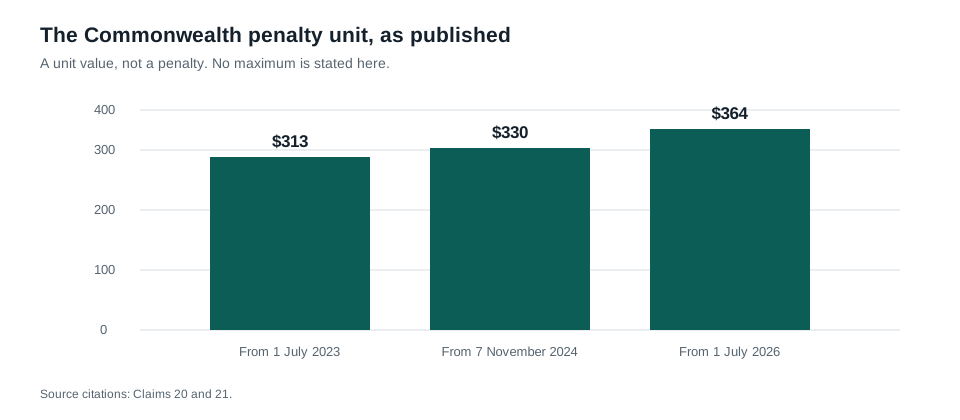
The figure belongs beside a discussion of statutory units because it is a unit chart, not a penalty chart. Its caption says so byte for byte. The drawing is not used to price the offer, not used to imply a maximum, and not used to transfer a wagering penalty into a casino section. It is the single figure token on this costed guide, resolved by the pages plugin, with no hand-written image tag and no alt text supplied in the fragment. The arithmetic in the standfirst remains the only money calculation the reader is asked to act on: $1,000, $40,000, $12.50, AUD throughout.
The margin we assume
The margin on this page is not a house edge, a return to player figure, a volatility figure, a hit rate or a maximum win for a game. None of those figures is published here, and The source record bars them for any named game title or studio. The margin is the distance between a headline and the conditions attached to it. On the model, that distance is $39,000: a $1,000 bonus sits beside $40,000 of turnover. The number is arithmetic on the assumption "forty times the bonus alone". It is the cleanest way to show why the offer must be read as a package of terms rather than as a gift of $1,000.
Assume a reader deposits, accepts the bonus and begins with $12.50 stakes. Under the simple model, the reader needs 3,200 equal counted stakes. If every stake counts in full and no other term intervenes, the arithmetic ends there. But a real offer rarely ends there. A contribution rate can double the number of nominal stakes. A maximum stake can force smaller units or void a stake. An expiry can compress the schedule. A cap can limit the amount that becomes withdrawable from bonus play. A document condition can sit between completion and withdrawal. A complaint route can be absent when the reader disputes how any of those terms was applied. Each field widens the margin between the headline and the reader's practical position.
The margin also includes uncertainty about the rail. On this key, the sourced record contains a dated news report, a missing primary closure page, an ACMA risk statement about high-volume, small-value transactions, a regulator note about contacting local payment service providers, an empty financial transaction heading, and explicit NOT PUBLISHED entries for PayID, Neosurf and the card or wallet brands as gambling methods. That is not enough to write a cashier manual. It is enough to write a warning: do not let a familiar payment phrase stand in for an offer term. The reader has to look at the cashier's own current wording. The page cannot supply it from affiliate marketing, a search snippet, a law firm note or memory.
Class F pages in this build are payment-token pages. Their commercial job is to help a reader choose an offer from a search phrase that already contains a payment intent. Their editorial job is to stop that intent from swallowing the cost model. The margin we assume is therefore a deliberate editorial margin: the page assumes a bonus amount, a multiple and a currency, then refuses to assume the fields that only an operator can publish. It does not say "typically", "most operators" or a category truth attached to a specific thing. It says what the model assumes and what the record does not publish.
Consider the missing ceiling again. A cashier at this end of the market rarely publishes the ceiling in the same place as the headline, and the model uses $12.50 only because it is a readable unit. If a published ceiling is lower, the model's stake count rises. If a published ceiling is higher, the stake count can fall, but the balance swing per stake rises. The margin is not simply "more play" or "less play". It is the reader's exposure to the terms while the turnover is being worked through. A buying guide that quotes the bonus without this exposure has quoted the most attractive number and hidden the operative one.
The identity and dispute material widens the same margin from the other side. Claim 143 states the AUSTRAC ACIP wording, claim 146 says the reach to an offshore operator with no Australian presence is not resolved, and claim 147 says no source states what an offshore casino does or does not verify. Claims 161 and 162 describe a complaint route and consumer rights language for licensed wagering providers, a different product. The casino offer being costed here has no Australian licence for this product, as the aside states with claims 5, 14 and 15. The reader's margin therefore includes the absence of a domestic licence-based complaint route and the absence of an Australian body to hold to the domestic verification rule. Those are absences, not findings about what any operator will do.
The payment gaps widen it further. Claim 138 says nothing authoritative is published about PayID as a gambling payment method. Claim 139 says nothing authoritative is published about Neosurf as a gambling payment method. Claim 140 says no scheme rule from Visa, Mastercard, Apple Pay or Google Pay about Australian gambling was located. Claim 141 permits the BetStop quote about voluntary bank-by-bank blocks and no list of banks. Claim 142 says no published figure for Australian deposits, withdrawal times or payout speeds at offshore casinos exists on this sheet. Every one of those entries is a sentence the page would otherwise have invented. "Nothing is published" is the finished outcome. It is not a challenge to fill the space with a plausible number.
This is also where the news report discipline matters to the margin. A reader who treats the itnews report of 13 July 2023 as a current cashier fact may make a decision on a status line the primary sources do not supply. A reader who treats the absence of a primary closure page as proof of the opposite may make the same mistake in reverse. The sourced record supports neither. It supports the dated report, the quoted merchant notification words, the wind down wording, the NZ local ownership sentence in that report, and the fact that no Australia Post or POLi primary page stating the closure was located. The margin includes that uncertainty. It is not resolved by tone.
The organisation Lucky Aussie Reels keeps the margin visible by separating its own arithmetic from sourced facts. The arithmetic is labelled as an assumption. The sourced facts are cited by claim number and attributed to the publisher or provision named in the record. The gaps are labelled as NOT PUBLISHED. The news report is labelled as a news report with its date. The wagering rules are labelled as rules for a different product that do not reach the casino offer. The reader can see which kind of sentence is doing which job. That separation is more useful than a confident paragraph that mixes all five.
There is no comparison table on this build, because operator sites are unreachable from this environment and the stop conditions in the source file govern. Nothing about that omission is written into the fragment for the reader. The guide still carries every other costed block: standfirst, lead-in, one board, contents, seven sections, one calculator, one figure token and caption, FAQ pairs, licence aside and onward links. The absence of a table does not change the cost model. It makes the model more important, because the reader is not being handed a set of operator-stated columns to lean on.
Finally, the margin is not an invitation to chase the turnover. This page states consequence and cost. It does not describe a playing plan, a staking system, a game choice, a way to meet a document request, a way around a bank block, a way around a self-exclusion register or a way to use a second account. The test in the build is whether a reader could follow the words as an instruction past a control. The answer here is no throughout. The calculator counts equal stakes under a simple assumption. It does not advise a sequence of play. The FAQ answers below keep the same boundary.
Knowing when to stop
Knowing when to stop is part of costing an offer, not a separate lecture appended to a buying guide. A $40,000 turnover requirement has a stopping point on paper: the counted stakes reach the requirement, or they do not. It also has a stopping point in practice: the reader decides that the conditions are not worth continuing to meet. The second point is the one a commercial page often avoids, because it sits against the sale. This page keeps it in view without pretending that a calculator can make the decision for the reader.
The first honest stop is at the terms. If the base is wider than the assumption, the reader recalculates. If the contribution table reduces the value of a stake, the reader recalculates. If a ceiling is lower than the intended unit, the reader recalculates. If an expiry makes the schedule unrealistic, the reader can stop before accepting the bonus. If a cap changes the upside, the reader can stop before treating the headline as withdrawable money. If an identity or withdrawal condition is not published where the reader can read it, the blank is a reason to pause. None of those pauses requires a prediction about a game. They are reading decisions.
The second honest stop is at the source boundary. If the only material about a payment token is an affiliate page, the reader stops before treating it as a term. If a page says a bank blocks gambling transactions and names the bank, the reader stops, because claim 141 permits no list of banks and claim 95 says no primary source states a bank must block a gambling transaction. If a page says a rail is instant, safe, accepted or blocked for gambling, the reader stops at claims 138, 139 and 140: nothing is published. If a page says POLi is unavailable in Australia as a sourced fact, the reader stops at claim 137 and Appendix B point 13: the dated news report is not a primary closure page. If a page turns the absence of such a page into the opposite status, the reader stops for the same reason.
The third honest stop is at the comparator boundary. A licensed Australian wagering operator has BetStop, the credit and digital currency prohibition, the National Consumer Protection Framework, a licence label and a complaint route to the agency that issued the licence. Those are claims 54-82, 83-95, 99-104, 143-147, 161 and 162. They belong to a different product and do not reach the casino offer. A page that uses them to promise casino protections has stopped reading the warning. A page that uses them to promise that an offshore casino lacks every possible check has also gone too far, because claim 81 and claim 147 say behaviour is not quantified or published. The correct stop is at the scope rule: say what is absent, and say nothing about what an operator will do.
BetStop's own words are the clearest boundary for self-exclusion: "BetStop - the National Self-Exclusion Register does not apply to online casino games or other gambling services that are illegally provided in Australia. You can make a complaint about these services to the ACMA". Claim 60. That is a scope statement. It is not an invitation, not a loophole, not a feature of an offer and not a statement about acceptance or checking. Claim 81 bars the behavioural inference. Claim 82 bars any description of how a registered individual could gamble. Appendix B point 6 bars material about gambling while registered, reaching a blocked site, getting round a bank block or an identity check. The page states the consequence and describes no procedure.
Claims 73 to 78 are also kept inside their purpose. Early cancellation has a counselling or general practitioner condition, a statutory declaration and a 7 day removal period after a valid application, and the sheet says no page may present it as a way out, frame it as a loophole or describe it as a route to gambling while registered. State and territory schemes are separate, a person needs to register themselves, up to five support people may be nominated, and as at 30 June 2025 nearly 45,000 Australians had excluded themselves with more than 30,000 active exclusions. Those facts show what the commitment costs to unwind and what the register covers. They are not used here as a route around anything.
Support facts are published in the source file and can be stated as published without turning this page into a help directory. The Commonwealth says the National Gambling Helpline, 1800 858 858, is "a free and confidential helpline open 24 hours a day, 7 days a week" (claim 176). Gambling Help Online publishes the same number as the "Gambling Helpline" and says "This service is available 24 hours a day, 7 days a week" (claim 177). BetStop says "If you would prefer to speak to someone, free and confidential support is available 24 hours a day, every day of the year. You can contact the National Gambling Helpline on 1800 858 858", and "These services are available for anyone affected by a gambling issue, not just the person who is gambling" (claim 178). Because claim 186 records that the service name differs across sources, a page must quote the name used by the source it cites. This paragraph has done that. It does not attribute the helpline to an organisation, because claim 187 says no source states who operates it. It does not state a State or Territory helpline number, because claim 188 says none is on the sheet and the national number must not be described as the only one.
Other support facts are quoted as their publishers state them. Gambling Help Online says its website "contains self-help material that you can access for free" and "also provides free 24/7 chat and email counselling and support"; the Commonwealth says "For free and confidential support visit the Gambling Help Online website" (claim 179). BetStop's own number for registration help and identity documents other than the three it lists is 1800 238 786 (claim 180). BetStop publishes Lifeline as "a national service providing free 24/7 help and crisis support", with "13 11 14", text "0477 131 114", or chat online (claim 181). BetStop publishes the National Debt Helpline as "Call the National Debt Helpline on 1800 007 007 for free and confidential advice from professional financial counsellors. The helpline is open from 9:30 am to 4:30 pm, Monday to Friday." (claim 182). It says "Gamblers Anonymous hosts local meetings across Australia", "Reset is a confidential and free app that helps if you want to quit or cut back on gambling", and that the Australian Government's Moneysmart website "can help you take control of your money with free tools, tips and guidance" (claim 183). Gambling Help Online says the helpline can arrange an interpreter, or a caller can contact the "Translating and Interpreting Service on 131 450"; for hearing or speech impairment it directs contact through the National Relay Service and gives no number (claim 184). BetStop says "There are different services available in different states and territories. You can find out more about the services available in your area at Gambling Help Online" (claim 185). Those claims are outside the wagering comparator slice but are support facts stated as published, not a second regulatory section and not a comparison.
The fourth honest stop is at the money itself. The standfirst says $1,000, $40,000 and $12.50. If those numbers no longer describe the reader's chosen offer because the cashier publishes different terms, the model has done its job by making the difference visible. If the reader finds the model too large, the answer is not to hunt for a phrase that makes the turnover sound smaller. The answer is to stop before accepting the bonus or to choose an offer with published terms that can be compared line by line. A page selling an offer can still say that. A page that cannot say it is not helping the reader choose.
Stop also at the absence of a licence. The aside below states "No Australian licence exists for this product" and cites claims 5, 14 and 15. That sentence is a structural fact, not a slur on a particular operator and not a claim about a licence held for a different product. It means there is no Australian online casino licence condition, no Australian online casino technical standard and no domestic licensee whose obligations can be held against the offer. Claims 174 and the appendix note in the source file describe the same absence for online design rules. This page does not use claim 174, because the brief restricts the comparator slice, but the licence aside carries the permitted structural citation set. The reader's stopping point is the recognition that the protections being compared are protections from a different product.
Finally, stop at the end of the sourced record. No page may state a cumulative website-blocking total, a single figure for services that left the market, a single figure for Australian offshore gambling spend, a minimum return to player percentage for Australia, a spin speed, a stake cap or loss limit for online play, a national land-based machine count or loss figure, a withdrawal time presented as anything but an operator's own stated term, a return or volatility figure for a named game or studio, winnings from an offshore casino are tax-free, an Australian body will hear a dispute against an offshore casino, Australian Consumer Law rights either way, a Schedule of the 2026 Act as current law before 1 January 2027, or how many Australian licensed wagering operators exist or are connected to BetStop. Those are Appendix B bars. A reader who sees one of them on a commercial page has reached a good place to stop reading that page.
Questions readers ask
- What does forty times the bonus alone mean on this page?
- It is the assumption used to cost the offer. A $1,000 bonus multiplied by forty produces $40,000 of turnover on the bonus alone, with AUD throughout. The $12.50 stake makes 3,200 equal stakes under that simple model. It is arithmetic, not an operator's own stated term and not a prediction of play.
- Does this page say POLi is unavailable in Australia?
- No. Claim 137 is a SOURCES DIFFER news report. itnews, 13 July 2023, reports "Australia Post has made the difficult decision to close the POLi business in Australia" and "we wind down operations by September 30 2023", and says NZ operations passed into local ownership. No Australia Post or POLi primary page stating the closure was located. This page does not state POLi is unavailable in Australia as a sourced fact.
- Is anything authoritative published about PayID, Neosurf or the card and wallet brands as gambling methods?
- Nothing is published for the purposes of this record. Claim 138 says nothing authoritative is published about PayID as a gambling payment method. Claim 139 says nothing authoritative is published about Neosurf as a gambling payment method. Claim 140 says no scheme rule from Visa, Mastercard, Apple Pay or Google Pay about Australian gambling was located. Claim 133 does record ACMA's statement about "significant risks to consumers through the use of high-volume, small-value transactions to illegal services".
- Does section 15C apply to an offshore online casino offer?
- No, and this is the different-product warning. Claim 91 says every limb of s 15C is addressed to a person providing "a regulated interactive gambling service that is a wagering service", read with s 8E as a licensed Australian betting operator. Section 15C does not bind an offshore online casino. The wagering rules belong to a different product and do not reach the casino offer.
- Does BetStop cover the casino offer being costed here?
- BetStop's own wording at claim 60 is "BetStop - the National Self-Exclusion Register does not apply to online casino games or other gambling services that are illegally provided in Australia. You can make a complaint about these services to the ACMA". Claims 58 and 59 give the statutory scope and consequence. This page does not say an offshore casino will accept a registered individual, nor that any of them checks, nor that any of them does not. Claim 81 bars those behavioural statements, and no procedure is described.
- Can this page quote a withdrawal time, name a bank with a gambling block, or explain an identity check?
- No. Claim 142 says no published figure for Australian deposits, withdrawal times or payout speeds at offshore casinos exists on this sheet. Claim 141 permits only BetStop's sentence: "Many major banks let you block gambling transactions on your bank accounts. Contact your bank and ask them how they can help you." No bank is named. Claim 143 gives AUSTRAC's ACIP wording, claim 146 says the reach to an offshore operator with no Australian presence is not resolved, and claim 147 says no source states what an offshore casino does or does not verify. Nothing here is advice on avoiding an identity check.