A reader comparing an offer of this kind usually starts with $1,000 in mind and can see a headline ceiling near $40,000, so the useful correction is often small and exact: forty times the bonus alone is the assumption used here, with a ceiling the cashier does not publish left as an absence rather than filled in, AUD throughout. That same assumption is what Lucky Aussie Reels asks a correspondent to identify when writing to the desk: state the figure challenged, state the assumption behind it, and state the primary source that would settle it.
What to send
The desk is for editorial corrections, not for a general opinion about a promotion. A useful note is short enough to be checked line by line. It names the sentence, gives the claim number attached to that sentence, quotes the words that should replace it, and points to the primary source where those words can be read. If the point concerns a quotation from a statute, the note should name the provision as well as the claim number. Section 4 of the Interactive Gambling Act 2001 (Cth) defines a "gambling service" to include a game played for money or value, of chance or mixed chance and skill, where a customer gives or agrees to give consideration, and claim 1 records that definition with the provision named. A note saying that a quotation from claim 1 has one word wrong is stronger than a note saying that the law feels different.
If the point concerns a regulator's own page, the note should give the publisher and the page as read, not a search result and not a summary written by somebody else. Claim 26 records that section 21(1) lets ACMA investigate on its own initiative or on a complaint under Division 1. Claim 28 records that Part 8 provides formal warnings, civil penalty enforcement, infringement notices, injunctions, enforceable undertakings, remedial directions and continuing contraventions. A proposed correction to either sentence should say which provision is meant, because the desk can compare a provision with the words on the page, while it cannot compare a hunch with a document that is not named.
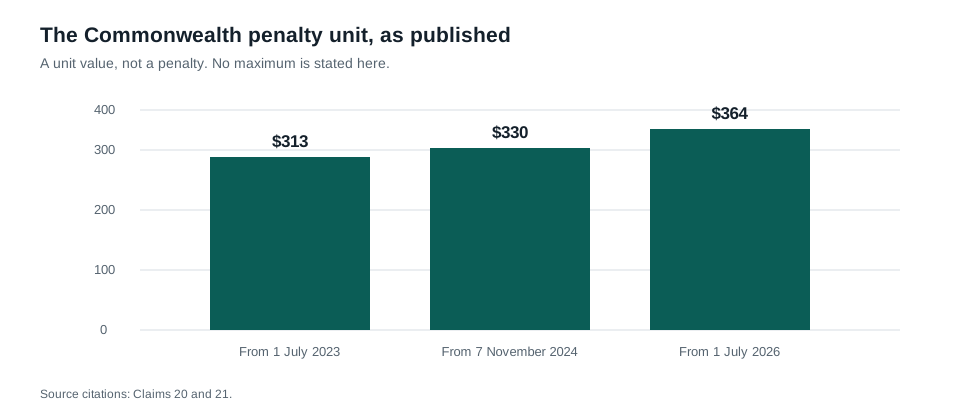
The same discipline applies to published figures. Claim 20 records that the Crimes (Amount of a Penalty Unit) Instrument 2026 sets the Commonwealth penalty unit at $364 for offences committed on or after 1 July 2026, and claim 21 records earlier values of $330 from 7 November 2024 and $313 from 1 July 2023 to 6 November 2024, attributed to AFSA. If a correspondent says one of those dates is wrong, the note should include the instrument or the AFSA page that carries the correction. Multiplying a unit by a number of units is arithmetic, not a published figure, and claim 22 is the reason the site does not publish a dollar maximum penalty under section 15. A note asking for that product to be printed as a sourced maximum would be refused even if the multiplication were neat.
Claim 25 is another useful example. It is a NOT PUBLISHED finding: no count of offshore operators serving Australia is published by any source reached, with ACMA publishing investigations, sites investigated, breaches and sites referred for blocking rather than a market size. A correspondent who has found a primary source that does publish such a count should identify the source, the date on which it was read, and the exact words used. A correspondent who has found a round number on an affiliate page has not supplied a replacement, because a search snippet, an affiliate site, casino marketing and a trade publication are not primary sources in this build. The desk would rather retain a blank than convert a marketing estimate into a fact.
Corrections to the treatment of conflicting material are also welcome, provided the note does not ask the desk to choose. Claims 48, 49 and 50 are SOURCES DIFFER findings. Claim 48 says no cumulative website-blocking total is available from any readable ACMA page, that a news report carries a total attributed to ACMA in general terms without naming a report, and that per-quarter figures at claims 44 to 46 may be cited at source. Claim 49 says two ACMA pages give different counts of services that left the market and a third gives a third framing, with "over 100", "Over 220" and "about 220 ... over eight years" all named and none presented as the figure. Claim 50 says two offshore-expenditure estimates in one ACMA document differ by about eight times, that ACMA notes the difference and does not reconcile it, and that no single number for Australian offshore spend may be stated. A good note on any of these says which source says what. A note that asks for one tidy number asks for the error the site was built to avoid.
Contact details are deliberately not invented here. No email address, form, response window or service level is published in this material as a fact. The address to use is not published in this page, so a reader should check the primary source held by Lucky Aussie Reels for the current contact channel, or use the site's ordinary contact route described in general terms on its own pages. That absence is not an invitation to guess an inbox from the domain, and it is not a promise that a message sent to a guessed address will reach anybody. The editorial point is the same as the factual point: if a channel has not been read from a primary source, it is not written as though it has.
How a correction is read
A correction is read against the claim slice that the page is allowed to use. On this site page, the permitted numbered material is claims 1-25, 26-53 and 156-165. Those claims cover the Interactive Gambling Act 2001 and online casino, ACMA's powers and published practice, and what a dispute is worth. A proposed sentence that relies on another slice is not rejected because it is unwelcome; it is rejected because this page does not hold the source base that would make it checkable. The desk keeps the layer separate so that a statutory provision and a named-party statement never end up sharing a sentence, a cell or a figure.
AT SOURCE claims may be stated when attributed, with the provision or publisher named. Claim 5 records that an online casino served to a person at home is a gambling service under paragraph (e), provided in the course of a business, over an internet carriage service, therefore prohibited under section 5(1), excluded by nothing in section 5(3), with no category for a licensed online casino in the Act. Claim 14 records that section 15AA is the licence route and online casino is not on it, because "regulated interactive gambling service" is defined by section 8E(1) as a closed list. Claim 15 records that a State or Territory licence cannot authorise an online casino served to a person at home, because the Commonwealth prohibition in section 15 applies regardless of any licence and section 15AA applies to a different closed class. Those are sentences of law read together, not a place for an editor to add a domestic licence that does not exist.
Claim 16 records ACMA listing banned services as "online casinos", "in-play sports betting", "sports betting services which do not hold an Australian licence" and "betting on the outcome of a lottery". Claim 17 records an ACMA compliance report describing prohibited interactive gambling services such as online casino services, including online slots, poker and roulette, and saying that online casinos providing slots, roulette, poker and other casino games are prohibited in Australia. Claim 18 records a Department of Infrastructure page describing prohibited interactive gambling services as including casino-style games such as online blackjack and roulette. A note about any of these should keep the publisher attached. ACMA saying a thing on an ACMA page is a citable fact; ACMA saying a thing in a paraphrase on somebody else's page is not the same record.
Claim 19 records that a "designated interactive gambling service" under section 4 means a prohibited interactive gambling service or an unlicensed regulated one, and that section 61DA prohibits broadcasting or datacasting such an advertisement in Australia while section 61EA prohibits publishing one. Claim 27 records that only an individual residing in Australia, a body corporate carrying on activities in Australia, or the Commonwealth, a State or a Territory may complain under section 19. Claim 37 records ACMA's 2020-21 report saying that winnings may not be honoured, that incentives and pressure tactics are used to target gamblers, that consumers who access these websites have little or no recourse, and that these services do not have the customer protections expected in Australia. Each of these has a source shape. The desk checks the shape before it checks the wording.
Claims 156 to 165 are read with the same care. Claim 156 records that a complaint to ACMA is a regulatory complaint, not a claim, and that nothing in Part 3 or Part 8 provides for a complainant to recover money or gives a complainant any remedy at all. Claim 158 records that BetStop's own route for an online casino complaint is ACMA and nothing else. Claim 159 records ACMA saying consumers who access these websites have little or no recourse. Claim 161 records a Queensland consumer page saying a consumer should talk to the business first and then, if unsatisfactory, lodge a complaint with the government agency that issued the provider's licence. Claim 162 records that Australian Consumer Law is stated to apply to gambling businesses on that Queensland page. A correction that uses claim 162 to assert a reader's rights against an offshore casino would be refused, because claim 163 records that no source reached says whether or how Australian Consumer Law is enforced against an offshore gambling operator with no Australian presence.
NOT PUBLISHED claims are read as findings of absence, not as invitations to fill the space. Claim 23 says no primary source states in terms that an Australian player commits no offence by using a prohibited service, and that a page may say the offences are written about providers but may not say it is legal to play. Claim 24 says no regulations under section 69A were located and no page may assert either that an agreement is unenforceable or that it is enforceable. Claim 51 says no ACMA page reached states that website blocking can be got round, and this sheet says nothing about how. Claim 164 says no Australian alternative dispute resolution scheme, ombudsman or arbitration body covering online gambling was located, and this sheet names none. Claim 165 keeps the agreement question open. Each one tells an editor what cannot be added, which is often more useful than a sentence that could be paraphrased into a mistake.
Use this small check before sending a correction. It records the arithmetic assumption only; it does not create a published fact.
Assumed qualifying amount: $1,000
Assumed multiple: forty times the bonus alone
Indicative turnover under the assumption: $40,000
AUD throughout. The ceiling the cashier does not publish stays unpublished.
What is not published
The clearest messages to the desk are often requests to add a figure that the source base does not carry. The answer is usually a short refusal with a claim number. Claim 25 is not a hidden market count waiting to be found in an affiliate paragraph: no count of offshore operators serving Australia is published by any source reached, and ACMA's investigations, sites investigated, breaches and sites referred for blocking are not a market size. The site will not print a number of offshore operators from that gap, and a correction asking for one needs a primary source that actually publishes the count.
Claim 52 records that ACMA publishes no register of offshore operators, no list of "safe" offshore operators and no rating of any operator. Its only register in this field is of licensed interactive wagering providers at claim 32, containing no casinos. A note saying that ACMA keeps a register, a safe list or a rating would therefore be wrong in three separate ways. A note saying that an operator is highly placed on an ACMA list would be wrong in a fourth, because there is no such list to be placed on. Claim 53 adds that the licensed interactive wagering providers page did not render a list on retrieval and no provider count could be read, so no page may state how many Australian licensed wagering operators there are.
Claim 142 records that no published figure for Australian deposits, withdrawal times or payout speeds at offshore casinos exists on this sheet, and that no page may state a withdrawal time for any operator or the offshore market, nor present a minimum deposit figure as anything other than a term an operator has stated for itself. That is why "published withdrawal time" is not a field here. A correspondent may point to an operator's own stated term with the exact page and date read, but a correction asking the desk to say that a market pays in a set window would be adding an estimate with the word "published" attached to it. The same restraint applies to payout speed language borrowed from a review site.
Claim 175 records that no page may state an RTP, a hit rate, a volatility or a maximum win for any named game title or any studio, because no such figure is on this sheet and the permission held in another build does not extend here. If the subject is a named game or studio, RTP, volatility and max win are not published by this material. A correction that supplies a number from a game sheet or a studio page would need that primary source added to the fact base before it could be used; it cannot be inserted into a sentence on this page by email. The refusal is about the record, not about whether the number might be true elsewhere.
Claim 187 records that no source states who operates the National Gambling Helpline, and that a page may not attribute the helpline to any organisation. So the operator of the helpline is not named in corrections, in rewritten sentences or in an aside. Lucky Aussie Reels can record the limitation without turning it into a label. A note that says a helpline operator must exist and then supplies one from memory is exactly the kind of plausible completion the claim exists to stop. The same list of refusals includes claim 22 on a dollar maximum penalty, claim 23 on player legality, claim 24 on agreement enforceability, claim 51 on blocking workarounds, claim 163 on Australian Consumer Law against an offshore operator, claim 164 on an Australian dispute body and claim 165 on the open agreement question. None of these gaps is a puzzle for a reader to solve in a message.
There is also material the site does not publish because the slice does not reach it. Claims 48, 49 and 50 are held as SOURCES DIFFER, with each source's account stated and no single number chosen. Claims 26 to 47 may be cited as ACMA material, but quarter figures stay attached to their own reports. Claim 44 records 187 websites referred to internet service providers for blocking in April to June 2026, claim 45 records 109 in January to March 2026 and claim 46 records 71 in July to September 2025. Adding those as a cumulative total would turn three sourced quarter reports into one unsourced total, which claim 48 forbids. A correction that asks for a grand total should say so plainly, and the answer will remain no.
Where to check first
Before sending a correction, check the primary source named by the claim. For statutory wording, the point-in-time compilation current at 1 January 2025, compilation date 14 October 2024, is the text base recorded for claims 1 to 19, 26 to 28 and 156 to 157. For the unit values, claims 20 and 21 name the 2026 instrument and AFSA. For ACMA practice, claims 33 to 47 name quarterly reports and compliance material. For what a dispute is worth, claims 156 to 162 name Parts 3 and 8, section 19, BetStop's own page, an ACMA compliance report, a 2017 government paper and a Queensland consumer page. A correction that begins with the source is already half checked.
Then check the label. AT SOURCE material can be stated with its provision or publisher attached. SOURCES DIFFER material can be stated as what each source says, with no winner selected. NOT PUBLISHED material can be stated as an absence, and nothing else. A note that asks for an AT SOURCE sentence to be softened into a general market truth, a SOURCES DIFFER line to be collapsed into one figure, or a NOT PUBLISHED gap to be filled with a plausible estimate is asking for a different fact base. The desk does not silently change the label to make a sentence easier.
Then check the boundaries. This page has no comparator section, no scorecard, no comparison table and no count of offers. It does not count operators, name a sponsor, list five operators or discuss placement. It does not print a contact address that has not been published in this material, and it does not state opening hours, response times or a service level. It does not describe how to get round a self-exclusion register, an identity check, a bank block or website blocking. Claim 51 says no ACMA page reached states that website blocking can be got round and this sheet says nothing about how. A message that includes a method is not treated as a correction, and no procedure is repeated back.
The licence position is stated once and kept separate from correspondence. The Interactive Gambling Act 2001 (Cth) has no category for a licensed online casino served to a person at home: claims 5, 14 and 15 are read together for that conclusion, with sections 4, 5, 8B, 8E, 15, 15AA and 69 in view. Claim 14 says the section 8E(1) list is closed and does not include online casino. Claim 15 says a State or Territory licence cannot authorise the service. This is not a comparison between a domestic licensee and an offshore one, because there is no domestic licensee for this product. It is a statement about what the Australian system does not contain, which is also why the site does not hold an Australian licence condition up as a measure of an offer.
Finally, check the tone. Write in Australian English, with "licence" as the noun, "organisation", "analyse" and "authorised" where those words belong. Use straight ASCII quotes and apostrophes. Avoid dashes, exclamation marks, invented testing, invented readers, star ratings, vote counts and promises. Do not say "guaranteed". Do not say "we tested" or "our team". Say what a source states, what a claim records, and what is absent. If the correction concerns a quote, give the quote; if it concerns a figure, give the number and the source; if it concerns a claim, give the claim number. That is enough for the desk to compare the words on the page with the words a primary source actually publishes.
FAQ
- What should a correction include?
- Include the sentence, the claim number, the exact replacement wording and the primary source that can be checked.
- Can I send a fix for a quoted law?
- Yes. Name the provision and the claim number, for example claim 1 and section 4, so the quote can be compared at source.
- Is a contact address published here?
- No. Check the primary source held by Lucky Aussie Reels for the current contact channel, or use the site's ordinary contact route described in general terms.
- Will the desk publish a withdrawal time?
- No. Claim 142 records no published withdrawal time for offshore casinos on this sheet, so a market timeframe is not added.
- Can I ask for one number where sources differ?
- No. Claims 48, 49 and 50 require each source's account to be stated without choosing a single figure.