A $1,000 bonus priced at forty times the bonus alone becomes $40,000 of counted stakes, and the assumption is stated in the same breath: AUD throughout, the deposit is not multiplied, and no assumed return is applied. At a $12.50 stake that is 3,200 counted stakes. Lucky Aussie Reels at luckyaussiereels.com uses this model to make the cost of an offer readable before a reader chooses it, while leaving out any guess about the outcome of the play.
What the model takes in
The model starts with a bonus amount, a wagering multiple and a stake. It does not start with a promise about winnings. The worked figure on this page is $1,000 of bonus money, a forty times requirement on the bonus alone, and a $12.50 stake. AUD is the currency for every amount on this page. The deposit is not added to the amount that carries the multiple. The calculation is therefore $1,000 multiplied by forty, producing $40,000 of counted stakes. Dividing $40,000 by $12.50 produces 3,200 counted stakes. Those four numbers are the whole of the arithmetic.
The reason the assumption sits in the opening paragraph is simple: the same headline bonus produces a different figure if the deposit is included. With a $1,000 deposit and a $1,000 bonus, forty times deposit plus bonus would be $80,000 of counted stakes, or 6,400 counted stakes at the same stake size. That is not the model used here. A reader can compare the two shapes without treating either as a prediction. Offers of this kind usually ask forty times, and the phrase "the bonus alone" is the part that decides which arithmetic applies. The page does not silently move between them.
Nothing in this model depends on a spin finishing in a particular time, on a sequence of wins and losses, or on a stated return. It is a turnover model, not a result model. A counted stake is a stake that the terms count toward the requirement. The page does not say how long it takes to place 3,200 counted stakes, because no timing input is held. It does not say what balance remains at the end, because no balance path is held. It does not say that the bonus cash can be withdrawn, because withdrawal terms are outside the inputs. What it says is that the amount to be counted is $40,000, and that at $12.50 each the count is 3,200.
That narrowness is deliberate. The cost a reader acts on is the size of the condition attached to the headline money. A page that mixes a bonus amount with an imagined balance path turns a condition into a forecast. A page that mixes a stake with a published payout speed turns a unit of arithmetic into a claim about an operator. The model keeps those apart. It writes the multiple, the base to which the multiple applies, the currency, the stake and the resulting count. It then stops.
The statutory background is cited where it is relevant to what a reader gives up by choosing outside the Australian system, and each such statement is attributed at source. Section 4 definition, paragraph (e) of the Interactive Gambling Act 2001 (Cth) includes a service for the conduct of a game played for money or value, of chance or mixed chance and skill, where a customer gives or agrees to give consideration (claim 1). Section 5(1) defines a prohibited interactive gambling service by reference to a gambling service provided in the course of carrying on a business and provided to customers using, among others, an internet carriage service (claim 2). Section 5(3) is a closed list of exclusions (claim 3). The only gaming exclusion is place-based, and section 8B(1) requires customers to be at a particular place, using electronic equipment made available at that place, with a State or Territory licence authorising provision at that place (claim 4). Read together, those provisions are why the site states that no Australian licence exists for this product (claim 5).
This section is about the inputs, not about the law of the offer. The legal point is carried here only because the phrase "this product" needs its provision named. It does not turn the $40,000 into a legal amount, and it does not turn 3,200 counted stakes into a legal duty. The arithmetic and the provisions sit in separate sentences. Lucky Aussie Reels cites claims by number, names the provision or publisher for an AT SOURCE statement, and keeps a NOT PUBLISHED statement to a bare statement that nothing is published. A source label is not used to smuggle in a number that the source does not print.
Commercial intent is plain. A reader arrives with a bonus figure in mind and wants to know how large the condition behind it is. That is why the first line carries $1,000 and $40,000 rather than a rule. The comparison that matters on a buying page is the cost of taking an offer from outside the system: terms can be read, but the Australian protections that would attach to a licensed product are absent. The interactive gambling framework is not used here to price a licensed wagering duty onto a casino offer. It is used to explain why the margin we assume must be published by us rather than read from an Australian licence condition.
The organisation name belongs to the site, not to the offer. The model is an editorial calculation written for Lucky Aussie Reels. It is not a term supplied by an operator, and it is not a figure that a cashier prints. Where an operator publishes a different multiple, or applies it to deposit plus bonus, the reader should use the operator's term. Where the operator publishes no term at all, the model on this page still shows what the usual forty times condition would mean, but it does not fill the empty field with a claim about that operator. The distinction is kept because the cost of an offer is the reader's decision, while the existence of a published term is a fact about what a supplier has made available.
The counted stakes figure also has a practical use before any play. It lets a reader compare a headline amount with a stake they are comfortable using. $40,000 at $12.50 is 3,200 counted stakes. At a smaller stake the count rises; at a larger stake the count falls. The total counted amount does not change. This is arithmetic that can be checked with a pencil, and it needs no hidden variable. The calculator below repeats the same four inputs so that a different bonus figure or stake can be entered without changing the assumption. It does not add an assumed return, because an assumed return would change the nature of the output from a turnover count to a balance estimate.
Finally, the model takes in no reader profile. It does not ask for a budget, a session length, a preferred game, a payment rail, a device or a location beyond the Australian currency context. It does not ask a reader to enrol in anything. It does not group readers into categories and it does not attach a score. A buying guide can be useful without pretending to know the person reading it. The most honest sentence in this section is the one that says what the calculation is not: it is not a forecast, a test, a review of a named game, or a statement of how an individual account will behave.
What the model leaves out
The most important omission is an assumed return. No return to player percentage, volatility, hit rate or maximum win is used for a named game, and no such figure is printed for a studio. These are not rounding choices. They are absent inputs. A turnover calculation can be exact with them absent: the amount to be counted is set by the multiple and the stake. A balance calculation cannot be exact without them, and it would also need a sequence of outcomes. Adding a single average return to hide that sequence would produce a number that looks precise and is not a published term. The page declines to manufacture it.
The deposit is also left out of the multiplied base. This is not the same as saying a deposit is irrelevant to the reader's cash position. A deposit is money the reader pays in, and it matters. It is left out because the stated assumption is forty times the bonus alone. If an offer applies the multiple to deposit plus bonus, the figure changes, as shown above. If an offer publishes another base, the reader can change it in the calculator. What the page will not do is write "$40,000" from a bonus-only assumption and then discuss the result as if the deposit had been included. That would make the standfirst false by the third paragraph.
Timing is left out. No spin speed is held, so the page cannot say how many minutes 3,200 counted stakes represent. No published withdrawal time is held, so it cannot say when a completed requirement would be paid. No deposit minimum is presented as a market figure, because a minimum deposit is an operator's own stated term when it is published at all. No payout window is attached to the calculator. A reader looking for a time estimate will not find one here, and the reason is not caution about wording. It is that the input does not exist in the model and, for the matters listed in the next section, nothing is published.
Game identity is left out. The page does not name a title, a studio, a feature or a prize ceiling. It does not say that one game counts fully toward a requirement while another counts partly, because that is a term an operator may publish and this page has no such term in its inputs. It does not say that a game has a particular behaviour over 3,200 plays. The word "stake" here is a unit of counted turnover, not a description of a title's settings. This keeps the arithmetic honest and keeps the page away from game facts that are not on the sheet.
Loss is not modelled as a path. The page says a requirement of $40,000 of counted stakes exists; it does not say how much of that amount a reader will lose. It does not use "risk" beside "free", and it does not call any part of a bonus free once a condition has been attached. It does not say what a session will feel like, how a balance will move, or what a reader should do after a particular outcome. Those are not inputs, and turning them into advice would move the page away from the figure the reader came to cost.
The model also leaves out the ranking. Nothing here points at a placement, a count of offers, a score, a chip list, a licence label, a supplier's copy, a paid sequence, or a disclosure about any of them. This is a site page, and it carries no board. It does not need a lead-in, and it does not carry one. It does not explain that its prose is independent of a commercial block, because a sentence about the page rather than the offer is a sentence to cut. The reader is here for the margin, not for furniture.
It leaves out a table. There is no editorial comparison table and no scroll wrapper on this page. There is no row of operators, no column of stated terms, no currency conversion, no licence claim in a cell, and no note attached to a grid. The absence is not announced to the reader as a gap in the service. The cost model is complete without a table because its inputs are few and are printed. A table would invite a reader to treat the $40,000 as one brand's term rather than as a stated assumption applied to a kind of offer. That would be a false comparison.
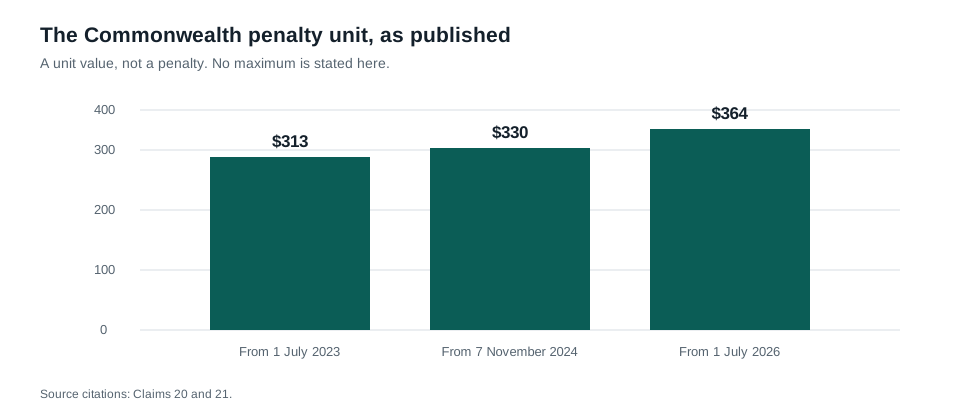
It leaves out a regulator's dollar maximum. The Crimes (Amount of a Penalty Unit) Instrument 2026, made under section 4AA(1A) of the Crimes Act 1914, publishes $364 for an offence committed on or after 1 July 2026 (claim 20). The previous values are $330 from 7 November 2024 and $313 from 1 July 2023 to 6 November 2024, as AFSA publishes them (claim 21). Section 15(1) of the Interactive Gambling Act 2001 states 5,000 penalty units and section 15(2A) states 7,500 penalty units (claims 6 and 7), and sections 15(2) and 15(2B) make both run per day (claim 8). Those are units and unit values. Multiplying them is arithmetic, not a published dollar maximum, and this page does not publish the product as a sourced figure. Claim 22 says nothing is published on that dollar maximum, and that is the whole of the statement.
It leaves out conduct advice. The page does not describe a way past a self-exclusion register, an identity check or a bank block. It does not name a mirror, a proxy, a second account, a document workaround, or a change of payment route. It states consequences where a primary source states them and stops. If a reader could follow a sentence as an instruction to get round a control, that sentence has no place here. The test is applied to the framing as well as the sentence list. Silence about method is not an invitation to look for one.
SOURCES DIFFER material is left unresolved where the sheet requires it. Claim 48 records that no cumulative website-blocking total is available from a readable ACMA page, that a news report carries a total attributed to ACMA in general terms without naming a report, and that per-quarter figures at claims 44, 45 and 46 may be cited at source. Claim 49 records that two ACMA pages give different counts of services that left the market and a third gives a third framing, and that none is to be presented as the figure. Claim 50 records two offshore-expenditure estimates in one ACMA document that differ, ACMA's note that it does not reconcile them, and a separate 2017 paper estimate, with no single number to be stated for Australian offshore spend. The page names what each source says only where it needs the shape of the disagreement, and it does not choose between them. No cumulative total, no single exit count and no single spend figure is printed here.
The figure below belongs to this discipline. Its caption states a unit value and not a penalty, and says why no maximum is printed. The drawing is not a comparison of offers, not a forecast of a balance, and not a chart of a game's behaviour. It is a reminder that a published unit is one thing and a computed product is another. The same distinction governs $1,000, $40,000, $12.50 and 3,200: all four are printed because the assumption that produces them is printed. A figure that required a hidden assumption is not printed at all.
What remains after all those omissions is narrow and useful. A reader can see the base, the multiple, the currency, the stake and the count. A reader can see that no return has been smuggled into the output. A reader can see that the deposit has not been multiplied. A reader can see that no game figure, timing figure, payout figure or operator figure has been invented to make the result more dramatic. The margin we assume is not a hidden margin. It is the stated distance between a headline amount and the turnover condition attached to it.
What is not published
Some of the most useful lines on this page are negative. They stop a writer from filling a quiet field with a plausible number. For each item below, nothing is published. That is the statement. No value, no range, no average, no substitute from another market, no estimate from a neighbouring product, and no explanation that turns the absence into a hint is added.
Nothing is published as a dollar maximum penalty under section 15 of the Interactive Gambling Act 2001 (claim 22). Nothing is published in terms that an Australian player commits no offence by using a prohibited service; claim 9 is a reading of the Act's structure, and claim 23 keeps the sentence at that limit (claim 23). Nothing is published as regulations under section 69A, so no page may assert either that such an agreement is unenforceable or that it is enforceable (claim 24). Nothing is published as a count of offshore operators serving Australia (claim 25).
Nothing is published by any ACMA page reached stating that website blocking can be got round, and this page says nothing about how (claim 51). Nothing is published as a register of offshore operators, a list of "safe" offshore operators or a rating of any operator; ACMA's only register in this field is of licensed interactive wagering providers, containing no casinos (claim 52). Nothing is published as a provider count on the licensed interactive wagering providers page when read for this sheet (claim 53). The model does not use any of those gaps as a selling point. A gap in a public register is not a feature of an offer.
Nothing is published on how many operators are connected to BetStop (claim 80). Nothing is published quantifying how many offshore casinos accept registered individuals, and nothing supports a claim that any proportion do; the published point is the scope rule, not behaviour (claim 81). Nothing here describes how a registered individual could gamble, and no method from the sources found during the build is reproduced (claim 82). These three statements sit together because the page's framing is under test. It may say that BetStop registration does not, by its own terms, reach an offshore casino. It may not turn that into a route, a reassurance, or an advertisement for absence.
Nothing is published as an instrument made under section 15C(4A)(d), so no page may say any method beyond the statutory list is covered (claim 94). Nothing is published stating that a bank must block a gambling transaction, and no named bank is said to offer or not offer one (claim 95). Nothing is published in the Commonwealth gambling reforms page's "Last updated" field as a date, beyond the implementation dates the page states (claim 103). Nothing is published here from State and Territory inducement statutes, no section from them is cited, and no penalty for an inducement breach is stated (claim 104).
Nothing is published here about any other State or Territory's machine numbers, losses or harm measures beyond the New South Wales material recorded in the sheet (claim 131). Nothing is published naming which State or Territory licenses a land-based casino or on what terms, and no casino licensing regime is named (claim 132). Nothing authoritative is published about PayID as a gambling payment method (claim 138). Nothing authoritative is published about Neosurf as a gambling payment method (claim 139). Nothing is published as a scheme rule from Visa, Mastercard, Apple Pay or Google Pay about Australian gambling (claim 140). Nothing is published as a list of banks offering gambling blocks (claim 141). Nothing is published as a figure for Australian deposits, withdrawal times or payout speeds at offshore casinos on this sheet (claim 142).
Nothing is published resolving how far the AUSTRAC phrase "all online gambling service providers" reaches an offshore operator with no Australian presence (claim 146). Nothing is published stating what an offshore casino does or does not verify (claim 147). Nothing is published addressing winnings from a gambling service unlawful to provide in Australia, so no page may state that winnings from an offshore casino are tax-free in Australia (claim 154). Nothing is published on the deductibility of gambling losses for an individual (claim 155).
Nothing is published saying whether or how Australian Consumer Law is enforced against an offshore gambling operator with no Australian presence; the page may not say a reader has such rights against an offshore casino, and may not say they have none (claim 163). Nothing is published naming an Australian alternative dispute resolution scheme, ombudsman or arbitration body covering online gambling, and this page names none (claim 164). Nothing is published resolving whether an agreement with an offshore casino is enforceable or whether civil proceedings lie to recover money; the question stays open (claim 165).
The game and timing gaps are stated here without figures, as required. Nothing is published as a minimum return to player percentage for Australia (claim 171). Nothing is published as a minimum game cycle time, spin duration or spin speed figure (claim 172). Nothing is published as a maximum bet per game and no loss limit is published (claim 173). Nothing is published as an RTP, spin speed, stake cap or loss limit binding any online casino serving Australia (claim 174). Nothing is published as an RTP, a hit rate, a volatility or a maximum win for any named game title or any studio (claim 175).
Those five items matter directly to the cost model. They are the reason the calculator has no return field, no spin duration field, no stake ceiling field, no loss limit field and no game title field. They are also the reason the standfirst says "no assumed return" rather than naming a percentage. The page is not saying an operator has no figures of its own. It is saying this sheet has no published Australian figure to put into the model, and that an invented one would be a defect. The honest output is a turnover count, not a dressed-up forecast.
One more absence belongs beside the calculator. Claim 142 says nothing is published for withdrawal times, payout speeds or deposit minimums as market figures on this sheet. The page therefore carries no published withdrawal time and no minimum deposit input. It does not present a deposit minimum as anything other than an operator's own stated term where such a term exists. Since the calculator is an editorial calculation and not an operator's form, it has no such term to print. The absence is not softened with "typically", "most operators" or a category truth attached to a specific thing.
AT SOURCE statements in this build are different in shape. Where a provision or publisher is named, the statement is attributed and the claim number is given. Section 21(1) says ACMA may investigate on its own initiative or on a complaint under Division 1 (claim 26). Section 19 says only an individual residing in Australia, a body corporate carrying on activities in Australia, or the Commonwealth, a State or a Territory may complain (claim 27). Part 8's toolkit is civil and administrative, not compensatory, and includes formal warnings, civil penalty enforcement, infringement notices, injunctions, enforceable undertakings, remedial directions and continuing contraventions (claim 28). ACMA states that consumers who access these websites have "little or no recourse", that "Winnings may not be honoured, and incentives and pressure tactics are used to target gamblers", and that the services "do not have the customer protections we expect in Australia" (claim 37, ACMA 2020-21 compliance report). The same report records that ACMA contacted 52 software providers and providers of local payment services (claim 38). Nothing in Part 3 or Part 8 provides for a complainant to recover money, and no provision found gives a complainant any remedy at all (claim 156).
Those statements are not converted into a dollar value for a dispute. A regulatory complaint is not a claim, and the page does not price one. It also does not say that a reader has or has not got Australian Consumer Law rights against an offshore casino, and it does not say that an agreement is or is not enforceable. It does not say it is legal or illegal for a player to use an offshore casino. The cost of sitting outside the system is stated as what is absent: no Australian licence condition for this product, no Australian technical standard attaching to one, no published withdrawal time, and no Australian body named here that will hear a dispute against an offshore casino. That is a buying consideration, not a verdict about the reader.
How the margin is calculated
The calculator below uses the same four inputs as the standfirst. It reads a bonus amount, a wagering multiple, a stake and a choice of base. On this page the base is set to bonus alone. It returns the counted turnover and the number of counted stakes. It does not return a projected balance, a session length, a win figure, a loss figure, a payout date or a score. The output is a restatement of the assumption in a form a reader can change.
Bonus $1,000 Multiple 40x Base bonus alone Stake $12.50 AUD throughout
Counted turnover: $40,000. Counted stakes: 3,200.
Deposit is not multiplied. No assumed return is applied. No volatility, RTP, hit rate or maximum win is used for a named game.
The phrase "forty times the bonus alone" is the shortest statement of the method. It fixes two things at once. "Forty times" fixes the multiple. "The bonus alone" fixes the base. Together they produce $40,000 from $1,000. If the base changes, the result changes. If the stake changes, only the count changes. If the currency changes, the page would have to say so at the top. Keeping those relationships visible is more useful than adding another output, because a reader can see which part of the sentence is doing the work.
Suppose a reader enters a $500 bonus with the same multiple, base and stake. The counted turnover is $20,000 and the count is 1,600 counted stakes. Suppose the stake is changed to $25.00 while the counted turnover stays at $40,000. The count is 1,600 counted stakes. Suppose the multiple is changed to thirty. The counted turnover is $30,000 and the count is 2,400 counted stakes at $12.50. Each result is a product or a quotient of the printed inputs. None requires a hidden parameter. None is sourced to an operator. None is a statement about a named game.
The calculator is also where the deposit exclusion is easiest to check. A $1,000 deposit sits outside the multiplied base on this page. It may matter to a reader's own budgeting, but it does not enter the $1,000 x 40 line. A reader who wants to model deposit plus bonus can change the base and see $80,000 from a $2,000 base at forty times. That alternative is arithmetic too. It is not the assumption printed in the standfirst, and the page does not drift back to it when discussing the result. The two shapes are kept separate so the reader can compare offers with different terms without mistaking one for the other.
The $12.50 stake is used because it divides $40,000 cleanly into 3,200 counted stakes. Clean division is a presentation choice, not a claim that a stake of that size is available, permitted, wise or common. Nothing is published here as a stake cap, and no minimum stake is imported from a venue standard or from another market. The figure is a unit in a division. Its job is to make the count legible. If a reader substitutes another stake, the counted turnover remains the figure set by the multiple and the base.
Counting stakes is not the same as counting time. A page can say 3,200 counted stakes because it has $40,000 and $12.50. It cannot say how long those stakes take, because no spin speed is published here and no session pattern is held. It cannot say how many counted stakes will be needed after a particular run of outcomes, because no outcome sequence is held. It cannot say that every stake placed will be counted at full value, because that is a term an operator may publish and this sheet does not hold it. The calculator's count is a conversion of turnover into units of the chosen stake, nothing more.
The Commonwealth penalty unit figure is nearby because it teaches the same discipline in a different field. The Crimes (Amount of a Penalty Unit) Instrument 2026 publishes $364 for offences committed on or after 1 July 2026 (claim 20), and AFSA publishes $330 from 7 November 2024 and $313 from 1 July 2023 to 6 November 2024 (claim 21). The Interactive Gambling Act 2001 states penalty units, including 5,000 units in section 15(1) and 7,500 units in section 15(2A) (claims 6 and 7). Publication of a unit value is not publication of a dollar maximum. Multiplication would be ours, not the source's. The calculator is allowed to multiply because it is labelled as our model and its assumption is printed in the same paragraph as the money. A sourced claim is not allowed to multiply because the result would be presented as though a primary source had printed it.
That distinction is the reason this page has a title about an assumed margin at all. The margin is not a fact found on a register. It is the distance created by a modelling choice, and the choice belongs to the organisation that publishes the page. Lucky Aussie Reels states the choice in the opening paragraph, repeats it in the calculator, and repeats the exclusions in the section about what is not published. A reader can reject the assumption, change it, or compare it with an operator's own term. What a reader cannot be asked to do is treat the output as a sourced fact about an operator, a game, a regulator or a payment system.
The page also keeps commercial intent intact. It helps a reader choose by making the condition behind a headline amount visible. It does not say "best casino" as a promise, does not carry a superlative in the body, does not use "guaranteed", does not say "we tested", "our team", "we played" or anything of that kind, and does not invent readers with stars, votes or review counts. It cites, models and calculates. It does not play. The language stays in Australian English: licence as the noun, analyse, organisation, authorised, programme nowhere, and program only where software would require it. Every quote mark and apostrophe is ASCII. There are no em dashes, no en dashes, no double hyphens and no exclamation marks in the prose.
Where a claim is AT SOURCE, the provision or publisher is named. Where claims differ, the page states what each source says and chooses none. Claim 48: no cumulative website-blocking total is available from any readable ACMA page, while a news report carries a total attributed to ACMA in general terms without naming a report; per-quarter figures at claims 44, 45 and 46 may be cited at source. Claim 49: one ACMA page says "over 100", another says "Over 220", and the 2024-25 report says "about 220 ... over eight years"; none is presented as the figure. Claim 50: one ACMA document carries GBGC US$175 million for 2020 and H2 Gambling Capital A$1,475 million for 2020, ACMA notes the difference and does not reconcile it, and the 2017 paper says the Review estimated "could be as high as $400 million annually"; no single number for Australian offshore spend is stated. The calculator uses none of them.
The limits of the calculation
The first limit is that a turnover count is not a cost in dollars lost. $40,000 of counted stakes is a condition to be met, not a bill payable in forty thousand dollars. It is printed in dollars because stakes are denominated in AUD, and it is described as counted turnover so that it is not mistaken for a deposit, a fee, a loss or a withdrawal. A reader who wants a budget decision needs more than this page holds. The page does not pretend otherwise. It gives the condition, the unit of stake and the count, then leaves the personal budgeting to the reader.
The second limit is that "no assumed return" is not a claim about any game. It is a statement about this model. The page has no RTP, hit rate, volatility or maximum win for a named game title or studio, and it prints none. It has no spin speed, no stake cap and no loss limit for online play in Australia. Those gaps are recorded in claims 171 to 175 as nothing published, without numbers. An operator may state its own figures in its own terms; this page neither repeats them nor denies them. It simply has no Australian published parameter to attach to a licence condition for this product, because no Australian licence exists for this product.
The third limit is that the statutory material does not become an offer term. Section 15AA(1) is a separate offence for services that can be licensed, with 5,000 units, and section 15AA(3) states a civil penalty of 7,500 units (claim 13). Section 8E(1) defines "regulated interactive gambling service" as a closed list, and an online casino is none of it (claim 14). Section 15 applies regardless of any such licence, section 69 preserves concurrent State law but does not create a category the Commonwealth has prohibited, and the sentence every page rests on is that a State or Territory licence cannot authorise an online casino served to a person at home (claim 15). ACMA lists banned services as "online casinos" among others (claim 16), and its compliance report describes online casino services targeting Australians in the same way (claim 17). None of that gives a wagering multiple, a stake, a bonus amount or a payout window.
The fourth limit is that a complaint route is not a compensation route. Section 21(1) gives ACMA power to investigate (claim 26), section 19 limits who may complain (claim 27), and Part 8 lists civil and administrative tools rather than compensation (claim 28). BetStop's own route for an online casino complaint is ACMA and nothing else (claim 158, drawing on claim 60). ACMA describes consumers who access these websites as having "little or no recourse" (claim 159). The 2017 Commonwealth paper says there is "limited legal recourse if they run into any difficulties obtaining winnings or deposits" (claim 160). Queensland's consumer page sets out the complaints route that does work for licensed operators, through the agency that issued the provider's licence (claim 161). Nothing here names an Australian body that will hear a dispute against an offshore casino, because none was found (claim 164). The calculator has no field for a dispute and no output that prices one.
The fifth limit is that the page does not write about player conduct or contract status. Section 15 is written about the provider, and no offence or civil penalty provision directed at a customer for using a prohibited service was found (claim 9). Nothing is published in terms that an Australian player commits no offence by using a prohibited service (claim 23). Nothing is published under section 69A that would let this sheet resolve enforceability (claim 24), and claim 165 keeps that question open. Nothing is published saying whether or how Australian Consumer Law is enforced against an offshore gambling operator with no Australian presence (claim 163). The page does not say it is legal or illegal for a player to use an offshore casino, does not say an agreement is or is not enforceable, and does not say a reader has or has not got Australian Consumer Law rights against an offshore casino.
The sixth limit is the safety line. BetStop says in its own words that "BetStop - the National Self-Exclusion Register does not apply to online casino games or other gambling services that are illegally provided in Australia. You can make a complaint about these services to the ACMA" (claim 60, BetStop about page). Section 61GB defines "licensed interactive wagering service" by reference to a wagering service, an Australian-customer link and not contravening section 15AA(3) (claim 58), and the consequence is that BetStop's obligations reach only Australian-licensed online and phone betting operators (claim 59). Nothing is published quantifying how many offshore casinos accept registered individuals (claim 81), and nothing here describes how a registered individual could gamble (claim 82). The page states the scope rule as a consequence and describes no procedure. It does not say an offshore casino will accept a registered person, nor that any of them checks, nor that any of them does not. It does not let "not on BetStop" read as a feature.
The seventh limit is that payment and identity material is not used to add colour to the model. Section 15C is addressed to a person providing "a regulated interactive gambling service that is a wagering service"; read with section 8E it means a licensed Australian betting operator, and section 15C does not bind an offshore online casino (claim 91). Section 15C(4A) lists a credit card, an account or service or facility in which payment is made from a credit card linked to it, digital currency, and a method determined by the Minister by legislative instrument (claim 87). No instrument under paragraph (d) was located (claim 94), and no primary source states that a bank must block a gambling transaction (claim 95). AUSTRAC states that from 29 September 2024 all online gambling service providers must complete the applicable customer identification procedure before creating an online gambling account or commencing to provide any designated service (claim 143). Nothing is published resolving how far that phrase reaches an offshore operator with no Australian presence (claim 146), and nothing is published stating what an offshore casino does or does not verify (claim 147). The calculator asks for none of it and prints none of it.
The eighth limit is that the page does not settle a disagreement between sources. Claim 122 records that the 14 October 2024 compilation and the 2026 amending Act are two documents with two dates and do not describe the same law; no compilation incorporating the 2026 Act was located, and a page must either quote the compilation as it stands or quote the amending Act and say the change commences 1 January 2027. Claim 123 records that the register page for the 2026 Act shows 26 August 2026 beside the citation but did not label it the assent date, while the Act's own text does; the Act's text is cited for the assent date. Claim 79 records that the Department of Social Services page describes the register as allowing consumers to exclude themselves from "all interactive gambling services in Australia", BetStop's own about page says it does not apply to online casino games or other gambling services illegally provided in Australia, and section 61GB is a third reading; the sheet does not resolve which the department meant. This page quotes BetStop's wording where it needs the scope rule and does not rest on the department's phrasing alone. It does not present the two as saying the same thing.
After those limits, the buying use is still clear. A reader can take the headline amount, check the multiple, check what the multiple applies to, choose a stake, and see the count. A reader can then compare that condition with the operator's own terms and decide whether the offer is worth pursuing. That is a practical comparison, and it does not require the page to invent a return, a speed, a ceiling, a payout time, a game figure, a dispute value or a licence label. The margin we assume is the part we publish. The parts we do not publish stay out of the calculation.
- What does forty times the bonus alone mean?
- It means the multiple applies to the bonus only. On this page, $1,000 x 40 gives $40,000 of counted turnover in AUD, with the deposit not multiplied.
- Why is the stake $12.50?
- It is the chosen unit for the count. $40,000 divided by $12.50 gives 3,200 counted stakes. It is not a published stake cap or a minimum stake.
- Does the model use an assumed return?
- No. No assumed return, volatility, RTP, hit rate or maximum win is used for a named game, and no balance path is printed.
- Is a withdrawal time or deposit minimum included?
- No. Nothing is published here for withdrawal times or payout speeds, and no minimum deposit is presented as a market figure.
- Can the output be treated as a forecast?
- No. It is a turnover count from stated inputs. It is not a predicted balance, a session length, a test result or an operator term.