The money question starts with the figure a reader acts on: a $1,000 bonus at forty times the bonus alone means $40,000 of turnover before the bonus is treated as withdrawable, with a ceiling the cashier does not publish and AUD throughout. Lucky Aussie Reels is paid for placement, and that payment buys position, not a finding about value, safety, speed or outcome. This page sets out what is bought, what is supplied, what is editorial, what is disclosed, and what is left alone.
What is paid for
Paid placement is the commercial base of this site. An offer supplier pays for a slot, and the site publishes that slot in a fixed sequence. Payment does not purchase an editorial conclusion, a legal characterisation, a licence label of this site's making, a calculated return, or a sentence in the guides. It purchases visibility in a commercial block whose order is set by the arrangement. The distinction matters because a reader who sees a large figure at the top of a commercial block may reasonably infer that somebody compared it with the figures below and decided it was worth more. No such inference is licensed here. The sequence was bought. It is a permanent feature of any arrangement built this way, not a comment on whatever stands in it today.
The organisation behind the site is Lucky Aussie Reels, on the domain luckyaussiereels.com. The site carries buying guides for readers who arrive searching for offers, and the guides cost those offers on stated assumptions rather than on a promise. Commercial income is disclosed here rather than folded into the language of review. Where a page models a bonus, it states the multiple, what the multiple applies to, the currency, and the missing ceiling. Where a page cites a law, a regulator, a register or a published report, it does so by claim number and names the provision or publisher. Where a supplier sends a figure, the figure is printed as supplied and is not held against any cited source as though the source had verified it.
Disclosure has a narrow job. It tells a reader that an interest exists and where that interest sits. It does not convert an advertisement into analysis, and it does not make an analysis less exact because an advertisement appears beside it. A paid slot remains a paid slot even when the wording is polite. An editorial calculation remains a calculation even when the reader reached it by scrolling past a paid slot. Saying both things plainly is more useful than a general warning at the foot of a page, because the reader can see which part of the document the interest attaches to.
The site does not claim that payment has no effect on what a reader notices. Placement affects attention; that is why it is sold. What payment does not do is authorise a factual assertion. The commercial block carries the supplier's copy, the supplier's figures, the supplier's licence label as supplied, the supplier's chip list, the supplier's button, and a score supplied as editorial. The rest of the site carries method, arithmetic, citations and stated gaps. Separation is maintained at the level of the sentence: a supplied bonus figure is not rewritten to make it agree with another line, and a cited statutory provision is not used to dress a supplied figure as a regulated term.
Consider the ordinary arrival. A reader searches for a bonus, lands on a guide, sees a calculation built on forty times the bonus alone, and then sees a commercial block. The calculation does not tell the reader which offer to choose. The commercial block does not tell the reader what the calculation assumed. This page explains the money behind the second thing. The first thing is explained on the pages that model margin, reading and limits. The arrangement is simpler than the vocabulary often used around it: space is sold, copy arrives, copy is displayed, the click is routed through a cloak, and the arrangement is disclosed here.
No agreement is made here about what a reader should do with a paid entry. A buying guide helps a reader choose; disclosure helps the reader know what kind of material is in front of them. Those are different services. The first is editorial, and it is answerable to the assumptions printed with it. The second is commercial, and it is answerable to the question of whether the interest was named before the reader had to guess. Lucky Aussie Reels names it here, in one place, with the mechanics attached, so that other pages can stay about the offer class rather than about the site's own bookkeeping.
The site also keeps a clear line around counting. Counting the paid entries, ranking them by their supplied numbers, or describing their order as a result would import a method that is not used. The order is supplied by the commercial arrangement. The numbers are supplied by the operator. The score is supplied as editorial. A reader is entitled to know each of those three things, and is not entitled to be told that the site produced a comparison it did not produce. That is why this page says what was bought, what was copied, and what was composed here.
The ranking and its numbers
This is the only page on Lucky Aussie Reels that names the ranking. It does so because the money disclosure cannot be complete without naming what is sold. The container is rendered by the shortcode The offers in this block are advertising. Placement is paid. Copy is supplied by the operator and is printed unaltered. More at How this site is paid. The arrangement is itemised at How this site is paid.
The ranking carries five operators. Their supplied figures are configuration, and they are printed verbatim where the board renders, including the inconsistencies that a copy editor would otherwise want to tidy. The money chips read 4000 A$, 5000 A$, 7400 A$, $11,400 and 5200 A$. The spin chips read 1200 FS, 250 FS, 255 FS, 270 FS and 150 FS. The supplied review counters, in the map's descending order, are 6990, 6441, 5113, 5041 and 4644. A separate header Appendix H1 records one card as carrying 5669 votes against $11,400 and 270 FS, which is a further supplied inconsistency and is not reconciled here. Every card reads 5/5. That score separates nothing, and the site does not present it as a measurement.
One supplied money chip reads 7400 A$ while that card's first offer line reads 600% up to $4800 + 255 free spins. One spin chip reads 150 FS while that card's first offer line reads 1500 free spins plus another 100 free spins on a later line. One offer line carries two exclamation marks. One third offer line has no space between a figure and its currency. A fifth card is internally consistent and establishes the convention the others are measured against. These are open supply defects, recorded and not corrected. The site does not invent a value onto a card to fill a gap, does not convert a currency, does not tidy capitals, and does not add a licence jurisdiction. Verbatim supply is part of the disclosure: the copy is the supplier's, with its own defects still visible.
The five partner names are not printed in page prose anywhere on the site, and they are not printed here. They appear only inside the board cards, where the plugin renders them from its own store. Their wordmarks and supply strings are configuration too. The page prose never names an operator from that set, never uses a wordmark as shorthand, and never turns a supplied name into an illustration in an editorial sentence. This is not coyness. It is the boundary between Layer 2, the sponsored board, and the editorial pages, and the boundary is what allows the disclosure to stay exact.
The buttons use a cloak. A served page carries a local path of the form /go.php?slot=royalxo/, /go.php?slot=caswino/, /go.php?slot=hellspin/, /go.php?slot=betmica/ or /go.php?slot=slotsgem/, or the equivalent numbered path. The five tracked destinations are held as opaque strings in the plugin store and are not printed in any document. The raw host is not printed here. The plugin reads the slot parameter, resolves it against a strict white-list, issues one 302 Location header, and exits. It bootstraps no WordPress and emits no HTML. The release check compares the Location header with the stored string byte for byte, because a mistyped destination still resolves and can fail silently. A served document containing the tracked host has leaked past the cloak.
The cloak is a routing mechanism and a paid-placement control, not a claim about the destination. The anchor carries a sponsored relation. The button's visible text is supplied. The alt text is generic. The payment logo strips are drawing tokens resolved by the drawing resolver, not typed text and not a list of methods endorsed by this site. Where a strip is absent in supply, it renders absent. Where a card carries no supplied strip, nothing is invented to make the row look complete. The board's single shared disclaimer sits with the board. This page's disclosure sits here.
The scorecard is a live commercial object. Offers are swapped, terms move, a cashier drops a payment method, and a replacement slot can be rotated in the plugin's map without regenerating the editorial pages. That is why the rest of the site carries method rather than a sentence about whatever stands in the scorecard today. It is also why this page, and only this page, can state the standing facts: five slots, paid sequence, unaltered supplier copy, editorial 5/5, supplied counters, supplied figures, and a local cloak path. Those facts describe the arrangement, not the merits of a current entry.
What the disclosure covers
Disclosure here covers the interest, the unit of sale, the supplied fields, the editorial fields, the outbound routing, and the separation between them. It does not cover a promise that the reader will win, that a figure will be honoured, that a withdrawal will arrive in a stated time, or that any Australian body will hear a dispute about an offshore casino. Claims 156, 159 and 164 are explicit: a complaint to ACMA is a regulatory complaint and not a claim; ACMA describes consumers who access the websites as having little or no recourse; and nothing is published naming an Australian alternative dispute resolution scheme, ombudsman or arbitration body covering online gambling. The commercial interest sits inside those limits. It is not a substitute for a protection that the cited record does not publish.
The disclosure also covers what the site does not hold itself out as doing. It does not say that it tested a game, played an offer, verified a cashier first hand, or counted votes of its own. It does not say a reader rated an operator. It does not say an offer is the best casino as a promise. It does not say that a bonus is guaranteed. It models, calculates and cites. It says when a figure is an operator's own stated term, when a figure is a supplied chip, when a figure is a unit value from a public instrument, and when nothing is published. The vocabulary is deliberately plain because a commercial page has a strong incentive to make an absence sound like a reassurance.
Claims 22 to 25 are NOT PUBLISHED, and each is handled as a gap rather than a sentence. No primary source states a dollar maximum penalty under section 15 of the Interactive Gambling Act 2001 (Cth). Nothing is published in terms about an Australian player's use of a prohibited service. No regulations under section 69A were located, so nothing is published here on whether an agreement with an offshore casino is enforceable or unenforceable. No count of offshore operators serving Australia is published by any source reached. Claims 51 to 53 are the same kind of record: nothing is published about getting round website blocking; ACMA publishes no register of offshore operators, no list of safe offshore operators and no rating of any operator; and the licensed interactive wagering providers page did not render a list, so nothing is published as a provider count.
Claims 163 to 165 sit beside that set. Nothing is published on whether or how Australian Consumer Law is enforced against an offshore gambling operator with no Australian presence, so the site neither grants nor denies ACL rights to a reader in that position. Nothing is published naming an Australian body that will hear a dispute against an offshore casino. Nothing is published resolving whether civil proceedings lie to recover money, because claim 24 leaves the regulation question open. Those limits are not softened by the existence of a paid block. A payment to this site buys a slot; it does not create a regulator, a forum, a remedy, or a published answer where the record records an omission.
Claims 48, 49 and 50 are SOURCES DIFFER, and the site names both sides without choosing. Claim 48 records that no cumulative website-blocking total is available from any readable ACMA page, while a news report attributed a total of 1,338 restricted gambling and affiliate websites to ACMA in general terms; per-quarter figures are cited at source and the cumulative figure is not stated as sourced. Claim 49 records three framings of services that left the market: "over 100" on the Act page, "Over 220" on the interactive gambling landing page, and "about 220 ... over eight years" in the 2024-25 report. None is presented as the figure. Claim 50 records two offshore-expenditure estimates in one ACMA document, GBGC US$175 million for 2020 and H2 Gambling Capital A$1,475 million for 2020, with ACMA noting the difference and not reconciling it, alongside the 2017 paper's "could be as high as $400 million annually". No single number for Australian offshore spend is stated.
The disclosure reaches the statutory background only far enough to keep a commercial sentence honest. Claim 1, from the section 4 definition, paragraph (e), places a game played for money or value, of chance or mixed chance and skill, with consideration from the customer, inside "gambling service". Claim 2, from section 5(1), places a gambling service provided in the course of carrying on a business to customers using an internet carriage service inside the prohibited interactive gambling service definition. Claim 3 records section 5(3) as a closed list of exclusions. Claim 4 records that the only gaming exclusion is place-based, under section 8B. Claims 5, 14 and 15 are the load-bearing reading: an online casino served to a person at home is not on the closed section 8E list that makes section 15AA relevant, and no State or Territory licence can authorise it. No Australian licence exists for this product. Paid placement does not change that.
Claims 16, 17 and 18 name the publishers behind the plain-language version. ACMA lists banned services as "online casinos", "in-play sports betting", "sports betting services which do not hold an Australian licence", and "betting on the outcome of a lottery". ACMA's compliance report says "Online casinos that provide slots, roulette, poker and other casino games are prohibited in Australia." The Department of Infrastructure page says prohibited interactive gambling services include casino-style games such as online blackjack and roulette. Those are attributed statements, not slogans, and they are not mixed in one sentence with a supplied operator chip or a bonus line.
The commercial disclosure has one further edge: a reader may ask whether the site is paid only when a click happens, only when an account is opened, or merely for the slot. This page does not invent a contract term that is not in the supplied record. What is stated is the unit that the page itself can see and describe: placement, with the sequence sold. The arrangement behind it is itemised here; the outbound path is local and cloaked; the supplier's copy is unaltered; the score is editorial; the site's own prose carries the method. Anything more specific about consideration between the operator and the site would be a fact from nowhere, and the fact base does not carry it.
Costs and cited limits
The calculator below costs one ordinary bonus assumption. It does not read an offer, choose an operator, or convert the supplied chips into a recommendation. It takes a bonus amount and a wagering multiple applied to the bonus alone, then prints the turnover implied by those two inputs. The assumption is printed with the result because a number detached from its assumption is the easiest number on a commercial page to misread. AUD is stated once at the standfirst and stays the currency of the model. If a cashier ceiling is not published, the model does not invent one; it leaves the ceiling as an unpriced limit and says so.
Bonus amount in AUD: $1,000
Wagering multiple: forty times the bonus alone
Calculation: 1,000 x 40 = 40,000
Implied turnover before the bonus is treated as withdrawable: $40,000
Cashier ceiling: not published by the offer class being modelled
What is not priced: game return, hit rate, volatility, maximum win, withdrawal time, identity check, bank treatment and dispute outcome
Claims 20 and 21 are AT SOURCE and are cited here because the figure below is a unit value, not a penalty. The Crimes (Amount of a Penalty Unit) Instrument 2026, made 15 June 2026 under section 4AA(1A) of the Crimes Act 1914, sets the penalty unit at $364 for offences committed on or after 1 July 2026. AFSA records $330 from 7 November 2024 and $313 from 1 July 2023 to 6 November 2024. Claims 6 and 7 state the units in the Interactive Gambling Act 2001: section 15(1) sets 5,000 penalty units for the offence and section 15(2A) sets 7,500 penalty units for the civil penalty. Claim 22 is NOT PUBLISHED: no primary source states a dollar maximum penalty under section 15. Multiplying a unit by a number of units is arithmetic and not a published figure, so the site prints no dollar maximum and the caption below says exactly that.
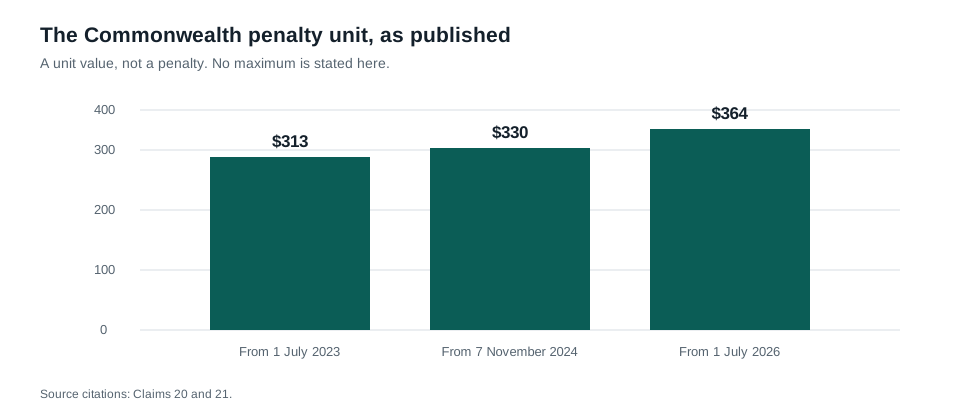
Claim 8 records that both section 15 limbs run per day: section 15(2) makes a separate offence for each day the contravention continues and section 15(2B) is the civil equivalent. Claim 9 records that section 15 is written about the provider, and that no offence or civil penalty provision directed at a customer for using a prohibited service was found in the provisions read. Claim 23 keeps the boundary: nothing is published in terms stating that an Australian player commits no offence, and the site does not turn the reading into a sentence about legality. Claim 10 records the Australian-customer link in section 8 and extended geographical jurisdiction category D in section 15(5). Claim 11 records the defence in section 15(3), and claim 12 records the reasonable diligence factors in section 15(4). Claims 26 to 28 record ACMA's complaint power, who may complain under section 19, and the civil and administrative toolkit in Part 8. None of that is a compensation scheme for a reader.
Claims 37 and 38 record ACMA's 2020-21 compliance report: winnings may not be honoured, incentives and pressure tactics are used to target gamblers, consumers who access these websites have little or no recourse, and the services do not have the customer protections expected in Australia; the report also records contact with 52 software providers and providers of local payment services, Australian traffic to the majority of targeted casinos decreasing by at least 90 per cent by June 2021, and 56 illegal offshore online casino services identified as targets. Claims 42 to 47 record quarterly activity: 465 enquiries and complaints in April to June 2026 with 417 valid, 30 investigations involving 76 gambling sites, 56 breach findings, 18 formal warnings and 187 websites referred to internet service providers for blocking; 422 enquiries in January to March 2026 with 366 valid, 25 investigations into 60 sites, 44 breaches, 13 formal warnings and 109 websites referred for blocking; and 411 enquiries in July to September 2025 with 350 valid, 29 investigations into 30 sites, 44 breaches, 20 formal warnings and 71 websites referred for blocking. Claim 48 governs the cumulative point: nothing is published as a sourced cumulative total, and the three bars are not added together.
Claims 156 to 162 set the cost of a dispute in the site's own terms. Claim 156 says a complaint to ACMA is a regulatory complaint and not a claim, with nothing in Part 3 or Part 8 providing for a complainant to recover money and no provision found giving a complainant any remedy at all. Claim 157 repeats the Australian connection in section 19. Claim 158 records BetStop's own route for an online casino complaint as ACMA and nothing else. Claim 159 records ACMA's consumer language. Claim 160 records the 2017 Commonwealth paper's "limited legal recourse if they run into any difficulties obtaining winnings or deposits" and its list of what offshore operators do not do. Claim 161 records the contrast that does work: a Queensland consumer page tells a consumer to talk to the business first, then lodge a complaint with the government agency that issued the provider's licence. Claim 162 records that the same State page says Australian Consumer Law applies to gambling businesses and that Australian online wagering providers must honour consumer rights and meet gaming licence requirements. The page does not stretch that sentence to an offshore casino, because claim 163 records that nothing is published on enforcement against one with no Australian presence.
The model therefore prices the bonus, not the protection. A reader can see $40,000 of implied turnover against a $1,000 bonus. A reader can also see, in the cited record, that the dollar maximum penalty is not published, the enforceability question is not published, the cumulative blocking total is not published, the market exit count is not resolved, offshore spend is not resolved, consumer law enforcement against an absent offshore operator is not published, a dispute forum is not published, and a provider count is not published. Disclosure is not a cure for those gaps. It is the statement that a paid arrangement exists beside them and that the site will not fill them with commercial copy.
Questions readers ask
- Is the ranking order an editorial result?
- No. The sequence is paid placement. It was bought, and the ranking's five entries sit in the supplied order with the supplied review counters descending as 6990, 6441, 5113, 5041 and 4644 in the map. The scorecard's 5/5 score is editorial as supplied and separates nothing. No editorial result is claimed for the order.
- Did Lucky Aussie Reels write the offer lines?
- No. The copy inside each entry was composed by whoever supplied it and leaves here untouched. The supplier's copy is printed verbatim, including a money chip that disagrees with its own offer line, a spin chip that disagrees with its own offer line, two exclamation marks in one supplied line, and a missing space between a figure and its currency in another. Nothing is invented onto a card to fill a gap.
- Why does this page name the shortcode but not show the board?
- Because this is the money disclosure and the only page allowed to name the ranking. The container is rendered by
Royalxo5/56990 ratings VISAPLAY NOWSlotsgem5/54644 ratings VISAPLAY NOWCaswino5/56441 ratings VISAPLAY NOWBetmica5/55669 ratings VISAPLAY NOWHellspin5/55113 ratings VISAPLAY NOWThe offers in this block are advertising. Placement is paid. Copy is supplied by the operator and is printed unaltered. More at How this site is paid. The arrangement is itemised at How this site is paid.
elsewhere. This site page carries no board, inserts no shortcode, and carries no lead-in. It names the arrangement so the reader can see what is sold, then sends the reader back to the guides for method. - Are the outbound addresses printed on the page?
- No. The page carries local cloak paths such as /go.php?slot=royalxo/, /go.php?slot=caswino/, /go.php?slot=hellspin/, /go.php?slot=betmica/ and /go.php?slot=slotsgem/, or the equivalent numbered path. The five tracked destinations stay in the plugin store. The raw host is not printed in any served document.
- Does the disclosure change the legal or dispute position?
- No. Claims 22 to 25, 51 to 53 and 163 to 165 are NOT PUBLISHED: nothing is published on a dollar maximum penalty under section 15, player use in terms, section 69A regulations, a count of offshore operators, getting round blocking, an offshore register or rating, a wagering provider count, consumer law enforcement against an absent offshore operator, a dispute forum, or enforceability. Claims 48, 49 and 50 are SOURCES DIFFER and no single figure is chosen. Payment buys placement only.
Where to go next
- Reading the offers
- The margin we assume
- Knowing when to stop
- What this site stores
- Terms and conditions of use
- Write to the desk
Lucky Aussie Reels, luckyaussiereels.com. The money arrangement is itemised above; the method pages stay about the offer class; the commercial block stays supplied, paid and labelled by this page.