A $1,000 high roller deposit at Lucky Aussie Reels is costed here as a $40,000 turnover obligation when the offer is read as forty times the bonus alone, with a cashier ceiling that is not published and an effective unit of $12.50 per turnover dollar of bonus commitment; the assumption is that the whole calculation is a model of a large deposit offer, AUD throughout, and that no operator term is being quoted as a live condition.
What sits under this paragraph is advertising. Its order was bought, none of its wording was composed here, and no figure in it has been held against a source cited anywhere on this site. The arrangement behind it is set out at How this site is paid.
The offers in this block are advertising. Placement is paid. Copy is supplied by the operator and is printed unaltered. More at How this site is paid. The arrangement is itemised at How this site is paid.
The deposit and the ceiling
The reader who arrives at a high roller page is not usually asking whether a small balance can be stretched. The reader is asking what a larger first payment buys, what it commits the balance to, and where the cashier stops. For this page the working deposit is $1,000. Under the assumption stated in the opening paragraph, the offer is modelled with a $1,000 matched amount and a turnover requirement of forty times the bonus alone. That gives $40,000 of counted play before the bonus component is treated as released. All amounts on this page are in AUD unless a cited source uses another published currency in its own text, and no conversion is performed here.
The phrase "high roller" is a search phrase, not a licence class and not a promise about service quality. It is used here because the page is about a large deposit and a cashier level that many readers approach with different expectations from a small first payment. A larger deposit changes the order of the questions. The first question is no longer "how small can I start". It is "how much balance has to move before the promotion stops controlling the balance". The second question is whether the cashier states a ceiling at all. On the assumption used here, the cashier ceiling is unpublished. That is not treated as a hidden number to be guessed. It is treated as a missing published figure, and the consequence is that the reader cannot compare a ceiling against the deposit, against a withdrawal request, or against the turnover obligation before committing funds.
This page is written by Lucky Aussie Reels as a buying guide. It is not written as a legal opinion about a player, and it does not tell the reader what a court would do with an agreement. It costs an offer on terms usual for offers of this kind, with the assumption in the same paragraph, and then sets out what is absent when the offer sits outside the Australian system. The comparison is practical: what the reader gives up when there is no domestic licence for the product, no Australian licence condition to read, no published cashier ceiling in the model, and no Australian complaints route that returns money to a complainant.
Under section 4 definition, paragraph (e) of the Interactive Gambling Act 2001 (Cth), a gambling service includes a service for the conduct of a game played for money or value, of chance or mixed chance and skill, where a customer gives or agrees to give consideration; online pokies, slots, roulette, blackjack and live dealer tables sit inside that description. Claim 1. Section 5(1) describes a prohibited interactive gambling service as a gambling service provided in the course of carrying on a business and provided to customers using, among others, an internet carriage service. Claim 2. The section 5(3) exclusions are a closed list. Claim 3. The only gaming exclusion is place based, and section 8B(1) requires customers to be at a particular place, using electronic equipment made available at that place, available for use by any customer there, with a State or Territory licence authorising provision at that place. Claim 4. The load bearing fact is that an online casino served to a person at home is a gambling service under paragraph (e), provided in the course of a business, over an internet carriage service, therefore prohibited under section 5(1), and excluded by nothing in section 5(3). Claim 5.
That statutory shape matters to a high roller deposit because the absence of a domestic licence is not a gap in a list of competing licences. There is no Australian licensed online casino category to compare against. Section 15AA is described at source as a separate offence for services that can be licensed, and "regulated interactive gambling service" is defined by section 8E(1) as a closed list that does not include online casino. Claims 13 and 14. A State or Territory licence cannot authorise an online casino served to a person at home, because the Commonwealth prohibition in section 15 applies regardless of any licence, and the only provision making a State or Territory licence relevant applies to a different closed class. Claim 15. The licence aside later on this page states the same point in one line, with claims 5, 14 and 15 cited, so the reader can carry it forward into every costed section.
For the $1,000 deposit, the commercial question is therefore not "which Australian licence condition applies". It is "what published term can be priced, and what remains a model assumption". The deposit figure is a model input. The forty times the bonus alone requirement is a model assumption. The $40,000 turnover figure is arithmetic from those two inputs. The $12.50 figure is another unit from the same model, explained in the next section. The unpublished ceiling is not a figure at all. Claim 142 says nothing is published for Australian deposits, withdrawal times or payout speeds at offshore casinos on this sheet, and no page may state a withdrawal time for any operator or the offshore market, nor present a minimum deposit figure as anything other than a term an operator has stated for itself. In the model used here, the cashier has no published ceiling, so the page does not invent one.
A reader choosing a large deposit offer usually wants to know whether a bigger payment receives a bigger headline, a faster cashier, a wider withdrawal path, or a clearer limit. On the sourced material available, none of those service promises can be priced as an Australian market fact. ACMA lists banned services as "online casinos", "in play sports betting", "sports betting services which do not hold an Australian licence", and "betting on the outcome of a lottery". Claim 16. ACMA's compliance report describes "prohibited interactive gambling services, such as online casino services (for example, online slots, poker and roulette)" and states that online casinos providing slots, roulette, poker and other casino games are prohibited in Australia. Claim 17. The Department of Infrastructure page says prohibited interactive gambling services include casino style games such as online blackjack and roulette, lists pokies and slot machines, and groups services into wagering, lotteries and gaming. Claim 18. Those are statements about the product category, not about a cashier ceiling.
The model can still be useful if it refuses to smuggle in an operator term. A $1,000 deposit with a $1,000 bonus component and forty times the bonus alone produces a $40,000 obligation. A $5,000 deposit scaled in the same way produces a $200,000 obligation, but only in this model, and only as a way to show linear arithmetic. It is not an operator term, it is not a published ceiling, and it is not a claim that any cashier accepts such a deposit or applies such a multiple. The scaling is included because a high roller reader may be thinking in larger units, and a linear model is easier to judge when the multiplier stays fixed. In this model, five times the deposit gives five times the bonus component and five times the turnover. In this model, the absent ceiling remains absent at both sizes. In this model, the only published figures are those cited from primary sources, and the only arithmetic figures are those derived from the stated inputs.
There is also a difference between an unpublished ceiling and a ceiling that is merely inconvenient. A published ceiling gives the reader a boundary before sending funds. A ceiling that is not published gives no comparable boundary. The reader can still decide whether to deposit, but the decision is made without a stated cashier limit against which a planned withdrawal can be measured. For a large deposit, that missing boundary is more expensive in practical terms than it is for a small one, because the amount at stake is larger and the turnover obligation is larger. The $40,000 figure is already large enough that a reader may want to split the decision into stages. The model does not tell the reader that staged play is available, that a withdrawal can be made at a chosen point, or that a bonus can be declined. It simply records that the ceiling is not published.
The term "unpublished ceiling cashier" is used here in a narrow sense. It means that, under the page's assumption and the claim set, the cashier's limit for the relevant movement of funds is not published. It does not mean that a hidden ceiling has been discovered, that a voucher ceiling exists, that a daily or weekly limit has been read, or that a payment rail has a published cap. Claims 138, 139 and 140 state that nothing authoritative is published about PayID, Neosurf, or scheme rules from Visa, Mastercard, Apple Pay and Google Pay about Australian gambling respectively. Those claims are about payment intents and cannot be turned into cashier terms. Claim 141 says BetStop describes bank gambling blocks as voluntary and bank by bank, with no list of banks offering them located, and a page may quote that sentence but may not name a bank, state a block's terms, or say anything about how a block behaves. None of that becomes a high roller limit.
ACMA's 2020 to 2021 report says "Winnings may not be honoured, and incentives and pressure tactics are used to target gamblers", "Consumers who access these websites have little or no recourse", and the services "do not have the customer protections we expect in Australia". Claim 37. The same report records contact with 52 software providers and providers of local payment services, says "Australian traffic to the majority of targeted casinos decreased by at least 90% by June 2021", and identifies 56 illegal offshore online casino services as targets. Claim 38. The 2024 to 2025 report records 63 software providers contacted, 27 committed to compliance, a further 7 took down or geo blocked games, and says ACMA "further disrupted the operations of one of the major players in the illegal offshore gambling market". Claim 39. Those are regulatory activity figures, not cashier limits, and they are cited here to keep the layers separate.
The opening money figure is the one the reader acts on. The rest of this page keeps returning to it because a high roller offer is easy to misread when the headline amount grows faster than the obligations. A $1,000 deposit is not a small balance with a larger label. It is a larger balance exposed to a $40,000 counted turnover under the model. The reader who treats $1,000 as the whole cost has counted the payment but not the commitment. The reader who treats $40,000 as a maximum loss has counted a turnover figure as if it were a loss figure. Neither reading is correct. Turnover is a measure of counted play, not a prediction of result, and the page does not state a return, hit rate, volatility or maximum win for any game title or studio. Claim 175 records that omission.
Finally, the absence of a domestic licence means there is no Australian technical standard attaching to an online casino licence condition. Claim 174 states that no RTP, spin speed, stake cap or loss limit binds any online casino serving Australia, and that the reason is structural: there is no Australian licence for online casino, so there is no Australian licence condition and no Australian technical standard attaching to one. That claim must be written as an absence of any Australian rule, not as an assertion that an operator's own figures are false or absent. For the large deposit reader, the safe wording is simple: the model prices the bonus condition; the Australian system supplies no licence condition to place beside it.
What forty times the bonus alone costs
The central assumption is "forty times the bonus alone". It is not "forty times deposit plus bonus", and the difference is large. With a $1,000 deposit and a $1,000 bonus component, forty times the bonus alone is 40 multiplied by $1,000, which is $40,000. If a reader accidentally used deposit plus bonus as the base, the base would be $2,000 and the same multiple would produce $80,000. That alternative is not used on this page. It is mentioned only to show why the words "bonus alone" sit beside the assumption every time the number appears. A high roller calculation that loses those two words doubles the obligation without changing the offer headline.
The $12.50 figure is a unit that helps compare the two numbers without pretending to know a game result. Divide the $1,000 bonus component by forty and the result is $25. Divide the $40,000 turnover obligation by 3,200 counted dollars of model units and the result is $12.50 per unit. A cleaner way to state the page's own unit is this: if the model treats $12.50 as the average counted stake, $40,000 of turnover is 3,200 counted stakes of $12.50. That is arithmetic, not a game rule, not a stake cap, and not an operator term. It is included because the brief for this page names $12.50 and because a reader may want a small unit against which to see the scale of a large turnover. It is not a recommended stake and it is not a statement about any game.
Under the same model, a $5,000 deposit with a $5,000 bonus component and forty times the bonus alone gives $200,000 of turnover. In this model, using the same $12.50 counted stake unit, that is 16,000 counted stakes. In this model, the relationship is linear: multiply the deposit by five, multiply the bonus component by five, multiply the turnover by five, and multiply the count of $12.50 units by five. In this model, nothing else changes. The cashier ceiling is still not published. The source base still supplies no withdrawal time. The statutory position is still the same. The reader's exposure to an unpublished cashier boundary is larger because the balance is larger, not because the law has changed.
The calculator block below carries one calculation only. It takes a deposit input, a multiple input, and a counted stake unit input, then returns a turnover figure and a unit count. It does not return a likely loss, a return to player percentage, a win probability, or a withdrawal date. The calculator is an arithmetic aid for the model, not a simulator of play. It is also not an operator comparison. No operator name appears in it, no operator figure is read into it, and no output from it is described as a live term. This keeps Appendix G and Appendix H separate and keeps the page within the rule that claims are cited by number.
Model inputs, AUD throughout.
Default result $40,000 turnover, or 3,200 counted stakes of $12.50.
If the deposit is $5,000, in this model the result is $200,000 turnover, or 16,000 counted stakes of $12.50. This is a model, not an operator term.
The arithmetic is deliberately plain. A buying guide earns trust by showing the base, the multiplier and the product, then by refusing to decorate the result with unsupported claims. The bonus alone base is $1,000. The multiple is forty. The product is $40,000. The unpaid question is what the reader must do before that counted turnover is treated as satisfied. Terms of this kind usually define eligible games, contribution rates, maximum counted stakes, time limits, bonus expiry, and what happens to winnings attached to a bonus balance. Those terms are not published here as operator terms, so the page does not supply them. It does not say a game contributes 100 per cent, it does not say a table game is excluded, and it does not say a maximum stake applies. Claim 174 says no stake cap or loss limit binds any online casino serving Australia through an Australian licence condition, and claim 175 bars a return, hit rate, volatility or maximum win for any named game title or studio.
The $12.50 unit also shows why a large deposit is not just a larger version of a small deposit in a commercial sense. At a $1,000 starting point, 3,200 counted units is a long sequence of counted events. At a $5,000 scaled point in this model, 16,000 counted units is five times as many. If the reader's purpose is to clear a promotion, the length of the sequence matters more than the headline size. If the reader's purpose is to place one large wager, the promotion may be irrelevant or even obstructive. The page does not tell the reader which purpose to choose. It gives the costed shape so that the choice is made with the $40,000 figure visible.
When the Australian statutory material is read beside this arithmetic, the point is not that the Act sets a wagering requirement. It does not. The point is that the Act supplies no domestic licensed online casino category within which a local condition could be compared. Section 15 is written about the provider, and no offence or civil penalty provision directed at a customer for using a prohibited service was found. Claim 9. The prohibition reaches an operator wherever it sits because an Australian customer link exists if any customers are physically present in Australia and section 15(5) applies extended geographical jurisdiction category D. Claim 10. Section 15(1) sets an offence of 5,000 penalty units, section 15(2A) sets a civil penalty of 7,500 penalty units, and both run per day under sections 15(2) and 15(2B). Claims 6, 7 and 8. Those are provider side provisions. They do not price a bonus.
The figure on this page concerns the penalty unit, because the default figure token for this build is the penalty unit drawing. The Crimes (Amount of a Penalty Unit) Instrument 2026, made 15 June 2026 under section 4AA(1A) of the Crimes Act 1914, states a penalty unit of $364 for offences committed on or after 1 July 2026. Claim 20. Previous values are $330 from 7 November 2024 and $313 from 1 July 2023 to 6 November 2024. Claim 21. No primary source states a dollar maximum penalty under section 15, because the Act states units, the Crimes Act instrument states a unit value, multiplying is arithmetic rather than a sourced figure, and the body corporate multiplier was not verified. Claim 22. The caption below is copied byte for byte from Appendix D and carries that limit with it.
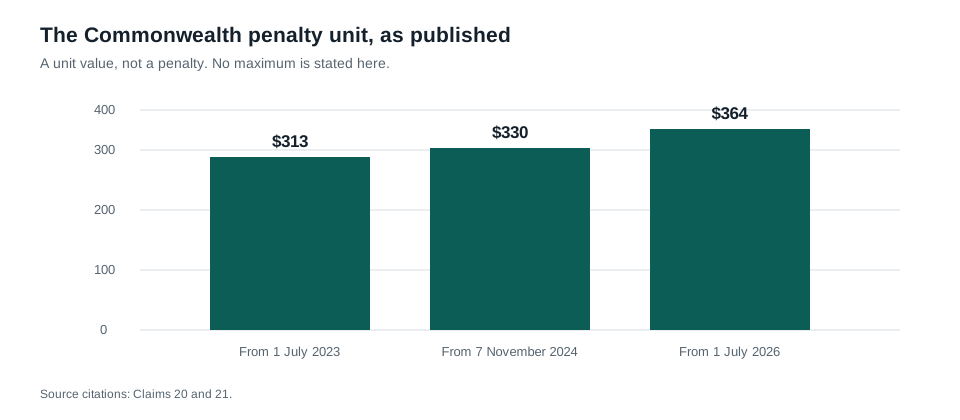
The figure is not a cost of the offer. It is a separate published unit that the regulatory section needs later. Its presence here may look like a detour from a high roller deposit, but it is the one drawing this build assigns to the penalty unit default and its caption states that a unit value is not a penalty. That discipline is the same discipline the calculator needs: do not turn a unit into a conclusion the source does not publish. The $12.50 counted stake unit is not a game rule. The $364 penalty unit is not a maximum penalty. The $40,000 turnover is not a loss. Each number has a narrow job.
A reader may ask why the page keeps an unpublished ceiling in the same calculation as a published penalty unit. The answer is that a buying guide has to price what it can and mark what it cannot. The penalty unit is published at source, so it can be cited by claim number. The cashier ceiling in this model is not published, so the page says that nothing is published and states nothing else about it. Claim 142 is the specific claim for deposits, withdrawal times and payout speeds, and the NOT PUBLISHED label requires that treatment. The reader is not given a substitute number, a range, a typical window, a usual minimum, or an implied speed. The gap stays a gap.
Section 5(3) being a closed list also prevents a tempting but false comparison. A reader might think a place based licence, a wagering licence, or a lottery exclusion can be used as a proxy for an online casino condition. Claims 3, 4 and 14 say otherwise for this product. The bonus calculation therefore sits beside an absence, not beside a domestic rulebook. The cost of that absence is discussed in the comparator section, where the worth of a complaint is set out from claims 156 to 165. For now, the commercial consequence is narrower: the reader has no Australian licence condition that says how a large deposit bonus must be presented, capped, or reconciled.
The model also avoids a common rhetorical mistake. It does not say "because no Australian rule applies, the operator's terms are unchecked". That would be an assertion about an operator, not a statement about the Australian system. Claim 174 says the absence is structural and must be written as an absence of any Australian rule, not as an assertion that the operator's own figures are false or absent. The page follows that wording. An operator may publish its own terms, and a reader may read them, but this page has no primary source record of those terms and does not invent them. It models forty times the bonus alone because that is the assumption supplied for this key, and it says so in the standfirst, in this section, and in the calculator note.
Reading the offers
Reading a large deposit offer is mostly an exercise in separating four kinds of text: a headline amount, a bonus condition, a cashier statement, and a regulatory statement. They look alike on a page because they all contain dollars and numbers. They do not do the same work. The headline amount tells the reader what is being advertised. The bonus condition tells the reader what has to happen before a balance is treated as withdrawable. A cashier statement tells the reader what the cashier will accept or process. A regulatory statement tells the reader what a statute, regulator or official report says. A high roller calculation collapses if any one of those is read as another.
In this model, "$1,000" is the deposit input. It is not a stated operator minimum deposit. Claim 142 says no page may present a minimum deposit figure as anything other than a term an operator has stated for itself, and this sheet has no such term. The "$40,000" is the turnover product from the bonus condition assumption. It is not a deposit limit, a withdrawal cap, or a maximum loss. The "$12.50" is a counted stake unit used to express scale. It is not a stake cap. The absence of a published ceiling is a missing cashier statement, not a hidden term. The penalty unit figures in the caption are published statutory unit values, not a maximum penalty. Each sentence on this page is written to keep those categories apart.
Offers of this kind usually ask a multiple of a bonus component, and a cashier at this end of the market rarely publishes the ceiling in the sense used here. That is a statement about the kind of offer being modelled, not a measured frequency and not a claim about a named operator. The page does not say "most operators", does not attach a category truth to a specific thing, and does not use "typically" as a hedge for a missing source. The sourced position on deposits and withdrawals at offshore casinos is the NOT PUBLISHED statement at claim 142. The commercial assumption is stated in the standfirst. The arithmetic is derived from that assumption. Those three layers are the whole method.
The reader should also separate a bonus ceiling from a cashier ceiling. A bonus headline may say "up to" a figure, while a cashier may have a separate limit for a payment, a withdrawal, or a period. This page does not have a published bonus headline from an operator's own site and does not have a published cashier limit. It therefore does not compare the two. The model's $1,000 deposit and $1,000 bonus component are inputs, not quoted terms. If a reader is looking at an actual offer, the useful check is whether the words "up to", the multiple, the base, and the cashier limit are all written down in the same place. If one of them is missing, the missing item cannot be filled from this page.
ACMA's 2024 to 2025 compliance report says there was "a very high level of compliance with the credit card and crypto ban, with no investigations commenced", and that a March 2025 review found 50 services still referring to credit card or crypto deposits, all removed by 30 June 2025. Claim 41. That claim concerns licensed wagering compliance work and regulatory activity, not a high roller cashier term. It is cited here because payment words often drift from one layer into another. A reader who sees a payment token in a search phrase may assume an authoritative rule exists for that token as a gambling method. Claims 138, 139 and 140 say nothing authoritative is published about PayID, Neosurf, or scheme rules from the named card and wallet brands about Australian gambling. Claim 136 says the statutory position on cards and wallets is narrower than most pages assume: a credit card and a credit card funded wallet are banned for licensed Australian wagering, and nothing in section 15C speaks to a debit card, a bank transfer, PayID, a voucher or a wallet funded from a bank account, and nothing in section 15C binds an offshore casino at all. None of that supplies a cashier ceiling for this offer.
The 2017 government paper describes the same movement alert list mechanism as placing directors on the Movement Alert List. Claim 31. ACMA states it can refer "the directors and principals of offending companies to the Australian Border Force" and that some operators "are not allowed to offer or enable lines of credit to Australians". Claim 30. ACMA publishes a list of licensed interactive wagering providers, and BetStop's about page points to it. Claim 32. ACMA publishes BetStop registration statistics, and BetStop says it never releases personal information about individuals on the register or their support people, although aggregated statistics can be found on the ACMA website. Claim 34. These are published administrative facts. They are not reasons to infer a deposit cap, a withdrawal window, or a published ceiling for a casino cashier.
Quarterly reports titled "Action on interactive gambling", retitled from January to March 2026 as "Action on interactive gambling and gambling advertising", carry claims 42 to 47. Claim 33. In April to June 2026, ACMA says it "looked into 465 enquiries and complaints", with 417, or 90 per cent, valid, and monthly complaints of 118 in April, 145 in May and 154 in June. Claim 42. In the same quarter it completed 30 investigations that involved 76 gambling sites, found breaches in 27, and recorded 56 breach findings as 30 prohibited, 24 unlicensed regulated and 2 advertising. Claim 43. It issued 18 formal warnings to providers, referred 187 websites to internet service providers for blocking, and reported 187 URLs to family friendly filter providers. Claim 44. Those figures are regulator activity, not offer terms, and they are not added into a cumulative total here.
January to March 2026 figures are 422 enquiries, 366, or 87 per cent, valid, 25 investigations into 60 sites, 44 breaches as 22 prohibited, 21 unlicensed regulated and 1 advertising, 13 formal warnings, and 109 websites referred for blocking. Claim 45. July to September 2025 figures are 411 enquiries, 350, or 85 per cent, valid, 29 investigations into 30 sites, breaches in 28, 44 breaches as 25 prohibited, 16 unlicensed regulated and 3 advertising, 20 formal warnings, and 71 websites referred for blocking. Claim 46. The gambling advertising stream under the Broadcasting Services Act 1992 is much smaller, with the April to June 2026 and January to March 2026 assessments and investigation outcomes set out at claim 47. These figures help a reader understand what the regulator publishes. They do not tell the reader what a cashier will do with a large balance.
Two source difference claims need careful handling in a high roller guide. Claim 48 is a news report. No cumulative website blocking total is available from any readable ACMA page because news articles carrying it are robots disallowed; Yogonet on 17 October 2025 reported "Since November 2019, a total of 1,338 illegal gambling and affiliate websites have been restricted", attributed to ACMA in general terms without naming a report. A page may cite per quarter figures 44 to 46 at source and may not state a cumulative total as a sourced figure. Claim 49 records that two ACMA pages give different counts of services that left the market and a third gives a third framing: "over 100", "Over 220", and "about 220 ... over eight years"; a page may quote whichever a line leans on, name it, and present none as the figure. Claim 50 records two offshore expenditure estimates in one ACMA document that differ by about eight times, GBGC US$175 million for 2020 and H2 Gambling Capital A$1,475 million for 2020, with ACMA noting the difference and not reconciling it, plus a 2017 paper estimate "could be as high as $400 million annually"; no page may state a single number for Australian offshore spend. Those claims are included here because "large deposit" pages are often where a writer reaches for a market size number. This page does not use one.
Claims 51, 52 and 53 are NOT PUBLISHED and shape the reading method. Claim 51 says no ACMA page reached states that website blocking can be got round, and this sheet says nothing about how; a page may say blocking is applied at the ISP and that ACMA refers URLs to filter providers under claim 44. Claim 52 says ACMA publishes no register of offshore operators, no list of "safe" offshore operators and no rating of any operator, and its only register in this field is of licensed interactive wagering providers under claim 32, containing no casinos. Claim 53 says ACMA's licensed interactive wagering providers page did not render a list on retrieval and no provider count could be read, so no page may state how many Australian licensed wagering operators there are. For a reader, the consequence is that a high roller offer cannot be validated by an Australian register of safe offshore operators. The absence is not a challenge to find a better list; it is the finding.
Reading the offer also means not mistaking a statutory unit for a customer protection. The Commonwealth penalty unit values at claims 20 and 21 are published, and claim 22 says no dollar maximum penalty under section 15 is stated by a primary source. A page cannot multiply units and publish a maximum as a sourced figure. That is the same reading discipline as the $40,000 turnover: the arithmetic is real, but the label attached to it has to stay narrow. The calculator gives a turnover number, not a predicted loss. The figure gives a unit value, not a penalty. The quarterly reports give activity counts, not a cumulative total or a market size. Each published number carries its own boundary.
Part 7A is another place where a reader may mix layers. A "designated interactive gambling service" means a prohibited interactive gambling service or an unlicensed regulated one, and section 61DA prohibits broadcasting or datacasting such an advertisement in Australia while section 61EA prohibits publishing one. Claim 19. Advertising a prohibited or unlicensed service is prohibited and this limb does reach offshore casinos, because Part 7A operates on a designated interactive gambling service, which includes a prohibited one. Claim 96. ACMA acts on this limb against affiliate sites, and quarterly breach findings count advertising separately: 2 in April to June 2026, 1 in January to March 2026, and 3 in July to September 2025. Claim 98. That tells the reader what the advertising rule reaches. It does not make the advertised terms true, sourced, or safe to price as operator terms.
The final reading rule is simple and commercial. If a figure is needed to choose an offer and it is not published on the page being read, mark it missing and lower the weight given to the offer. If a figure is published only as an assumption in a model, keep it inside the model. If a figure is published at source, cite the claim by number and keep the publisher's label attached. This page follows that rule for $1,000, $40,000, $12.50, the scaled $5,000 to $200,000 example, the penalty unit values, and the regulatory activity counts. It never turns the unpublished ceiling into a number.
The Act and what a dispute is worth
This is the single regulatory section on the page. The comparator is the Interactive Gambling Act 2001 (Cth) and what a dispute is worth. It does not tell the reader that using an offshore casino is legal or illegal for a player, it does not say an agreement is enforceable or unenforceable, and it does not say the reader has or has not got Australian Consumer Law rights against an offshore casino. Claims 23, 24 and 165 keep those questions open. What it does say is what the statute writes about providers, what the regulator can do with a complaint, and what the regulator itself says a consumer's position is when a dispute concerns winnings or deposits.
Section 15 is written about the provider, as are sections 15AA, 15A and 15C; the section 3 simplified outline lists duties on providers, ISPs and advertisers. No offence or civil penalty provision directed at a customer for using a prohibited service was found. Claim 9. A page may say the statutory liability falls on the operator, but it may not say playing is therefore without cost, because the losses in the claim base are losses of protection, not losses of liberty. Claim 23 says no primary source states in terms that an Australian player commits no offence by using a prohibited service, and a page may not say "it is legal for you to play". Claim 24 says no regulations under section 69A were located; section 69A is a regulation making power about agreements having no effect and civil proceedings not lying to recover money, and no page may assert either that such an agreement is unenforceable or enforceable. Claim 165 repeats that the question stays open.
The provider side duties are specific. Section 15(1) makes it an offence to intentionally provide a prohibited interactive gambling service with an Australian customer link, with a penalty of 5,000 penalty units. Claim 6. Section 15(2A) sets a civil penalty of 7,500 penalty units. Claim 7. Separate offences and civil penalties arise for each day a contravention continues under sections 15(2) and 15(2B). Claim 8. Section 15(3) provides a defence where the person did not know and could not with reasonable diligence have ascertained the Australian customer link, with the evidential burden on the person. Claim 11. Section 15(4) lists reasonable diligence factors, including whether prospective customers were told Australian law prohibits provision to persons physically present in Australia, an express condition not to use the service while in Australia, personal details required and what they suggested, network data indicating customers were outside Australia at account opening and throughout, and any other relevant matters. Claim 12. None of these provisions gives a reader a cashier figure or a refund route.
Section 21(1) allows ACMA to investigate on its own initiative or on a complaint under Division 1. Claim 26. Section 19 limits who may complain: an individual residing in Australia, a body corporate carrying on activities in Australia, or the Commonwealth, a State or a Territory. Claim 27. Part 8's toolkit is civil and administrative, not compensatory: formal warnings under 64A, civil penalty enforcement under 64B, infringement notices under 64C, injunctions under 64D, enforceable undertakings under 64E, remedial directions under 64F, and continuing contraventions under 64G. Claim 28. Section 59 allows the Federal Court to order a person to cease supplying internet carriage services for breach of the online provider rules. Claim 29. Website blocking as practised is a request to ISPs, not a statutory direction under the Act; quarterly reports describe referring websites "to internet service providers for blocking" and separately reporting URLs to family friendly filter providers. Claim 36. These are enforcement tools, not a consumer claims fund.
Claim 156 states the spine of the dispute section: a complaint to ACMA is a regulatory complaint, not a claim; claim 26 is the power to investigate and claim 28 is the toolkit, and nothing in Part 3 or Part 8 provides for a complainant to recover money, with no provision found giving a complainant any remedy at all. Claim 157 adds that only a person with an Australian connection may complain at all under section 19. Claim 158 says BetStop's own route for an online casino complaint is ACMA and nothing else. Claim 159 gives ACMA's own words: "Consumers who access these websites have little or no recourse", "Winnings may not be honoured, and incentives and pressure tactics are used to target gamblers", and these services "do not have the customer protections we expect in Australia". Those sentences are quoted because they are the published description of the consumer's position. They are not rewritten as a promise that a regulator will recover a balance.
The Commonwealth said the same in 2017: many consumers are unaware the offshore sites they use are unlicensed in Australia, and "there is limited legal recourse if they run into any difficulties obtaining winnings or deposits". The paper lists what offshore operators do not do: pay Australian taxes or racing and sporting fees, share suspicious betting information with law enforcement or sporting bodies, or provide more than minimal harm minimisation and consumer protection. Claim 160. For a high roller deposit, those words have a direct commercial meaning. The larger the balance, the more expensive "limited legal recourse" becomes, because the amount that may be held in a dispute is larger. The page does not quantify that exposure. It says the published description is little or no recourse and leaves the dollar amount with the reader's own deposit decision.
Claim 161 describes the complaints route that does work for licensed operators, and that is the contrast. Queensland's consumer page tells a consumer to talk to the business first, then if unsatisfactory "lodge a complaint with the government agency that issued the provider's licence", which should be displayed on the provider's website; Queensland complaints go to the Office of Liquor and Gaming Regulation, and for Northern Territory licensed providers the page points to NT Consumer Affairs. Claim 162 says Australian Consumer Law is stated to apply to gambling businesses, with Queensland saying "You have consumer protections when using online gambling services", that it is illegal for businesses to act misleadingly or deceptively, to act unconscionably, or to claim to offer gifts or prizes and not provide them, and that "Australian online wagering providers must honour your consumer rights and meet their gaming licence requirements". Those claims concern Australian providers. They are not transferred to an offshore casino here.
Claim 163 is NOT PUBLISHED: no source reached says whether or how Australian Consumer Law is enforced against an offshore gambling operator with no Australian presence; claim 162 is a State consumer page addressing Australian providers, and a page may not say a reader has Australian Consumer Law rights against an offshore casino, and may not say they have none. Claim 164 is also NOT PUBLISHED: no Australian alternative dispute resolution scheme, ombudsman or arbitration body covering online gambling was located, and this sheet names none. A page may not name an Australian body that will hear a dispute against an offshore casino, because none was found. It may say claims 156 to 159: ACMA takes complaints, enforces against the operator, and describes the consumer's recourse as little or none. Claim 165 keeps the agreement question open. For the reader, the practical absence is a missing forum that returns money, not a missing rule that can be quoted as a threat.
This section is also where the licence aside belongs. Claims 5, 14 and 15 support the short statement that no Australian licence exists for this product. Section 15AA is the licence route and online casino is not on it, because the definition in section 8E(1) is a closed list: telephone betting, excluded wagering, excluded gaming, place based betting, designated broadcast or datacast link, excluded lottery, and exempt service. Claim 14. Section 15 applies regardless of any licence, section 69 preserves concurrent State law but does not create a category the Commonwealth has prohibited, and section 15AA applies to a different closed class. Claim 15. The short aside later in the page uses that wording without reopening the argument.
Claims 156 to 160 are not abstract for a large deposit. Suppose the model's $1,000 deposit has become a balance subject to a $40,000 turnover condition and the reader then asks why a withdrawal has not been honoured. The reader can complain to ACMA if they meet section 19, and ACMA can investigate under section 21(1). ACMA can issue a formal warning, seek a civil penalty, give an infringement notice, seek an injunction, accept an enforceable undertaking, give a remedial direction, or act on continuing contraventions. None of those tools is described at source as a payment to the complainant. That is the cost of sitting outside the system: the regulator can act on the service, while the published description of the consumer's money position remains little or no recourse.
The page does not soften that by saying a particular operator will or will not honour winnings. Claim 159 says "Winnings may not be honoured", which is the regulator's own phrasing. Claim 160 says there is limited legal recourse if consumers run into difficulties obtaining winnings or deposits. A statement that an operator always pays, never pays, checks a register, or ignores a complaint would be an invented behaviour. The claim base does not publish it. The page's buying advice is therefore about the structure of the choice: a larger deposit increases the amount that depends on an unpublished cashier ceiling and on a dispute route that is regulatory rather than compensatory.
Claim 37's phrase "do not have the customer protections we expect in Australia" is also left in the regulator's voice. It is not paraphrased into a list of protections that the reader supposedly keeps, and it is not turned into a claim about Australian Consumer Law rights against an offshore operator. The page does not say a reader has those rights, and does not say the reader has none. Claim 163 bars both. The section says what ACMA publishes, what Part 8 does, and what is not published. That is the whole comparator.
The single regulatory heading on this page is therefore not a warning label pasted onto a buying guide. It is the price of the missing domestic system. The $40,000 turnover is the price of the bonus condition under the model. The unpublished ceiling is the price of missing cashier information. The dispute position is the price of a balance that, if contested, meets a toolkit built for enforcement against providers and described by the regulator as little or no recourse for consumers. Those three costs sit together, and none of them needs a claim about player legality, enforceability, or Australian Consumer Law rights to be understood.
The margin we assume
The margin on this page is not a house edge and not a return to player figure. It is the margin between what a model can calculate and what a source can support. On one side sit the $1,000 deposit input, forty times the bonus alone, the $40,000 turnover product, the $12.50 counted stake unit, and, in this model, the $5,000 to $200,000 scaling. On the other side sit the published claims, cited by number, with their AT SOURCE, SOURCES DIFFER and NOT PUBLISHED labels respected. The reader is asked to keep a margin between them, because a high roller page fails when arithmetic is allowed to look like a sourced operator term.
Claim 174 is the clearest example. It says no RTP, spin speed, stake cap or loss limit binds any online casino serving Australia, and the reason is structural: there is no Australian licence for online casino, so there is no Australian licence condition and no Australian technical standard attaching to one. That is an absence of any Australian rule, not an assertion that the operator's own figures are false or absent. Claim 172 says no minimum game cycle time, spin duration or spin speed figure was found, and a writer must not import the British figure. Claim 173 says no maximum bet per game and no loss limit was found. Claim 171 says this sheet has no number for the minimum return to player on an Australian gaming machine, because the parameter exists at claim 167 but its value lives in Appendix B, which was not in the retrievable text. Claim 175 bars any RTP, hit rate, volatility or maximum win for a named game title or studio. Those claims explain why the calculator returns only turnover and a unit count.
The land based standard mentioned in the claim base does not fill the gap for an online offer. The Australian and New Zealand Gaming Machine National Standard, Revision 12.1, May 2025, is published by State regulators for gaming machines in venues. Claim 166. Clause 4.15 requires a minimum return to player "will be greater than or equal to [MINRTP]", a bracketed parameter defined in Appendix B, and clause 4.16 sets a ceiling at [MAXRTP]. Claim 167. Clause 4.17 says a change in betting options must not change theoretical RTP by more than 0.20 per cent; clause 5.47 caps an in symbol prize at 150 times the maximum wager, or [MAXNPWIN], whichever is lesser; clause 3.9 caps the win from each gamble attempt at [GAMBWIN]; clause 4.22 limits awarded free games to 20 per base game; and section 2 defines a substantial win as a prize of at least [LARGEWIN]. Claim 168. Those are venue machine standard details, not online casino rules, and they are not used to price the $40,000 turnover.
Claims 169 and 170 keep that boundary. Clause 1.2 lets a jurisdiction supply a local appendix, and Tasmania publishes its own Gaming Machine Standards with the national standard as Appendix A, versions dated 1 December 2025, Revision 11.1, and 6 July 2026, Revision 12.1. Claim 169. The land based limits published as numbers are State harm measures, not design parameters: a $500 cash input limit for new machines in NSW and a 4 am to 10 am mandatory shutdown. Claim 170. Those figures are not national online figures, and this page does not generalise them. Claim 131 says the sheet researched one State's land based position, New South Wales, and states nothing about any other State or Territory's machine numbers, losses or harm measures, so a page may not generalise claims 128 to 130 to Australia and may not state a national machine count or a national loss figure. Claim 132 says no source reached states which State or Territory licenses a land based casino, or on what terms, and the sheet names no casino licensing regime.
The margin also concerns dates. The Interactive Gambling Amendment (Gambling Reform) Act 2026, Act No. 72 of 2026, was assented 26 August 2026 and is shown as in force on the Federal Register. Claim 105. The commencement table has three rows: sections 1 to 4 and anything not elsewhere covered on the day of Royal Assent, 26 August 2026; all Schedules except Schedule 5 on 1 January 2027; and Schedule 5 on 27 August 2026. Claim 106. Every substantive change listed in G6 is not in force on 1 November 2026 and comes into force on 1 January 2027. Claim 122 says the compilation and the amending Act are two documents with two dates and do not describe the same law: the compilation date is 14 October 2024, the amending Act was assented 26 August 2026 with substantive commencement 1 January 2027, no compilation incorporating the 2026 Act was located, and a page must not blend the two or describe any Schedule as current law before 1 January 2027. Claim 123 says the register page for the 2026 Act shows 26 August 2026 beside the citation but did not label it the assent date, while the Act's own text does, so the Act's text is the source for that date. This page cites the claims in that bounded way and does not describe a future Schedule as current law.
One future facing claim is relevant to payment keys but not to this page's cashier model. Schedule 2 Part 1, new section 15J(2), would require banks and payment system participants to prevent, so far as reasonably practicable, a payment or funds transfer connected with a designated interactive gambling service from an account held in Australia to such a provider or associated person, with a civil penalty of 1,000 units. Claim 108. New section 15H says "funds includes, but is not limited to ... money; digital units of value, including digital currency" within the GST Act meaning. Claim 109. Claim 110 says this provision will reach the payment keys from the bank's side rather than the casino's, because section 15J bites on a designated interactive gambling service, which includes a prohibited one, which includes an online casino, and unlike section 15C it is not limited to licensed wagering. Those changes commence 1 January 2027 under claim 106. They are not used here to say a bank must block anything today, and claim 95 says no primary source states that a bank must block a gambling transaction.
The margin is also where the page handles source differences without choosing a winner. Claim 48 is a news report and must be labelled as such; claim 49 gives three framings of services that left the market and says present none as the figure; claim 50 gives two offshore expenditure estimates in one ACMA document that differ by about eight times and a 2017 paper estimate, and says no page may state a single number for Australian offshore spend. Claim 79 is a framing difference, not a news report: the Department of Social Services page says the register "allows consumers to exclude themselves from all interactive gambling services in Australia", BetStop's own about page says it "does not apply to online casino games or other gambling services that are illegally provided in Australia" and describes coverage as "all online and phone wagering providers licensed in Australia", and section 61GB is a third reading; the sheet does not resolve which the department meant. This page does not rest on the department's phrasing alone and does not present the two as saying the same thing.
Claims 59 and 60 are used only in the bounded form the safety rule allows. BetStop's obligations reach only Australian licensed online and phone betting operators; they do not reach a casino game, because it is not a wagering service under the section 4 definition, and they do not reach an offshore operator, because paragraph (c) of the section 61GB definition requires the service not to contravene section 15AA(3). Claim 59. BetStop's own words are: "BetStop - the National Self-Exclusion Register does not apply to online casino games or other gambling services that are illegally provided in Australia. You can make a complaint about these services to the ACMA". Claim 60. This is a statement about a duty. Claim 81 says no primary source quantifies how many offshore casinos accept registered individuals, and nothing supports a claim that any proportion do; a page may say BetStop registration does not, by its own terms, reach an offshore casino, but may not say an offshore casino will accept a registered individual, nor that any of them checks, because no source says either. Claim 82 says nothing here describes, and no page may describe, how a registered individual could gamble. This page states the consequence and gives no procedure.
The margin between model and source is visible in the FAQ as well. Every answer repeats that the $1,000 and $5,000 figures are model inputs, that the $40,000 and $200,000 figures are turnover arithmetic, that the $12.50 figure is a counted stake unit, and that the cashier ceiling is not published. The FAQ does not add an operator behaviour, a withdrawal window, a minimum deposit term, a payment method claim, a game return, or a dispute body. It uses ASCII question and answer pairs, with straight quotes and apostrophes, no em dash, no en dash, no double hyphen, and no exclamation mark. That style is not decorative; it keeps the served document stable when the FAQ is mirrored elsewhere by the build.
A practical way to use the margin is to write two columns in the reader's head. In the first column, put the figures this page can derive from its own stated inputs. In the second, put the figures a primary source publishes and the gaps a NOT PUBLISHED claim records. If a decision requires a figure from the second column that is not there, the decision cannot be completed from this page. That is not a failure of the model. It is the honest boundary of a buying guide written where operator sites are unreachable from this environment and where no estimated row, no placeholder column, and no table of comparison terms is emitted. The page still helps the reader choose by showing the size of the commitment and the cost of the missing information.
The margin is also why the organisation name is handled narrowly. This page is written for Lucky Aussie Reels, and the name appears where the reader needs to know who is speaking: in the standfirst, in this section's framing, and in the licence aside context. It is not used as an operator term, not used as a licence label, and not placed beside a statutory provision in a way that would fuse a brand fact with a claim fact. The claims are cited by number. The model is labelled as a model. The statutory material is attributed to its provision or publisher. The reader can therefore see which sentence is doing which job.
Cashier limits and unpublished figures
The cashier is where a high reader's expectations meet the thinnest part of the published record. A large deposit page invites the reader to ask about a ceiling, a withdrawal window, a minimum deposit, a payout speed, and a payment rail. Claim 142 says no published figure for Australian deposits, withdrawal times or payout speeds at offshore casinos exists on this sheet; no page may state a withdrawal time for any operator or the offshore market, nor present a minimum deposit figure as anything other than a term an operator has stated for itself. The short form required by the brief is that nothing is published about those limits and withdrawals. The page states that and states nothing else about them.
That is harder than it sounds, because a high roller page naturally reaches for comparative language. It wants to say that larger deposits clear faster, that a ceiling rises with status, that a cashier publishes a weekly figure, or that a method has a cap. None of those sentences is available. Claims 138, 139 and 140 say nothing authoritative is published about PayID as a gambling payment method, nothing authoritative is published about Neosurf as a gambling payment method, and no scheme rule from Visa, Mastercard, Apple Pay or Google Pay about Australian gambling was located. Claim 141 says BetStop describes bank gambling blocks as voluntary and bank by bank, with no list of banks offering them located, and a page may quote that sentence but may not name a bank, state a block's terms, or say anything about how a block behaves. Claim 95 says no primary source states that a bank must block a gambling transaction. Claim 135 says the 2024 to 2025 report's contents carry a heading "Financial transaction blocking" with no text beneath it in the retrieved document, and the statutory duty that would give it content does not commence until 1 January 2027 under claim 108. Those are gaps, not cashier terms.
ACMA's payment work is also directed at services rather than at a scheme the reader can use as a published cap. Its 2020 to 2021 report records contacting "the providers of local payment services used by the targeted casinos" alongside 52 software providers. Claim 134. The 2024 to 2025 compliance report states "significant risks to consumers through the use of high volume, small value transactions to illegal services". Claim 133. Those claims are attributed to ACMA and do not say PayID is permitted, prohibited, blocked, faster, safer or instant for gambling. Claim 136 says section 15C catches a credit card and a credit card linked account for licensed wagering and says nothing about a debit card, a bank transfer, PayID, a voucher or a wallet funded from a bank account, and nothing in section 15C binds an offshore casino at all. None of that yields a ceiling for the model's $1,000 deposit.
Claims 51, 52 and 53 are also NOT PUBLISHED and belong here. Claim 51 says no ACMA page reached states that website blocking can be got round, and this sheet says nothing about how; a page may say blocking is applied at the ISP and that ACMA refers URLs to filter providers under claim 44. Claim 52 says ACMA publishes no register of offshore operators, no list of "safe" offshore operators and no rating of any operator; its only register in this field is of licensed interactive wagering providers, containing no casinos. Claim 53 says ACMA's licensed interactive wagering providers page did not render a list on retrieval and no provider count could be read, so no page may state how many Australian licensed wagering operators there are. A cashier ceiling cannot be inferred from any of those absences.
The reader can still make a decision with an unpublished ceiling, but the decision has a different shape. Instead of comparing a planned withdrawal to a stated limit, the reader compares the size of the deposit to the size of the uncertainty. At $1,000 with a $40,000 turnover condition, the uncertainty attaches to a substantial commitment. At $5,000 scaled in this model to $200,000, the uncertainty attaches to five times that commitment. In this model, the ceiling remains unpublished at both sizes. In this model, no withdrawal window is supplied. AUD throughout. The commercial conclusion is not "do not deposit" and not "deposit". It is that the missing boundary is part of the price.
Claim 142 also protects the page from turning a model input into a minimum deposit. The $1,000 figure is not an operator's stated minimum deposit. It is a model deposit. The standfirst says so by calling it a working figure and by stating the assumption. This section repeats it because the word "minimum" is common on high roller pages and would be misleading here. If an actual offer states a minimum deposit, that statement belongs to the operator's own published term, read from the operator's own site with a date and address in a separate research record. No such record is available on this sheet, and no row is emitted from the supplied pool. The page therefore does not print a minimum deposit column, a withdrawal window, or a placeholder reading "not published". It says the sourced record has no published figure for those items and moves on.
The same discipline applies to limits and withdrawal language in the FAQ. Each answer uses the words "nothing is published" where a figure would otherwise be invented. It does not say "unknown", because "unknown" can sound as though a value exists somewhere. It does not say "varies", because that would imply measured variation. It does not say "instant", because several keys ask for instant withdrawal and claim 142 bars a withdrawal time. It does not say "high limits", because that would be a present tense operator term. It does not say a ceiling is generous, flexible, private, or reserved for VIPs. The cashier is described only through the model's missing published ceiling.
Claim 37 says "Winnings may not be honoured, and incentives and pressure tactics are used to target gamblers", "Consumers who access these websites have little or no recourse", and these services "do not have the customer protections we expect in Australia". Claim 159 repeats the consumer position, and claim 160 says there is "limited legal recourse if they run into any difficulties obtaining winnings or deposits". Those statements make the unpublished ceiling more consequential, but they do not describe a withdrawal process. A reader may be tempted to read "may not be honoured" as a payout speed or a refusal rate. It is neither. It is the regulator's warning about the consumer's position. The page keeps it in that voice.
The 2026 Act material is another boundary. Claim 107 says anti avoidance bridges the gap and is already live: section 4(1) makes it a contravention to enter into, begin to carry out or carry out a scheme after commencement of section 4 and before commencement of Schedule 1 whose sole or dominant purpose is to avoid new Part 7C or 7D, with a civil penalty of 7,500 units, and section 4(4) applies it whether the scheme is in Australia, outside, or partly in each. Claim 108 describes the future payment prevention duty. Claim 111 describes protection from civil suit for action taken to prevent such a payment where taken to comply in good faith, reasonably proportionate to information reasonably expected to be available, and promptly within a stated window. Claim 112 describes future duties for an ISP, DNS provider, app distribution service provider and internet search engine service provider. Claim 113 describes a future online content service advertising provision. Claim 114 says new wagering advertising content restrictions do not reach an offshore casino. Claim 119 says Schedule 3 changes BetStop but does not extend its scope to online casino. None of these claims is a current cashier ceiling, and claim 106 fixes the commencement date for the substantive changes as 1 January 2027.
The model's "unpublished ceiling cashier" phrase can therefore be stated in one sentence without overreach: under the assumption used here, the cashier's relevant limits and withdrawal figures are not published, and claim 142 says nothing is published about deposits, withdrawal times or payout speeds at offshore casinos on this sheet. Everything else in this section is there to prevent that gap being filled by a neighbouring topic. Payment tokens, bank blocks, website blocking, future duties, regulator activity counts, and dispute wording all have their own claims and their own boundaries. They do not become cashier terms.
For the reader, the useful checklist is negative. Do not treat $1,000 as a published minimum. Do not treat $40,000 as a withdrawal cap. Do not treat $12.50 as a stake cap. Do not treat the $5,000 to $200,000 scaling as an operator term. Do not treat a payment token as a method rule. Do not treat a future duty as current law. Do not treat ACMA's enforcement figures as a list of operators. Do not treat BetStop's scope statement as a claim about offshore operator behaviour. Do not treat a complaint route as a refund route. If those negatives are held, the cashier section says exactly what the sourced record allows and no more.
That restraint is commercially useful because it tells the reader where to spend attention when looking at an actual offer. The first item to find is the multiple and what it applies to. The second is the base, because "bonus alone" and "deposit plus bonus" are different prices. The third is any published cashier ceiling. The fourth is any published withdrawal window. The fifth is the complaint position if a balance is contested. This page supplies the first two as a model, records the third and fourth as not published, and supplies the fifth from claims 156 to 160. The reader can then compare an actual offer against those five items without importing a figure from this page that the page never had.
Knowing when to stop
Knowing when to stop is part of costing a high roller offer because the model's turnover figure is a sequence, not a single event. At $40,000 of counted turnover, using a $12.50 counted stake unit, the reader is looking at 3,200 counted units. In this model, a $5,000 deposit scaled to $200,000 of turnover is 16,000 counted units. Those counts are arithmetic. They are not advice to keep going until a number is reached, and they are not a prediction that a balance will last that long. They are a way to show that a promotion condition can turn one large deposit into a long commitment. A stopping decision should be made before the deposit, not discovered inside the sequence.
BetStop's scope is relevant here but must be stated in the bounded form. Section 61HA(1) says "The ACMA must arrange for a body corporate (the Register operator) to keep, on behalf of the ACMA, a register to be known as the National Self exclusion Register", in electronic form and not as a legislative instrument. Claim 54. BetStop says "Dataworks Group Limited (ABN 85 612 182 368) operates BetStop - the National Self Exclusion Register on behalf of the ACMA", and section 61HA(6) bars ACMA from arranging with a gambling service body corporate, a related one, one holding an ownership interest in one, or one undertaking gambling related lobbying, with section 61HA(7) requiring that as a condition. Claim 55. The start date is 21 August 2023, from the Commonwealth gambling reforms page, the ACMA provider FAQ cost recovery arrangements, and the statutory mechanism under section 61GC(1). Claim 56.
Exactly who is bound is set out in claim 57: section 61KA(1) creates an offence for "a licensed interactive wagering service provider" who provides a licensed interactive wagering service to "a registered individual", with a penalty of 500 units and a civil penalty of 750 units under section 61KA(3). The definition that settles scope is claim 58: "licensed interactive wagering service" means a regulated interactive gambling service that is a wagering service under section 4, has an Australian customer link under section 8, and is not provided in contravention of section 15AA(3); a wagering service is paragraph (a) or (b) of the section 4 definition, covering placing, making, receiving or accepting bets, or introducing those who want to bet. Claim 59 says BetStop's obligations reach only Australian licensed online and phone betting operators, do not reach a casino game, and do not reach an offshore operator. Claim 60 gives BetStop's own sentence: "BetStop - the National Self Exclusion Register does not apply to online casino games or other gambling services that are illegally provided in Australia. You can make a complaint about these services to the ACMA".
The page states that consequence and gives no procedure. Claim 81 says no primary source quantifies how many offshore casinos accept registered individuals, and nothing supports a claim that any proportion do; published is the scope rule at claims 59 and 60, and that is a statement about a duty, not about behaviour. A page may say BetStop registration does not, by its own terms, reach an offshore casino; it may not say an offshore casino will accept a registered individual, nor that any of them checks. Claim 82 says nothing here describes, and no page may describe, how a registered individual could gamble, and sources that do exist were found during the build but no method from them is reproduced. This page gives no mirror, proxy, second account, document workaround, bank block workaround, or registration advice. It states the absence of the duty's reach and stops there.
What BetStop does cover is set out in claims 61 to 78 and can be quoted without turning it into a casino promise. BetStop describes "a free and secure way to exclude yourself from all online and phone wagering providers licensed in Australia in one go", "Block access to all phone and online gambling providers", and a process that "allows you to block yourself from accessing all Australian licensed online and phone wagering providers in a single process". Claim 61. Its FAQ says "No. Signing up for BetStop - the National Self Exclusion Register excludes you from all licensed online and phone wagering companies in Australia", so there is no partial exclusion. Claim 62. Duration is "You can register for a minimum of 3 months, up to a lifetime", with the statute providing months, years or life at sections 61JF(1), (3) and (5). Claim 63. Registration takes about five minutes and needs a mobile number, an email address and one of an Australian driver licence, Australian passport or Medicare card; others call 1800 238 786. Claim 64.
Provider duties while registered are: "should not: open a wagering account for you; allow you to place bets, or; send you marketing material. Providers should also close any accounts you have and refund any credit to you." Claim 65. Marketing prohibitions are statutory and separate under sections 61LA to 61LD. Claim 66. Accounts are not reactivated afterwards, because "Wagering providers must close any existing accounts if you self exclude. If you want to start gambling again, you will need to open a new account." Claim 67. Pending bets are the one carve out: ACMA's provider FAQ says providers "are not required to close their account until all pending bets are resolved", while they must stop new bets, and sections 61MB and 61MC distinguish the two cases. Claim 68. Those are wagering provider duties. They are not a description of what an offshore casino does.
Claim 69 says a provider may request the Register operator to inform it whether specified individuals are registered, the Register operator must comply within the period set by the Register rules, and section 61NC(6) requires all reasonable steps to have a computer system and continuous internet carriage service enabling requests "at any time of the day or night". Claim 70 says the checking obligation has no fixed timing, because ACMA's provider FAQ says legislation and Register rules do not specify when a provider must check, and "To avoid committing an offence, a wagering provider can submit requests." Claim 71 records the due diligence defence where the provider "took reasonable precautions, and exercised due diligence, to avoid the contravention". Claim 72 says section 61JP lets Register rules require providers to promote BetStop and ensure customers can readily access the website and app. None of these details are used here to infer offshore behaviour, because claim 81 bars that inference.
Claim 73 records early cancellation wording exactly so a reader can see what the commitment costs to unwind: "You can apply to cancel your self exclusion early after at least 3 months of self exclusion. To cancel, you must complete a Commonwealth statutory declaration to confirm you have seen a counsellor or a general practitioner to discuss your decision to cancel your self exclusion. If your application is valid and has been completed correctly, you will be removed from the register after 7 days. You can withdraw your application to cancel at any time during this period if you change your mind." The claim says no page may present it as a way out, frame it as a loophole, or describe it as a route to gambling while registered. This page quotes it only as part of the published commitment and gives no instruction built from it.
Claim 74 says State and territory schemes are separate: "No. You must register with BetStop - the National Self Exclusion Register even if you are registered with an existing program." Claim 75 says separate schemes exist for venues: "There are other exclusion programs available to help block you from other gambling services. This includes blocking yourself from venues with poker machines and casinos. These programs differ depending on where you live." Claim 76 says "No. A person needs to register themselves for BetStop - the National Self Exclusion Register." Claim 77 says up to five support people may be nominated, and they are told when registration changes, including an early cancellation attempt. Claim 78 says as at 30 June 2025, nearly 45,000 Australians had excluded themselves, with more than 30,000 active exclusions, and ACMA "stepped up our compliance and enforcement activities in 2024 25". Claim 80 says no source states how many operators are connected to BetStop, so no count is given.
Support services are stated as their publishers state them. The National Gambling Helpline, 1800 858 858, is described by the Commonwealth as "This is a free and confidential helpline open 24 hours a day, 7 days a week." Claim 176. Gambling Help Online publishes it as the "Gambling Helpline", 1800 858 858, saying "This service is available 24 hours a day, 7 days a week"; calls are free and will not appear on a phone bill, and counsellors provide confidential free support, crisis support, a listener, referrals to local ongoing gambling counselling, information, and tips and strategies. Claim 177. BetStop says "If you would prefer to speak to someone, free and confidential support is available 24 hours a day, every day of the year. You can contact the National Gambling Helpline on 1800 858 858", and "These services are available for anyone affected by a gambling issue, not just the person who is gambling." Claim 178. Gambling Help Online says the website "contains self help material that you can access for free" and "also provides free 24/7 chat and email counselling and support", while the Commonwealth says "For free and confidential support visit the Gambling Help Online website." Claim 179.
Claim 180 gives BetStop's own number for registration help and for identity documents other than the three it lists as 1800 238 786. Claim 181 publishes Lifeline as "Lifeline is a national service providing free 24/7 help and crisis support. You can talk to someone on 13 11 14, text 0477 131 114, or chat online". Claim 182 publishes the National Debt Helpline as "Call the National Debt Helpline on 1800 007 007 for free and confidential advice from professional financial counsellors. The helpline is open from 9:30 am to 4:30 pm, Monday to Friday." Claim 183 says Gamblers Anonymous hosts local meetings across Australia, Reset is "a confidential and free app that helps if you want to quit or cut back on gambling", and Moneysmart "can help you take control of your money with free tools, tips and guidance", including guidance on where to obtain free legal advice. Claim 184 says the Gambling Helpline can arrange an interpreter, or a caller can contact the "Translating and Interpreting Service on 131 450", and for hearing or speech impairment the page directs contact through the National Relay Service and gives no number. Claim 185 says State and territory services differ and the referrer is Gambling Help Online.
Claim 186 is a SOURCES DIFFER claim about the service name. One State badged page publishes 1800 858 858 under a different service name again: "For confidential, free, 24/7 support, call Gambler's Help on 1800 858 858." The same page records that "The Victorian Responsible Gambling Foundation ceased operating from 1 July 2024", with functions transferred to the Department of Health, the Department of Justice and Community Safety, and the VGCCC. The number is the same across all sources, but "National Gambling Helpline", "Gambling Helpline" and "Gambler's Help" all appear, and the sheet does not pick one. A page must quote the name used by the source it cites. Claim 187 says no source states who operates the National Gambling Helpline, so a page may not attribute it to any organisation. Claim 188 says no State or Territory gambling helpline number is on this sheet, and a page must not state a State number from memory, nor state that the national number is the only one. This page follows both limits.
The stopping decision for the $1,000 model is therefore framed around the reader's own limit, not around an operator feature. A reader can set a deposit limit before sending funds, set a time limit before starting, and decide that a long turnover condition is not worth the headline. Those are decisions about the reader's conduct, not instructions about an identity check, a bank block, or a self exclusion register. The page does not say how to get round any safeguard, because claim 82 bars that content and the safety rule asks whether a reader could follow the text as an instruction. Here the answer is no: the text states published scope, published support, and the consequence of a duty not reaching a product. It describes no procedure.
For a high roller offer, the most useful stopping line may be the simplest one in this guide: if the unpublished ceiling, the forty times the bonus alone condition, and the dispute position together make the offer hard to price, the reader can stop before the $1,000 is sent. If the reader scales the thought to $5,000 and $200,000 in this model, the same line applies at the larger size. AUD throughout. The model gives no promise of a result, no withdrawal date, and no reason to continue. It gives the reader a clear point at which to decline the offer.
FAQ
- Q: Is $1,000 an operator minimum deposit?
- A: No. $1,000 is the model deposit used on this page, AUD throughout. Claim 142 says no published figure for Australian deposits, withdrawal times or payout speeds at offshore casinos exists on this sheet, and nothing is published here as an operator term.
- Q: What does $40,000 represent?
- A: It is the turnover product from the stated assumption: a $1,000 bonus component at forty times the bonus alone. It is not a loss figure, a deposit cap, or a withdrawal ceiling.
- Q: What is $12.50 used for?
- A: $12.50 is a counted stake unit in the model. At that unit, $40,000 of turnover is 3,200 counted stakes. It is arithmetic and not a stake cap or a game rule.
- Q: Does the $5,000 to $200,000 example quote a live term?
- A: No. It is a scaled example, in this model only, with five times the deposit, five times the bonus component, and five times the turnover. It is not an operator term and it is not a published ceiling.
- Q: Is a cashier ceiling or withdrawal window published?
- A: Nothing is published about those limits and withdrawals on this sheet. Claim 142 says no published figure for Australian deposits, withdrawal times or payout speeds at offshore casinos exists here, so this page gives no ceiling, window, or speed.
- Q: Who hears a dispute about an offshore casino balance?
- A: Claims 156 to 159 say ACMA takes a regulatory complaint and can enforce against the operator, but Part 3 and Part 8 provide no money remedy for a complainant, and ACMA describes consumers as having little or no recourse. Claim 164 says no Australian alternative dispute resolution scheme, ombudsman or arbitration body covering online gambling was located.