A Visa casino offer that turns a $1,000 deposit into a $1,000 bonus can ask for $40,000 in settled wagers before the bonus side is treated as withdrawable, because the assumption used throughout this guide is forty times the bonus alone, a ceiling the cashier does not publish, and AUD throughout. At a $12.50 average stake, that is 3,200 staked attempts at the terms we model, before any ceiling, game weighting, excluded bet, balance rule or cashier review is considered. Lucky Aussie Reels costs the offer as a buying decision in Australian dollars, states the assumption in the paragraph where the money is calculated, and then shows what sits outside the Australian protections when the product is a casino offer rather than a licensed wagering service.
What sits under this paragraph is advertising. Its order was bought, none of its wording was composed here, and no figure in it has been held against a source cited anywhere on this site. The arrangement behind it is set out at How this site is paid.
The offers in this block are advertising. Placement is paid. Copy is supplied by the operator and is printed unaltered. More at How this site is paid. The arrangement is itemised at How this site is paid.
The money before the card
The first number a reader acts on is rarely the card name. It is the deposit that opens the bonus, the bonus that sits beside it, the multiple that attaches to it, and the amount that must be staked before a withdrawal request is considered. On this page the model starts with $1,000 in AUD, adds a matching $1,000 bonus under the assumed offer, and applies forty times the bonus alone. That produces $40,000 in wagering. The calculation is not a promise about a particular cashier, and it is not a claim about a published Visa rule. It is a cost model for offers of this kind, with the assumption stated in the same paragraph that carries the money.
The average stake of $12.50 is the second figure that matters. Dividing $40,000 by $12.50 gives 3,200 wagers. A reader who sees only the matching headline can miss the change in scale. A $1,000 balance with a $1,000 bonus looks like $2,000 available to play with. Under the modelling assumption, it also carries a $40,000 turnover condition. That is twenty times the nominal starting balance, and it is the reason the cost of the offer belongs in the opening paragraph rather than in a footnote after the cashier steps.
Visa is a payment intent in this key, not a legal category invented for this page. The reader arrives asking whether a familiar card can be used with an offshore casino style offer, and the useful answer has two parts. First, cost the offer on the terms that decide the withdrawal. Second, state the narrow set of facts that can be cited about the payment method itself. Those two parts are kept separate here. The cost model uses AUD throughout, because a reader depositing from Australia needs one currency in view. It does not convert a foreign currency chip, and it does not borrow a figure from a supplied advertising line.
Offers of this kind usually publish a headline match and often attach a multiple to the bonus, to the deposit plus bonus, or to a combined balance that the terms define elsewhere. This guide uses the clearest version of the usual wording: forty times the bonus alone. That choice is an assumption, not a term taken from an operator. It is stated in the standfirst and repeated here so the calculator below cannot be read as a source of an offer term. If a cashier states a different base, the reader should replace the base before using the arithmetic. If the cashier does not publish the base, the honest outcome is that the number cannot be completed from primary material.
A ceiling the cashier does not publish is a different problem from a low ceiling that is hard to find. A published cap can be entered into the model and compared with the deposit. An unpublished cap cannot be priced, and no figure should be inferred from a neighbour, an affiliate page, a currency chip, or a cashier screenshot. The model therefore keeps the ceiling as an unknown. It does not say that a ceiling exists, and it does not say that no ceiling exists. It says that nothing in the assumed terms supplies one for the calculation.
The first section stays with money because the reader is making a buying decision. A payment label can make an offer feel familiar, but familiarity does not change the wagering multiple. It does not change the average stake a reader chooses. It does not change the order in which a bonus balance, a cash balance and a pending withdrawal are treated by the cashier. Those are the fields that settle whether $1,000 of the reader's own money becomes a short session, a long turnover requirement, or a request caught by a term that was not visible at the deposit step.
There is also a timing cost that belongs beside the wagering figure. A $40,000 requirement at $12.50 per wager is 3,200 staked attempts. A lower stake increases the count. A higher stake reduces it, but changes the rate at which a balance can move. No published figure for Australian deposits, withdrawal times or payout speeds at offshore casinos exists on the sheet used for this build, and the site states no withdrawal time for any operator or the offshore market. Claim 142 is a limit on what can be said, not a hidden estimate. The reader can still see the arithmetic of the turnover condition, because that arithmetic is generated from the stated assumption.
The commercial point is simple. A card rail is only one part of the offer. If the bonus carries forty times the bonus alone, the cost of the bonus is settled long before the card label matters. If the terms apply the multiple to deposit plus bonus, the model changes and the cost rises. If the terms exclude the games a reader prefers, the nominal turnover can remain $40,000 while the practical path to completing it narrows. This page does not invent game weighting, excluded titles, studio figures, hit rates or maximum wins. It keeps the buying decision on the money fields that are stated in its own assumption.
The margin we assume is the distance between the $2,000 nominal balance and the $40,000 turnover condition. That distance is why a Visa casino search should be answered first with arithmetic, then with the narrow published facts about payment rules, and only then with the protections that an Australian reader gives up by taking a casino offer from outside the domestic system.
Nothing in this section says that a card is permitted, prohibited, blocked, faster, safer or instant for gambling. Claim 140 records that no scheme rule from Visa, Mastercard, Apple Pay or Google Pay about Australian gambling was located, and the words used here are kept inside that limit. The phrase "nothing is published" is the whole payment finding. It is not a gap to fill with a marketing claim, a bank practice, a scheme policy inferred from another market, or a statement about the behaviour of a particular transaction.
The calculator below uses the same figures. It holds the deposit at $1,000, the bonus at $1,000, the multiple at forty times the bonus alone, and the average stake at $12.50. The reader can change those inputs to see how the turnover count responds. The result is arithmetic, not an operator term. It has no licence label, no brand name, no star, no vote and no invented reader. It is a way to see the size of the condition before money is committed.
Change the four inputs to model an offer of this kind. AUD throughout.
Modelled turnover: $40,000. Modelled staked attempts at $12.50: 3,200.
The calculation uses forty times the bonus alone. It does not include a ceiling, because a ceiling the cashier does not publish is not a number this page can use. Claim 140 is not a source for a payment speed or a scheme treatment. Claim 142 is not a source for a withdrawal time.
Readers often ask whether the deposit is at stake while the bonus is being cleared. The model cannot answer that for an offer it has not read from an operator's own site. It can say what the arithmetic assumes: the deposit and bonus sit in one playing balance, and the turnover condition is measured against the bonus alone. That is a modelling assumption, not a cashier rule. The safe way to use it is to replace each field with the figure the offer itself states, and to stop where the offer states nothing.
Readers also ask whether a smaller first deposit improves the position. Under this model, a smaller deposit with a smaller matching bonus reduces the turnover condition proportionally. It does not change the multiple. It does not change the absence of a published ceiling. It does not change the difference between a casino product and a licensed Australian wagering product. A buying guide can help a reader choose the size of the commitment, but it cannot turn an unpriced term into a priced one.
The next section keeps the same discipline with the card name. It separates what the reader means by Visa from what can be cited as a fact about an Australian gambling payment rule. The separation is important because the search phrase contains a brand, while the source base contains a statute about credit and digital currency for licensed wagering services. Those are different objects, and the gap between them is where most payment pages invent their most confident sentence.
What Visa means in the terms
In the phrase "Visa casino", Visa works as a familiar sign for the cashier step. It tells a reader what they hope to see at the deposit screen. It does not, by itself, tell them the currency of the account, the base of the wagering multiple, the order of balances, a withdrawal window, a document request, a game weighting rule, or a ceiling. This page treats the word as a search intent and refuses to promote it into a legal category. That refusal is not caution for its own sake. It follows directly from claim 140, which records that no scheme rule from Visa, Mastercard, Apple Pay or Google Pay about Australian gambling was located.
The sourced statutory material about cards and wallets is narrower than most pages assume. Section 15C(4A) lists a credit card, an account, service or facility in which payment is made from a credit card linked to it, digital currency, and a method of a kind determined by the Minister by legislative instrument. Claims 83, 84 and 85 place that list inside Part 2B and record the assent and commencement history of the Interactive Gambling Amendment (Credit and Other Measures) Act 2023. Claim 86 states the offence for a person intentionally providing a regulated interactive gambling service that is a wagering service and accepting or offering to accept one of those methods from a customer physically present in Australia. Claim 87 gives the exhaustive list in paragraph form. Claim 88 explains the debit wallet point: paragraph (b) catches an account only where payment is made from a credit card linked to it, so a digital wallet funded from a debit card or bank account is not caught by (b). Claim 89 says digital currency takes its meaning from the GST Act. Claim 90 separately prohibits providing or offering credit, or facilitating or promoting the provision of credit by a third person, in connection with the service. Claim 91 states who is bound.
Those claims do not combine into a statement about a Visa casino offer. Claim 91 is the stop sign. Every limb of s 15C is addressed to a person providing "a regulated interactive gambling service that is a wagering service". Read with the closed s 8E list, that means a licensed Australian betting operator. Section 15C does not bind an offshore online casino. The next section sets that out as the one regulatory comparison on this page, with the required qualification that licensed Australian wagering is a different product and the rule does not reach the casino offer. This section stays with the payment wording so that no licensed wagering rule is silently transferred into the cashier description.
Claim 140 is a NOT PUBLISHED finding. Its permitted output is "nothing is published" about a scheme rule from Visa, Mastercard, Apple Pay or Google Pay concerning Australian gambling. The user's instruction for this page is strict: do not write that Visa is permitted, prohibited, blocked, or faster. Do not write that a rule allows it, forbids it, or prevents it. Do not write that a transaction reaches the casino more quickly than another rail. The phrase "nothing is published" appears here because it is the finding, not because it is a polite way to imply a conclusion. The sentence ends at the gap.
Claim 95 is another NOT PUBLISHED finding. No primary source states that a bank must block a gambling transaction. A page may not state that a card block is a legal requirement, and may not state that any named bank does or does not offer one. The correct line for this page is that the bank is not obliged to block a gambling transaction by any primary source on this sheet. That is all. It does not become a statement about what a card issuer will do, and it does not become advice about a customer elected block.
Claim 141 allows one quotation from BetStop, with no bank names: "Many major banks let you block gambling transactions on your bank accounts. Contact your bank and ask them how they can help you." The quotation is reproduced here because it is the sourced wording about voluntary, bank by bank blocks. It is not followed by a list of banks, a description of terms, an account of how a block behaves, or any procedure. No source describing how to get round a bank block is used, and no method from such material appears anywhere on the page. The line is a support statement, not a payment rule, and it is kept inside the words BetStop publishes.
Claims 138 and 139 are NOT PUBLISHED findings about other search intents in this payment family. Nothing authoritative is published about PayID as a gambling payment method, and nothing authoritative is published about Neosurf as a gambling payment method. This page states those limits only as limits. It does not compare the rails, assign a speed, assign a fee, assign a limit, or carry the finding into a claim about Visa. Claim 133 is the ACMA risk statement about significant risks to consumers through the use of high volume, small value transactions to illegal services, and claim 134 records that ACMA's payment work has been directed at services and the providers of local payment services used by targeted casinos. Those claims describe regulatory attention, not a scheme rule for this card.
Claims 103 and 104 are also NOT PUBLISHED findings, but they concern dating and State and Territory inducement statutes. The Commonwealth gambling reforms page carries a "Last updated" field with no date in it, so this sheet does not describe the page as current as at a particular day. The sheet did not research the State and Territory inducement statutes and states no provision from any of them. On a Visa casino page those limits matter because a bonus headline can look like an inducement question. The page does not cite a State Act, does not state a penalty for an inducement breach, and does not turn the Commonwealth summary at claims 99 and 100 into a rule for an offshore casino.
Claim 142 says no published figure for Australian deposits, withdrawal times or payout speeds at offshore casinos exists on this sheet. A minimum deposit figure may be presented only as a term an operator has stated for itself. Because operator sites are not used as a row source in this environment, this page uses its own stated modelling input of $1,000 and labels it as an input. It does not call $1,000 a market minimum. It does not call $12.50 a market average. It does not call $40,000 a published cap. Those figures are arithmetic inputs held in AUD throughout.
Claim 143 is an AT SOURCE identity verification statement from AUSTRAC: "From 29 September 2024, all online gambling service providers must complete ACIP", the applicable customer identification procedure, "before creating an online gambling account or commencing to provide any designated service". Claim 144 records the interim period from 29 September 2023 to 28 September 2024, and claim 145 records the Commonwealth entry for the same measure. Claim 146 says AUSTRAC's page uses "all online gambling service providers" without qualifying the phrase, and this sheet does not resolve how far that reaches an offshore operator with no Australian presence. Claim 147 says no source states what an offshore casino does or does not verify. This page quotes the rule as AUSTRAC states it, leaves the reach unresolved, and gives no advice on avoiding an identity check. There is no procedure here, no document workaround, no second account suggestion, and no framing of an absent check as a feature.
Claims 59 and 60 are in scope on this page because the comparator allow list includes them. Claim 59 says BetStop's obligations reach only Australian licensed online and phone betting operators, not a casino game and not an offshore operator. Claim 60 gives BetStop's own sentence: "BetStop - the National Self-Exclusion Register does not apply to online casino games or other gambling services that are illegally provided in Australia. You can make a complaint about these services to the ACMA". This page states the consequence and stops. It does not say an offshore casino will accept a registered individual, does not say any of them checks, and does not say any of them does not. Claim 81 is not used. Section 5 of the build bars content that helps anyone past a self exclusion register, an identity check or a bank block, and this fragment contains zero procedural content about getting round any of them.
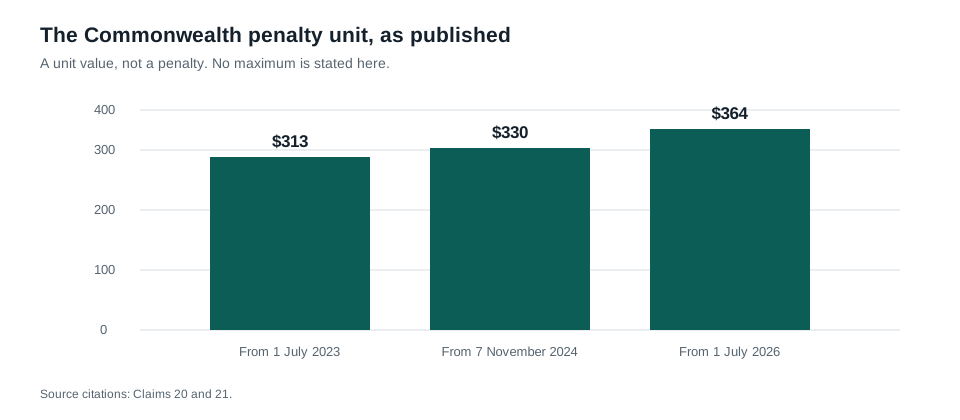
The figure below is not a payment diagram. It is the penalty unit drawing from the figure store, included because this is a costed guide and the contract requires one figure with its caption copied byte for byte. Its presence is not an invitation to turn a unit value into a maximum penalty. The caption itself says that no maximum is stated there, because multiplying a unit by a number of units is arithmetic and not a published figure. That is the same discipline as the wagering model: calculation is shown, sourced figures are attributed, and a product of two numbers is not promoted into a fact the source did not publish.
The practical reading of this section is a short checklist with no invented answers. The card name is a search intent. The scheme rule gap is claim 140 and says "nothing is published". The bank duty gap is claim 95 and says the bank is not obliged to block a gambling transaction by any primary source on this sheet. The voluntary block wording is claim 141, quoted without bank names. The statutory card and wallet list is claims 86 to 91, and it belongs to licensed Australian wagering, a different product that does not reach the casino offer. The withdrawal and payout gap is claim 142. The verification gap is claims 146 and 147. Every line ends where the source ends.
That is also why the buying guide does not print a comparison table of operator terms. In this environment operator sites are unreachable, so the build's stop conditions govern. No figure is estimated, no row is seeded from the supplied brand record, and no placeholder column is printed. The omission is not explained to the reader as a site issue. The prose simply does not claim to have read terms it has not read. The calculator remains useful because it works from assumptions the page states, not from an operator's unpublished cashier field.
When a reader sees a card logo beside a casino bonus, the question worth asking is not whether the logo looks familiar. It is whether the terms state the base of the multiple, the ceiling, the balance order, the withdrawal handling, the currency and the identity step. If those fields are not published, the cost model cannot be completed. A page that fills them from memory has made an offer sound more definite than the material allows. A page that keeps the gap visible has done the commercial job properly: it has helped the reader decide how much uncertainty is being bought with the $1,000 deposit.
The wagering operator next door
This is the single regulatory section on the page. Its comparator is licensed Australian wagering, which is a neighbouring product and not the casino offer being costed. The qualification is part of the section, not a note attached later: licensed Australian wagering is a DIFFERENT product, and s 15C does NOT reach a casino offer of the kind addressed by this page. No duty of a licensed wagering operator is applied to the casino offer. The comparison is used only to say what the reader does not get from that domestic regime when choosing the casino product.
The statutory material begins with Part 2B, "Prohibitions relating to credit and digital currency for certain interactive wagering services", at claims 83 to 85. The 2023 amendment was assented on 11 December 2023, with Schedule 1 items 1 to 29 commencing on 11 June 2024. Section 15B's simplified outline says: "Credit must not be provided to customers of certain interactive wagering services. Such services must also not accept or offer to accept payment using specified methods, including credit cards and digital currency." Those words are about certain interactive wagering services. They are not a general law of card use for casino offers.
Claim 86 states the offence where a person intentionally provides a regulated interactive gambling service that is a wagering service and accepts or offers to accept a payment method in s 15C(4A) from a customer physically present in Australia. The penalty stated by the provision is 500 units, with a civil penalty of 750 units under s 15C(3A). Claim 87 gives the exhaustive list: (a) a credit card; (b) an account, service or facility in which payment is made from a credit card linked to it; (c) digital currency; (d) a method of a kind determined by the Minister by legislative instrument. Claim 88 says a debit wallet funded from a debit card or bank account is outside paragraph (b), because that paragraph catches an account only where payment is made from a credit card linked to it. Claim 89 says digital currency takes the GST Act meaning. Claim 90 separately prohibits the provision or offering of credit, and facilitating or promoting the provision of credit by a third person, in connection with the service.
Claim 91 is the boundary. Every limb of s 15C is addressed to a person providing "a regulated interactive gambling service that is a wagering service". Read with s 8E's closed list, that means a licensed Australian betting operator. Section 15C does not bind an offshore online casino. A casino taking a credit card or crypto deposit from an Australian is not contravening s 15C by that act because s 15C does not reach it; the separate structural point is that an online casino served to a person at home is outside the licensed route altogether. The aside at the end of this fragment states the licence position in one line and cites claims 5, 14 and 15. This section does not build a "licensed here versus licensed offshore" argument, because no Australian licence exists for this product.
Two narrow exceptions sit inside the wagering regime. Claim 92 records s 15D for certain telephone betting where the provider's or group's annual wagering turnover is under $30 million and conditions are met, including a wholly voice call and wagering at an Australian racecourse. It records s 15E where the customer is itself a provider of a gambling service. Those exceptions are quoted here only to show the shape of the regime. They are not exceptions for a casino cashier, and they are not converted into advice. Claim 93 records the older National Consumer Protection Framework credit line implemented on 17 February 2018: "Online gambling service providers cannot provide credit to people who gamble on their site or app." Again, the framework's own stated scope, recorded at claim 102, is licensed wagering: "The National Framework applies to all licensed online wagering service providers." It does not mention online casinos.
Claim 94 is a NOT PUBLISHED finding under s 15C(4A)(d): no instrument made under that paragraph was located, and the Act's instruments page lists one 2019 instrument and names no such determination. The finding is recorded in the source as "nothing is published". A page may not say any method beyond (a), (b), (c) is covered. That is the correct treatment of paragraph (d) here. The existence of a power to determine another method is not a determination, and a gap in the instrument list is not permission to invent one.
Claim 95 is a NOT PUBLISHED finding about banks: no primary source states that a bank must block a gambling transaction. The bank is not obliged to block a gambling transaction by any primary source on this sheet. Claim 141 is the associated BetStop wording, quoted earlier in full and without bank names: "Many major banks let you block gambling transactions on your bank accounts. Contact your bank and ask them how they can help you." A bank by bank voluntary facility is not a statutory duty, and it is not a term of the Visa brand. No bank is named, no block is described in operation, and nothing about getting round a bank block is written.
Claims 99, 100, 101 and 102 describe the National Consumer Protection Framework and State and Territory inducement rules as the Commonwealth records them. Claim 99 says inducements are restricted by State and Territory law, not the Commonwealth, with implementation dates 26 May 2019 in all jurisdictions except NSW and 26 November 2019 in NSW, and quotes: "Online gambling providers cannot offer any incentives to open an account." Claim 100 records the Queensland consumer page wording about credit, vouchers, rewards, referral benefits, direct marketing and unsubscribe. Claim 101 lists the other framework measures and dates. Claim 102 states the framework's scope as licensed wagering. Claims 103 and 104 are gaps: the Commonwealth page has a "Last updated" field with no date, and the sheet did not research State and Territory statutes, so no section of a State Act and no penalty for an inducement breach are stated here. What may be said is that those rules bind licensed operators and therefore are not rules an offshore casino is within.
Claims 143, 144, 145, 146 and 147 concern identity verification. AUSTRAC states that from 29 September 2024 "all online gambling service providers must complete ACIP" before creating an online gambling account or commencing to provide any designated service, and that the AML/CTF Rules were amended to strengthen the applicable customer identification procedures. The interim period from 29 September 2023 to 28 September 2024 allowed some delay in special circumstances. The Commonwealth records the same as NCPF measure 3. But AUSTRAC's page does not qualify "all online gambling service providers", and this sheet does not resolve how far that reaches an offshore operator with no Australian presence. No source states what an offshore casino does or does not verify. The honest line is that the Australian verification rule is a rule about when an account may be opened, and nothing here is advice on avoiding an identity check.
Claims 59 and 60 belong to BetStop, not to s 15C, and they are included in this one comparator section because they show another domestic protection that stops at the product boundary. Claim 59 says BetStop's obligations reach only Australian licensed online and phone betting operators; they do not reach a casino game, which is not a wagering service under the statutory definition, and they do not reach an offshore operator. Claim 60 quotes BetStop: "BetStop - the National Self-Exclusion Register does not apply to online casino games or other gambling services that are illegally provided in Australia. You can make a complaint about these services to the ACMA". Claim 81 is not used, so the page says nothing about whether an offshore casino will accept a registered individual, checks the register, or does not check it. The consequence is stated as an absence of the duty, not as a feature of the offer. There is no content here that helps anyone past a self exclusion register.
Claims 161 and 162 are the complaints contrast. Queensland's consumer page tells a consumer to talk to the business first, then if unsatisfactory to "lodge a complaint with the government agency that issued the provider's licence", which should be displayed on the provider's website. Queensland complaints go to the Office of Liquor and Gaming Regulation, and for Northern Territory licensed providers the page points to NT Consumer Affairs. The same page says "You have consumer protections when using online gambling services" and "Australian online wagering providers must honour your consumer rights and meet their gaming licence requirements." That route works for licensed operators. It is not recast here as a route for a casino offer, and the page does not say a reader has Australian Consumer Law rights against an offshore casino or that they have none. Claims 163, 164 and 165 are NOT PUBLISHED gaps and are not used to fill the difference.
The commercial cost of the boundary is what the reader gives up, not a present tense rule invented for the casino offer to be absent from. A licensed Australian wagering operator sits inside a defined regime with credit and payment method prohibitions, BetStop duties, a licensing regulator a consumer can be pointed to, customer identification timing, a framework of account and marketing measures, and a complaints path that begins with the licensing authority. A casino offer is outside that product regime. That does not create a new casino rule. It means the reader cannot price the offer by assuming those protections travel with a familiar card logo. The price of the offer remains the wagering condition, the unpublished ceiling, the balance terms and the cashier handling described in this guide's own model.
The single regulatory section therefore ends where the comparator ends. Licensed Australian wagering is a DIFFERENT product. Section 15C is a rule for that product. It does NOT reach the casino offer. Claims 86, 500 and 750 units, s 15C(4A)(a) to (d), the debit wallet point in claim 88, the credit prohibition in claim 90, and the "who is bound" statement in claim 91 are all stated with their product boundary intact. "Nothing is published" under claim 94 stays a gap. The bank is not obliged to block a gambling transaction under claim 95. The BetStop quotation at claim 141 stays without bank names. Claims 138, 139, 142, 146 and 147 stay as gaps or limits. Claims 103 and 104 stay as dating and research limits. Claims 59 and 60 state only the absence of BetStop's reach. Claims 161 and 162 describe the licensed complaints route. Claim 81 is not used. Section 5 of the build is respected with zero procedural content about circumvention, and no second regulatory section appears anywhere else on the page.
The margin we assume
The margin we assume is not a house edge, a return to player figure, a volatility rating, a spin speed, a stake cap, a maximum win or a hit rate. No such figure for an online casino serving Australia is used on this page. The margin here is narrower and more useful to a buyer: the difference between the nominal balance shown at deposit and the turnover condition attached to the bonus. On the stated inputs, that is $2,000 against $40,000. The gap is a multiple of twenty, and it is generated by forty times the bonus alone.
The model can be stated in four lines. Deposit: $1,000. Bonus: $1,000. Multiple: forty times the bonus alone. Turnover: $40,000. Average stake: $12.50. Staked attempts: 3,200. AUD throughout. Those six figures are not operator terms. They are inputs and outputs of a calculation. The standfirst states them with the assumption, and the calculator repeats them so the reader can change the deposit, the bonus, the multiple or the stake without losing the currency label.
If the bonus stays at $1,000 and the multiple rises to fifty, the turnover becomes $50,000 and the staked attempt count becomes 4,000 at $12.50. If the bonus falls to $500 and the multiple stays at forty, the turnover becomes $20,000 and the count becomes 1,600. If the average stake falls to $10, the $40,000 condition becomes 4,000 staked attempts. If the average stake rises to $25, it becomes 1,600. Each result follows from the same equation. None of them tells the reader how a game will behave. They tell the reader how large the condition is under the assumption.
Offers of this kind sometimes attach the multiple to deposit plus bonus rather than to the bonus alone. On the same $1,000 deposit and $1,000 bonus, forty times deposit plus bonus would be $80,000 rather than $40,000. That is why the base matters more than the advertised number forty. This guide uses forty times the bonus alone because the user's instruction fixes that assumption for the page. It does not present the alternative base as a term of any cashier. It shows the alternative only to explain why a reader should read the base before comparing two offers.
A ceiling the cashier does not publish cannot be inserted into the model. If a term says that winnings from bonus play are capped, and the cap is printed, the model can show how much of the theoretical balance is excluded. If the cap is not printed, there is no sourced number to enter. The same applies to game weighting. If the terms say that some games contribute a stated percentage, that percentage can be applied. If the terms say nothing, the page does not import a percentage from another market or a named game. No game title and no studio is named on this page.
The margin also has a money handling side. A bonus can be sticky, a cash balance can be locked until the condition is met, a withdrawal can cancel the bonus, or a cashier can review the account before paying. Those are term shapes, not facts about a particular offer. The page does not assert that any of them applies. It says only that a $40,000 condition is not the same object as a $2,000 balance, and that a reader needs the balance order before deciding whether the offer is worth the deposit.
Claim 20 and claim 21, cited in the figure caption, show a related discipline. The Commonwealth penalty unit was $313 for an offence committed from 1 July 2023, $330 from 7 November 2024, and $364 from 1 July 2026. The caption says the figure is a unit value and not a penalty, and no maximum is stated because multiplying a unit by a number of units is arithmetic and not a published figure. The wagering model uses the same idea in reverse. It is honest about arithmetic, but it does not call the arithmetic an operator's published term. It labels the inputs, states the assumption, and leaves the unpublished fields unpublished.
The commercial choice is therefore between certainty and uncertainty. A reader who can see the base, the ceiling, the balance order, the currency and the withdrawal handling can compare the offer with another offer on the same fields. A reader who sees only a card logo, a match percentage and a spin count cannot. The model does not tell the reader which offer to buy. It tells them what has to be known before the price is knowable. That is the job of a buying guide built on a cost assumption rather than on a claim to have played, tested, timed or verified an operator first hand.
Lucky Aussie Reels models, calculates and cites. It does not play. There is no "we tested", no "our team", no "we played", no "we verified first hand", no star rating, no vote count, no review count and no "rated by players". There is no "guaranteed", no "risk" paired with "free", and no promise that a search phrase carrying a superlative makes the body a promise. The figures in this section are written in Australian dollars, with AUD throughout stated once in the standfirst and repeated only where the calculator needs a currency label.
The next section collects the gaps that remain after the arithmetic. It is not a second comparator section. It does not add a new regulatory regime. It holds the NOT PUBLISHED findings that stop the page from inventing a scheme rule, a bank duty, a withdrawal speed, a card treatment, a brand policy, an operator term or a verification behaviour. Each gap is written as a limit on this page, not as a hidden answer.
Limits that are not published
The most important sentence about Visa in the source base is "nothing is published". Claim 140 records that no scheme rule from Visa, Mastercard, Apple Pay or Google Pay about Australian gambling was located. This page does not write that Visa is permitted, prohibited, blocked, or faster. It does not write that a scheme has allowed Australian gambling, forbidden it, or prevented a transaction. It does not write that a card deposit arrives more quickly than another method. It does not write that a card deposit is safer. The sentence ends at the gap, because the gap is the sourced finding.
Claim 95 records that no primary source states a bank must block a gambling transaction. The bank is not obliged to block a gambling transaction by any primary source on this sheet. The page does not name a bank, does not state that a named bank offers a block, does not state that a named bank does not offer one, and does not describe a block's terms. Claim 141 permits the BetStop quotation used earlier: "Many major banks let you block gambling transactions on your bank accounts. Contact your bank and ask them how they can help you." That quotation appears without bank names and without any further operational description. Nothing in this fragment tells a reader how to get past a bank block.
Claims 138 and 139 record that nothing authoritative is published about PayID as a gambling payment method and nothing authoritative is published about Neosurf as a gambling payment method. Those findings are stated here only to keep the payment family clean. They are not used to draw a comparison with Visa. They are not used to assign availability, limits, fees, speed, safety or treatment by an Australian institution. Claim 133's ACMA wording about high volume, small value transactions to illegal services and claim 134's record of ACMA contacting providers of local payment services are regulatory material, not a scheme policy. They do not become a statement about a card brand.
Claim 142 says no published figure for Australian deposits, withdrawal times or payout speeds at offshore casinos exists on this sheet. The page states no withdrawal time for any operator or the offshore market. The $1,000 deposit, $1,000 bonus, $40,000 turnover, $12.50 stake and 3,200 staked attempts are model inputs and outputs in AUD. A minimum deposit figure may be presented only as a term an operator has stated for itself, and no such term is presented here. No "instant" claim is made. No "fastest" claim is made. No payout window is estimated from a neighbour.
Claim 94 says nothing is published under s 15C(4A)(d) as an instrument made under that paragraph, and claim 103 says the Commonwealth gambling reforms page carries a "Last updated" field with no date in it. Claim 104 says the sheet did not research State and Territory inducement statutes and states no provision from any of them. Claim 146 says AUSTRAC's phrase "all online gambling service providers" is not qualified and this sheet does not resolve how far it reaches an offshore operator with no Australian presence. Claim 147 says no source states what an offshore casino does or does not verify. Each is a limit, and each is written here as a limit.
Claims 138, 139, 140, 141, 142, 146 and 147 are NOT PUBLISHED or quotation limited findings. Claims 103 and 104 are NOT PUBLISHED findings about dating and research scope. The page uses only the words those claims permit. It does not turn a gap into a feature. It does not say that an absent verification rule makes an account easier to open. It does not say that an absent scheme rule makes a card deposit available. It does not say that an absent bank duty makes a payment certain. It does not say that an absent withdrawal figure means a quick payout. Absence is described as absence.
Claims 59 and 60 are included in the comparator section, and their consequence is also kept inside section 5 of the build. BetStop registration does not, by its own terms, reach an offshore casino. The page does not say an offshore casino will accept a registered individual, checks the register, or does not check it. Claim 81 is not used. There are no mirrors, no proxies, no VPN advice, no second accounts, no advice on registering without documents, no advice about gambling while registered, no advice about reaching a blocked site, and no description of getting round an identity check. The test is whether a reader could follow the words as an instruction. The answer is no throughout.
Claims 161 and 162 are used only to describe the licensed complaints route, and claims 163, 164 and 165 are not used to assert a result about Australian Consumer Law, an alternative dispute body, or the enforceability of an agreement with an offshore casino. The page does not say an agreement is enforceable or unenforceable. It does not say a reader has ACL rights against an offshore casino or that they have none. It does not name an Australian body that will hear a dispute against an offshore casino. It does not state that winnings are tax free. It does not state a dollar maximum penalty under the Interactive Gambling Act. It does not state that it is legal or illegal for a player to use an offshore casino.
The licence position is stated once in the aside at the end of this fragment: "No Australian licence exists for this product", with claims 5, 14 and 15 cited. That aside is not a comparison between a domestic casino licensee and an offshore one. There is no domestic casino licensee for this product. Section 15AA is the licence route for a closed class of regulated interactive gambling services, and online casino is not on it. The Commonwealth prohibition applies regardless of any State or Territory licence, and s 69 preserves concurrent State law without creating a category the Commonwealth has prohibited. No page may argue "licensed in Australia versus licensed offshore".
The limits also shape the language of the page. There are no em dashes, no en dashes and no double hyphens in §4. There are no exclamation marks in prose. Quotes and apostrophes are straight ASCII. Australian English is used: licence as the noun, organisation, authorised, analyse, offence, defence, practise as the verb and practice as the noun, enrol, fulfil, and program for software. The currency is AUD throughout, with $1,000, $40,000 and $12.50 written as figures the reader can act on. There are no hex values, no tracked addresses, no hand written image tags, no second H1, no title element, no JSON-LD block in this fragment, and no report appended after the content.
What remains after all the gaps is still a buying guide. The reader can model the bonus, choose a stake, see the turnover count, decide whether an unpublished ceiling is acceptable, and understand that the domestic wagering protections do not travel with the card label. The page helps the reader choose an offer without pretending that a missing source is a source. That is the commercial value of "nothing is published": it stops a confident sentence from charging the reader more than the arithmetic does.
Questions readers ask
- Is Visa permitted, prohibited, blocked or faster for Australian gambling?
- Nothing is published. Claim 140 records that no scheme rule from Visa, Mastercard, Apple Pay or Google Pay about Australian gambling was located, and this page does not say the card is permitted, prohibited, blocked or faster.
- How is the $40,000 figure calculated?
- The model uses a $1,000 deposit, a $1,000 bonus, forty times the bonus alone, a $12.50 average stake and AUD throughout. Forty times $1,000 is $40,000, and $40,000 divided by $12.50 is 3,200 staked attempts.
- Does s 15C reach a Visa casino offer?
- No. Section 15C is a rule for a regulated interactive gambling service that is a wagering service, read as a licensed Australian betting operator. Licensed Australian wagering is a DIFFERENT product, and s 15C does NOT reach the casino offer. Claim 91 states who is bound.
- Must a bank block a gambling transaction?
- No primary source states that a bank must block a gambling transaction. Claim 95 is a NOT PUBLISHED finding. BetStop says "Many major banks let you block gambling transactions on your bank accounts. Contact your bank and ask them how they can help you." No bank is named here and no block terms are described.
- Does BetStop reach an offshore online casino?
- BetStop registration does not, by its own terms, reach an offshore casino. Claims 59 and 60 state the scope rule. This page does not say that an offshore casino will accept a registered individual, checks the register, or does not check it, and it gives no procedure about gambling while registered.
- Is a withdrawal time or a minimum deposit published here?
- No. Claim 142 says no published figure for Australian deposits, withdrawal times or payout speeds at offshore casinos exists on this sheet. The $1,000 figure is a model input in AUD, not a market minimum, and no payout speed is stated.
Where the money goes next
Once the arithmetic is in view, the decision is about the terms that sit around it. A $1,000 deposit with a $1,000 bonus and forty times the bonus alone commits the reader to a $40,000 turnover condition under the model. At $12.50, that is 3,200 staked attempts. The reader can lower the deposit, lower the bonus, look for a lower multiple, raise or lower the stake, or walk away from an unpublished ceiling. Each choice is a choice about money, not about the card logo.
The next page worth reading is the money disclosure, because the advertising above this prose has a paid order and supplied wording. The page named How this site is paid itemises the arrangement. It is the one place on this build that names the ranking, and the link text is capitalised as a page title. The reader does not need any pointer to a count, a score, an operator or a live term to understand the commercial setting.
For the terms themselves, Reading the offers explains how to read the base of a multiple, a ceiling, a balance order, a currency and a cashier condition without importing a figure from an affiliate page. For the arithmetic, The margin we assume keeps the model separate from an operator's published term. For limits, Knowing when to stop carries the support material. For the payment family that includes this hub, E-wallet pokies is the onward title.
The five link texts above are repeated in the onward block in the required order and with the required capitalisation. They are names, not descriptions, so each opens with a capital. No link carries a lower case page title, no link carries a tracked destination, and no link names an operator. The board's own outbound controls remain inside the board render, with its cloak path and sponsored attributes held in the plugin store. This fragment writes no raw destination and no hand written image.
There is no second H1 here. There is no title element, no JSON-LD block, no report, no word count, no generated note, no markdown heading and no sign off. The fragment began with the exact H1 and will end with the closing tag of a content block. The seven h2 sections are complete, the contents list links to each one, the one calculator is in the first section, the one figure is in the second, the one regulatory section is the third, the FAQ has six pairs, and the licence aside follows the FAQ before the onward block.
The licence aside states the position once. It cites claims 5, 14 and 15. It does not compare a domestic casino licence with an offshore licence, because there is no Australian licence for this product. It does not say the offers are unlicensed as against an Australian licensed alternative. It does not say playing is legal or illegal. It does not say an agreement is enforceable or unenforceable. It does not say a reader has or has not got Australian Consumer Law rights against an offshore casino. It does not name an Australian dispute body for an offshore casino.
The final commercial sentence is a plain one. A reader who wants a casino offer should price the bonus first, then decide whether the unpublished fields are acceptable, and only then look at the cashier label. A card brand can help a reader find a page, but it does not supply the wagering base, the ceiling, the balance order, the withdrawal handling, the identity step or the domestic protections. Those are the fields that decide what $1,000 becomes. In this model it becomes $40,000 of turnover at forty times the bonus alone, with 3,200 staked attempts at $12.50, in AUD throughout.
Onward reading
Sources on this page are cited by claim number only. AT SOURCE statements are attributed to the provision or publisher named in the claim. NOT PUBLISHED findings state the gap and nothing else. Claims 54-82, 83-95, 99-104, 143-147, 161 and 162 are the only claims used, with claims 5, 14 and 15 in the licence aside and claims 20 and 21 in the figure caption as required by the supplied contract.
The one comparator on this page is licensed Australian wagering, a neighbouring product and not this one. The qualification is stated in the same section as every licensed wagering rule: licensed Australian wagering is a DIFFERENT product, and s 15C does NOT reach the casino offer. No second regulatory section is written. Claims 59 and 60 state the BetStop scope consequence. Claim 81 is not used. Section 5 of the build is respected with zero circumvention content.
Claim 140 is kept to "nothing is published". The page does not say Visa is permitted, prohibited, blocked, or faster. Claim 95 says the bank is not obliged to block a gambling transaction by any primary source on this sheet. Claim 141 is quoted without bank names. Claims 138, 139, 142, 146 and 147 are limits only. Claims 103 and 104 are dating and research limits. Claims 161 and 162 describe the licensed complaints route. Claims 94, 99, 100, 101 and 102 remain inside the single comparator section.
The model remains: $1,000 deposit, $1,000 bonus, forty times the bonus alone, $40,000 turnover, $12.50 average stake, 3,200 staked attempts, AUD throughout, and a ceiling the cashier does not publish. The assumption is stated in the standfirst and in the paragraph where the money is calculated. No operator term, no withdrawal time, no game figure, no studio name, no star, no vote, no invented reader and no invented testing is added.