A $1,000 bonus at forty times the bonus alone asks for $40,000 of eligible stakes before the bonus stops shaping the balance, and the first decision on this page is whether that $12.50 of apparent value per $1,000 of turnover is worth the price of taking an offer with no BetStop protection attached to it. All money on this page is in AUD, the assumption is that the wagering multiple applies to the bonus alone rather than to deposit plus bonus, the cashier ceiling is not published in the offer copy, and the cost being compared here is the cost of an absent Australian safeguard, not a claim that any present-tense rule for a casino has been broken.
What sits under this paragraph is advertising. Its order was bought, none of its wording was composed here, and no figure in it has been held against a source cited anywhere on this site. The arrangement behind it is set out at How this site is paid.
The offers in this block are advertising. Placement is paid. Copy is supplied by the operator and is printed unaltered. More at How this site is paid. The arrangement is itemised at How this site is paid.
The money before the absence
The phrase a reader brings to this page sounds like a category, but the buying question is narrower and more practical. It is whether an offer that sits outside the National Self-Exclusion Register is priced well enough to justify what is missing. This page helps choose an offer by putting that missing protection into the same calculation as the bonus. It does not treat being outside the register as a feature. It does not describe availability to any person. It does not describe any way past a self-exclusion decision, a bank block or an identity check. The comparison is between a bonus that asks for a large volume of play and a safeguard whose obligations do not attach to the product being bought.
Start with the ordinary shape of a welcome offer of this kind. A headline may turn $1,000 of bonus money into a requirement for forty times the bonus alone, which is $40,000 of eligible stakes. If a cashier does not publish a ceiling on conversion, the reader cannot turn the headline into a cash figure until the terms are read closely. The arithmetic is simple enough to do in advance: $1,000 divided by $40,000 is $0.025 of bonus face value per dollar of required turnover, and $12.50 is the bonus face value carried by each $500 slice of that turnover. That is not a return, not a value promise and not an outcome. It is only a way of seeing how small the headline becomes once it is spread across the obligation that gives it meaning.
The same calculation changes when the multiple applies to deposit plus bonus. On the assumption stated at the top of the page, it does not. A reader should still check the wording, because a bonus that attaches to both halves of the balance asks for a larger volume before the restriction lifts. A bonus that attaches to the bonus alone asks for $40,000 on a $1,000 headline. A bonus that attaches to deposit plus bonus on the same $1,000 deposit asks for $80,000. The difference is not a technicality. It changes how long the reader is likely to be playing before the withdrawal terms settle, how much of the session is shaped by the promotion, and how much ordinary bankroll management is displaced by the requirement to keep turning over eligible stakes.
Offers of this kind also arrive with more than one number. There may be a headline amount, a match percentage, a cap, a spin count, a minimum deposit, a list of eligible games, a maximum bet while the bonus is active, a time limit, a conversion ceiling, and a clause about what happens to bonus funds if the reader asks to withdraw early. None of those figures becomes a fair comparison until they are read as parts of one contract. A $1,000 headline with a low ceiling and a narrow game list can be a smaller offer than a lower headline with a wider ceiling and a cleaner withdrawal clause. The right question is not which number is largest. The right question is how many dollars of play are being bought, what terms govern those dollars, and what protections the reader gives up while the play is happening.
That last question is where this key becomes dangerous if it is written carelessly. A search phrase built on absence can be made to sound like a door. This page does not open that door. It prices the absence. The absence is that the duties BetStop places on licensed Australian online and phone wagering providers do not attach to casino games, and do not attach to an offshore operator. Those are statements about the reach of a duty. They are not statements about what any operator will accept, check, decline, request, notice or ignore. No primary source quantifies operator behaviour here, and no behaviour is invented to make the buying guide feel more complete.
The commercial frame is still a buying frame. A reader comparing two offers can prefer the one with clearer wagering, a lower effective turnover, a published ceiling and fewer clauses that turn a balance into a long session. That preference is rational. What this page asks the reader to add to it is the price of a missing national protection. A bonus with forty times the bonus alone may be a better written offer than one with a larger headline and a harsher multiple. It remains an offer from a product to which the BetStop obligations do not reach. The cost is not a fee printed in the cashier. It is the loss of a mechanism that, in a different product, would have closed accounts, stopped new bets, stopped marketing and refunded credit as part of one national process.
Keep the two ledgers separate. The bonus ledger contains dollars, multiples, caps and time limits. The protection ledger contains what a registered person can expect a licensed Australian wagering provider to do, and what nobody is obliged to do for a casino offer under that register. A choice made only on the first ledger looks cheap at the point of sign up and expensive later, because the second ledger is where the cost appears when a decision to stop needs institutional force. This page is arranged so that the second ledger is read before the reader acts on the first.
All figures here are AUD throughout, and the model uses $1,000, $40,000 and $12.50 as a way to hold the arithmetic still while the surrounding terms are examined. No operator term is being quoted as a measured market fact. Offers of this kind usually ask forty times the bonus alone, and a cashier at this end of the market rarely publishes the ceiling in the headline. Those are modelling assumptions, stated in the same paragraph as the figures they govern. The page calculates, cites and compares. It does not play, test, verify first hand or promise an outcome.
Reading the offers
Reading a casino offer well means reading the order in which money becomes constrained. First there is a deposit. Then a bonus is credited or spins are attached. Then the wagering requirement defines how much eligible stake volume must pass before the balance can be treated as ordinary money. Then the withdrawal terms decide whether the headline amount, any winnings from it, or only a capped portion can be requested. Finally, the account terms decide what documents, reviews or internal checks may sit between a request and payment. A careful reader writes those stages down before comparing headline figures, because a large first number can be made smaller at every later stage.
The wagering line is the place to begin. Under the assumption used on this page, the multiple is forty times the bonus alone. On a $1,000 bonus that is $40,000 of eligible stakes. If the terms instead say deposit plus bonus, the same $1,000 deposit and $1,000 bonus produce $80,000. If the terms say forty times the bonus but cap eligible stakes at a low figure per round, the number of rounds required to complete $40,000 can become the real time cost. If the terms exclude the games a reader wanted, the turnover has to be completed somewhere else. The headline does not tell any of this. The multiple does. The multiple also explains why $12.50 is a useful unit: it is the bonus face value in each $500 of required turnover when $1,000 is spread over $40,000.
Next read the ceiling. A cashier at this end of the market rarely publishes the ceiling in the first line of an offer, and a reader who does not find it before depositing has accepted an unknown cap on conversion. That unknown cap belongs beside the wagering multiple, not after it. If a bonus requires $40,000 of stakes and then limits the amount convertible to cash, the effective value of the promotion is not the $1,000 headline. It is the lower of the cap, the balance remaining after eligible play, and whatever the terms allow to be withdrawn. A buying guide can model that uncertainty, but it should not fill it with a cheerful estimate.
Next read the clock. A time limit converts a mathematical requirement into a schedule. Forty times a bonus alone is already $40,000 of eligible stakes. A short window makes that volume more demanding, because it reduces the reader's ability to stop, return later, or spread play across a budget. A long window does not make the requirement smaller. It only changes the pressure. The clock matters most on a page about self-exclusion because the absence of a national duty is felt precisely when a reader wants time and structure to hold. A promotion that compresses play into a short period is priced differently from one that does not, even if both show the same $1,000 headline.
Next read the game weighting and maximum stake clauses. Eligible stake volume is not the same as money passing through any game. If some games contribute less, $40,000 can require more than $40,000 of actual stakes. If a maximum stake is exceeded, bonus funds and winnings may be voided under the terms. These clauses are often written as routine housekeeping, but they decide whether the model on this page has any purchase. A reader who ignores them can believe the wagering requirement is being completed when the account ledger says otherwise. The point is not to hunt for a trick. The point is to translate the offer into a single sentence: how much play, on what games, at what stake, by what date, with what cap.
Next read the withdrawal wording. A reader may want to know whether bonus funds can be removed before the requirement is met, whether a withdrawal request cancels the promotion, whether winnings are reduced to a cap, and whether identity or payment review is described as a later step. That reading is part of pricing the offer. It is not a procedure for avoiding any check. Identity verification has its own legal setting in Australia, and a page can say that a rule exists without turning it into advice. AUSTRAC states that from 29 September 2024 all online gambling service providers must complete the applicable customer identification procedure before creating an online gambling account or commencing to provide any designated service, and that special circumstances formerly allowing delayed verification have been repealed. Claim 143. AUSTRAC's wording says all online gambling service providers without qualifying the phrase, and the sheet does not resolve how far that reaches an offshore operator with no Australian presence. Claim 146. The honest buyer's conclusion is narrow: a rule about when an account may be opened is not a substitute for reading the cashier's own terms, and nothing here says what an offshore casino does or does not verify. Claim 147.
Next read the promotional language around the offer. Incentives to open an account are regulated in Australia under State and Territory law for licensed wagering, not by the Commonwealth as a casino rule. The Commonwealth gambling reforms page records National Consumer Protection Framework measure 4 as regulated by states and territories, implemented 26 May 2019 in all jurisdictions except NSW and 26 November 2019 in NSW, with the wording that online gambling providers cannot offer any incentives to open an account. Claim 99. The same Commonwealth page states that the National Framework applies to all licensed online wagering service providers and does not mention online casinos. Claim 102. Queensland's consumer page says online providers and on-course bookmakers cannot offer credit or a voucher, reward or benefit to try to get someone to open a betting account, and that direct marketing is limited to customers who expressly opt in with easy unsubscribe. Claim 100. The sheet did not research State and Territory inducement statutes and states no provision from any of them. Claim 104. Those claims belong to a neighbouring product. They are cited here only to show that a framework the reader may have heard about is a licensed wagering framework, and it does not become a set of casino offer terms by association.
Finally, read what the offer does not say. It will not usually tell the reader that no Australian licence exists for this product. It will not usually price the loss of a national self-exclusion duty. It will not usually set out that a complaint about an illegal service is a regulatory complaint rather than a money claim. It will not usually say that ACMA describes consumers who access such websites as having little or no recourse. The absence of those sentences from an advertisement is not a defect in the advertisement. It is the reason a buying guide has to write them somewhere else.
A clean reading habit is to write a short note before depositing: bonus amount, wagering base, turnover, cap, date, eligible games, maximum stake, withdrawal consequence, and the protection that is absent. If one field cannot be found, the note should say so. That is not a score and not a rating. It is a way of stopping a large headline from doing all the work. On this key, add one more line that cannot be filled by the offer copy: BetStop's obligations do not reach a casino game and do not reach an offshore operator. Claims 58 and 59. Keep that line in the same note as the $40,000 turnover, because both are part of the price.
The margin we assume
The calculator below is a pricing instrument, not a prediction. It holds three things still so that the rest of the offer can be compared: a $1,000 bonus, forty times the bonus alone, and AUD throughout. It outputs $40,000 of required eligible stakes and $12.50 of bonus face value per $500 of that turnover. It does not output winnings, a return to player figure, a withdrawal time, a probability, a recommended stake, or a route to play. It does not tell a registered individual how to gamble. It shows how quickly a headline is diluted when it is spread over the volume of play the bonus asks for.
Change the bonus amount or the multiple to see the turnover and the $500 slice value. The default keeps the assumption used in the standfirst: $1,000, forty times the bonus alone, AUD throughout.
The output is arithmetic on the inputs. It is not an operator term, a published withdrawal figure, a payout speed, a game parameter or a statement about any account.
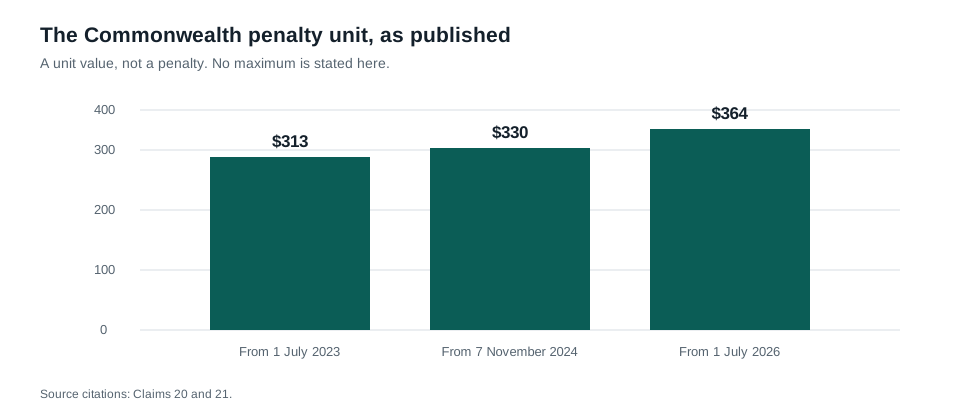
Why show a penalty unit figure on a page about a bonus? Because the figure is a unit value, not a penalty, and it is a useful reminder that a number printed by government is not automatically a number a reader can use as a dollar outcome. The drawing below is reproduced with the caption from the figure store. It says that no maximum is stated here, because multiplying a unit by a number of units is arithmetic and not a published figure. That discipline is the same discipline the calculator asks for. A $1,000 headline, a forty times multiple and a $12.50 slice are inputs and arithmetic. They are not an offer outcome.
The margin a reader should assume is wider than the gap between $1,000 and $40,000. It includes uncertainty about the cashier ceiling, uncertainty about eligibility, uncertainty about the clock, and the structural absence of an Australian casino licence. It also includes the absence of the BetStop duties that would, for licensed wagering, close accounts and stop marketing during a registered exclusion. A commercial page can still help a reader choose the better written bonus. It should not make that choice look as if the only cost is $40,000 of turnover. The absent protection is not a bonus term, but it is part of the price.
There is another limit on the model. Appendix G records no published figure for Australian deposits, withdrawal times or payout speeds at offshore casinos, and a page may not state a withdrawal time for any operator or the offshore market, nor present a minimum deposit figure as anything other than a term an operator has stated for itself. Claim 142. The calculator therefore has no payout field. It has no minimum deposit field. It has no field for a payment brand. A search intent about a payment method is not a legal category, and nothing authoritative is published about PayID as a gambling payment method beyond ACMA's risk statement about high-volume, small-value transactions to illegal services. Claim 133. That is a clean gap, and a clean gap is better than a plausible number.
Use the calculator in a plain way. If one offer doubles the bonus but also doubles the multiple, the turnover doubles and the slice value stays the same. If one offer lowers the multiple but narrows eligible games, the arithmetic improves while the practical burden may not. If one offer publishes a conversion ceiling and another does not, the published ceiling is worth more than an imagined one. If one offer asks for $40,000 and another asks for $80,000 on the same nominal bonus, the second is buying twice as much play. None of those sentences says which offer to take. They say what the reader is being asked to pay.
What BetStop covers and what it does not
This is the only regulatory section on the page, and its comparator is licensed Australian wagering. Licensed Australian wagering is a different product from online casino, and the rule described here does not reach the casino offer being priced. That qualification governs every paragraph below. BetStop is not being used as a rule the offer breaks. It is being used to show, by contrast, what a reader gives up when choosing a product to which those duties do not attach.
The register has a statutory base. Section 61HA(1) says the ACMA must arrange for a body corporate, the Register operator, to keep on behalf of the ACMA a register to be known as the National Self-exclusion Register, in electronic form and not as a legislative instrument. Claim 54. BetStop says Dataworks Group Limited, ABN 85 612 182 368, operates BetStop - the National Self-Exclusion Register on behalf of the ACMA, and section 61HA(6) bars ACMA from arranging with a gambling-service body corporate, a related one, one holding an ownership interest in one, or one undertaking gambling-related lobbying, with section 61HA(7) requiring that as a condition. Claim 55. The start date is 21 August 2023: the Commonwealth gambling reforms page gives that implementation date, the ACMA provider FAQ says cost recovery arrangements commenced on 21 August 2023, and the statutory mechanism is a proclaimed start day under section 61GC(1). Claim 56.
Who is bound is the whole point. Section 61KA(1) creates an offence for a licensed interactive wagering service provider who provides a licensed interactive wagering service to a registered individual, with a penalty of 500 units, and section 61KA(3) sets a civil penalty of 750 units. Claim 57. Section 61GB defines licensed interactive wagering service as a regulated interactive gambling service that is a wagering service under section 4, has an Australian-customer link under section 8, and is not provided in contravention of subsection 15AA(3). A wagering service is paragraph (a) or (b) of the section 4 definition: placing, making, receiving or accepting bets, or introducing those who want to bet. Claim 58.
That definition excludes the product on this page twice over. The consequence recorded in the fact base is that BetStop's obligations reach only Australian-licensed online and phone betting operators; they do not reach a casino game, because a casino game is not a wagering service under paragraphs (a) or (b), and they do not reach an offshore operator, because paragraph (c) requires the service not to contravene section 15AA(3), which means it must be licensed. An online casino is caught by section 15, not section 15AA, and is outside the definition twice over. Claim 59. Licensed Australian wagering is a different product and the norm does not reach casino. This paragraph is the qualification required whenever that neighbouring regime is used as a comparator on this page.
BetStop says the same in its own words. The sentence to quote is: "BetStop - the National Self-Exclusion Register does not apply to online casino games or other gambling services that are illegally provided in Australia. You can make a complaint about these services to the ACMA". Claim 60. The hyphen-minus in that quotation is printed as supplied. The words do not say that an offshore casino will accept a registered individual. They do not say that any operator checks the register, and they do not say that any operator does not check it. They state the scope of the register and point to a complaint route. Nothing in this section turns that scope statement into a behavioural claim.
What the register does cover is broad within its own product. BetStop describes it as a free and secure way to exclude yourself from all online and phone wagering providers licensed in Australia in one go, and as allowing a person to block access to all Australian licensed online and phone wagering providers in a single process. Claim 61. The FAQ says there is no partial exclusion: signing up excludes a person from all licensed online and phone wagering companies in Australia. Claim 62. The minimum duration is 3 months, up to a lifetime, with the statute providing months, years or life at sections 61JF(1), (3) and (5). Claim 63. Registration takes about five minutes and needs a mobile number, an email address and one of an Australian driver licence, Australian passport or Medicare card; others call 1800 238 786. Claim 64.
During registration, provider duties are concrete. BetStop says providers should not open a wagering account for you, allow you to place bets, or send you marketing material, and that providers should also close any accounts you have and refund any credit to you. Claim 65. Marketing prohibitions are statutory and separate: section 61LA covers regulated electronic messages to a registered individual's electronic address, with 120 units where the provider knows and 60 where reckless, and civil penalties of 180 and 90; sections 61LB, 61LC and 61LD cover telemarketing, direct marketing material and disclosure of a registered individual's information for marketing. Claim 66. Accounts are not simply waiting to be switched back on afterwards. BetStop's FAQ says wagering providers must close any existing accounts if a person self-excludes, and that if the person wants to start gambling again, a new account will be needed. Claim 67. Pending bets are the one carve-out: the ACMA provider FAQ says providers are not required to close an account until all pending bets are resolved, while they must stop new bets, and sections 61MB and 61MC distinguish the two cases. Claim 68.
The checking architecture is written for licensed wagering providers. Section 61NC(1) allows a provider to request the Register operator to inform it whether specified individuals are registered; section 61NC(3) obliges compliance within the period set by the Register rules; section 61NC(6) requires all reasonable steps to have a computer system and continuous internet carriage service enabling requests at any time of the day or night. Claim 69. The checking obligation has no fixed timing in the legislation and Register rules, and the ACMA provider FAQ says that to avoid committing an offence, a wagering provider can submit requests. Claim 70. Section 61KA(5) provides a due diligence defence where the provider took reasonable precautions and exercised due diligence to avoid the contravention. Claim 71. Section 61JP lets Register rules require providers to promote BetStop and ensure customers can readily access the website and app, with an offence of 120 units and a civil penalty of 180. Claim 72. Every one of those sentences is about a licensed wagering provider's duties. None is a description of casino account handling.
Early cancellation belongs in the same section for one reason only: it shows what the commitment costs to unwind. BetStop says a person can apply to cancel self-exclusion early after at least 3 months of self-exclusion, must complete a Commonwealth statutory declaration confirming they have seen a counsellor or a general practitioner to discuss the decision, will be removed after 7 days if the application is valid and correctly completed, and can withdraw the application at any time during that period if they change their mind. Claim 73. The fact base quotes this so a reader can see the weight of the decision. It is presented here as the price of the obligation, not as a loophole, not as a way out, not as a route to gambling while registered, and not as an instruction. A page about choosing an offer has no reason to turn a protective process into a shortcut, and this one does not.
Other boundaries matter. BetStop says a person must register with the National Self-Exclusion Register even if registered with an existing program, so State and Territory schemes are separate. Claim 74. BetStop's support tools page says there are other exclusion programs available to help block a person from other gambling services, including blocking yourself from venues with poker machines and casinos, and that these programs differ depending on where you live. Claim 75. A person needs to register themselves for BetStop. Claim 76. Up to five support people may be nominated, and they are told when registration changes, including an early-cancellation attempt. Claim 77. As at 30 June 2025, nearly 45,000 Australians had excluded themselves, with more than 30,000 active exclusions, and ACMA said it stepped up compliance and enforcement activities in 2024-25. Claim 78. Those figures describe the register, not the casino market.
One source difference must be stated without being smoothed over. The Department of Social Services page describing the tenth National Consumer Protection Framework measure says the register allows consumers to exclude themselves from "all interactive gambling services in Australia". BetStop's own about page says it "does not apply to online casino games or other gambling services that are illegally provided in Australia" and describes coverage as "all online and phone wagering providers licensed in Australia". Section 61GB is a third reading. Claim 79. The sheet does not resolve which the department meant. This page quotes BetStop's wording at claim 60 and cites the statutory definition at claim 58. It does not rest on the department's phrasing alone, and it does not present the two as saying the same thing. That distinction is not pedantry. A buyer who reads the broader phrase as if it covered online casino would think a protection exists where the register's own words say it does not.
Two omissions close the section. No source states how many operators are connected to BetStop. Claim 80. No primary source quantifies how many offshore casinos accept registered individuals, and nothing supports a claim that any proportion do; published is the scope rule at claims 59 and 60, and that is a statement about a duty, not about behaviour. Claim 81. Nothing here describes, and no page may describe, how a registered individual could gamble. Claim 82. The buying consequence is therefore stated only as absence: a person choosing an online casino offer is choosing a product outside the BetStop obligations. The page does not add a present-tense casino rule for that absence to be measured against, does not advertise the absence, and does not convert the absence into an instruction.
The cost of an absent protection
The cost of an absent protection is easiest to see by listing what a licensed Australian wagering provider must do for a registered individual, then removing every item before looking at the casino offer again. Account opening stops. New bets stop. Marketing stops. Existing accounts close. Credit is refunded. A national process applies across all licensed online and phone wagering companies in Australia rather than requiring a separate decision with each business. Claims 61, 62, 65. Those are not promises of good service. They are duties attached to a different product. Licensed Australian wagering is a different product and the norm does not reach casino, so for the offer being priced each item is absent rather than breached.
Now put the $1,000 bonus beside that list. The bonus asks for $40,000 of eligible stakes under the assumption used here. The absent protection does not add a dollar to the wagering requirement, but it changes what the $40,000 means. It is turnover completed in an environment where the national self-exclusion mechanism is not a term of the product and not a duty owed by the provider. A reader who wanted a single process to stop all licensed online and phone wagering in Australia has that process in its own product. A reader who takes a casino offer does not have it in this one. That is the whole comparison. It is not a claim that any person will be accepted, rejected, checked or left unchecked.
The comparison also changes the meaning of marketing. Section 61LA and the following provisions impose marketing prohibitions on licensed wagering providers in relation to registered individuals. Claim 66. Queensland's consumer page, addressing Australian online wagering providers, says Australian Consumer Law applies to gambling businesses, that it is illegal for businesses to act misleadingly or deceptively or unconscionably, or to claim gifts or prizes and not provide them, and that Australian online wagering providers must honour consumer rights and meet gaming licence requirements. Claim 162. The same page tells a consumer to talk to the business first, then if unsatisfactory lodge a complaint with the government agency that issued the provider's licence, which should be displayed on the provider's website; Queensland complaints go to the Office of Liquor and Gaming Regulation, and for Northern Territory licensed providers the page points to NT Consumer Affairs. Claim 161. Those are licensed-operator routes. They work because there is a licence issuer to complain to. They are cited here as the contrast, not as a route for a casino dispute.
For a casino offer, the complaint route named by BetStop is ACMA. Claim 60. A complaint to ACMA is a regulatory complaint, not a claim: ACMA may investigate under section 21, and Part 8 provides formal warnings, civil penalty enforcement, infringement notices, injunctions, enforceable undertakings, remedial directions and continuing contraventions, but nothing in Part 3 or Part 8 provides for a complainant to recover money and no provision found gives a complainant any remedy at all. Claims 26, 28, 156. Only a person with an Australian connection may complain at all under section 19. Claim 157. ACMA's own 2020-21 report says consumers who access these websites have little or no recourse, that winnings may not be honoured and incentives and pressure tactics are used to target gamblers, and that the services do not have the customer protections we expect in Australia. Claim 159. BetStop's own route for an online casino complaint is ACMA and nothing else. Claim 158.
No Australian alternative dispute resolution scheme, ombudsman or arbitration body covering online gambling was located, and the sheet names none. Claim 164. No source reached says whether or how Australian Consumer Law is enforced against an offshore gambling operator with no Australian presence; claim 162 is a State consumer page addressing Australian providers, so a page may not say a reader has Australian Consumer Law rights against an offshore casino, and may not say they have none. Claim 163. Whether an agreement with an offshore casino is enforceable and whether civil proceedings lie to recover money remain open on the fact base, because no regulations under section 69A were located. Claim 165. A buying guide that priced a $1,000 bonus as if a familiar complaints pathway sat behind it would be pricing a protection that is not part of the offer.
There is a second absent layer in the cost model. Identity verification is an AML obligation, not an interactive gambling obligation, and AUSTRAC states it bites before the account exists. Claim 143. AUSTRAC's page says all online gambling service providers without qualifying the phrase, and the sheet does not resolve how far that reaches an offshore operator with no Australian presence. Claim 146. No source states what an offshore casino does or does not verify; the honest line is that the Australian verification rule is a rule about when an account may be opened, and a reader taking an offer from outside the Australian system has no Australian body to hold to it. Claim 147. That is a statement about institutional reach. It is not a hint about documents, account creation, second accounts, registering without documents or getting past an identity check. None of those procedures appears here.
The credit and digital currency rules are another neighbouring set of duties that must not be silently transferred. Part 2B of the Interactive Gambling Act 2001 is headed prohibitions relating to credit and digital currency for certain interactive wagering services. Claim 83. It was substituted and amended by the Interactive Gambling Amendment (Credit and Other Measures) Act 2023, assented 11 December 2023, with Schedule 1 items 1 to 29 commencing 11 June 2024 and items 30 to 36 on 12 December 2023. Claim 84. Section 15B's simplified outline says credit must not be provided to customers of certain interactive wagering services and that such services must also not accept or offer to accept payment using specified methods, including credit cards and digital currency. Claim 85. Section 15C(1A) creates an offence where a person intentionally provides a regulated interactive gambling service that is a wagering service and accepts or offers to accept payment using a method in section 15C(4A) from a customer physically present in Australia, with 500 units and a civil penalty of 750 under section 15C(3A). Claim 86.
The list in section 15C(4A) is exhaustive on the fact base: a credit card; an account, service or facility in which payment is made from a credit card linked to it; digital currency; and a method of a kind determined by the Minister by legislative instrument. Claim 87. Paragraph (b) catches an account only where payment is made from a credit card linked to it, so a digital wallet funded from a debit card or bank account is not caught by that limb. Claim 88. Digital currency has the same meaning as in the A New Tax System (Goods and Services Tax) Act 1999 and is not defined afresh. Claim 89. A separate credit prohibition in section 15C(1) covers providing, offering, facilitating or promoting credit in connection with the service to a customer physically present in Australia, with 500 units and a civil penalty of 750 under section 15C(3). Claim 90. Every limb is addressed to a person providing a regulated interactive gambling service that is a wagering service, read with section 8E, so it means a licensed Australian betting operator; section 15C does not bind an offshore online casino. Claim 91. Two narrow exceptions exist for certain telephone betting and for a customer that is itself a provider of a gambling service. Claim 92. The older credit lines ban is recorded under the National Consumer Protection Framework as measure 1, implemented 17 February 2018. Claim 93. No instrument under section 15C(4A)(d) was located, so the sheet does not say any method beyond the three named limbs is covered. Claim 94. No primary source states that a bank must block a gambling transaction. Claim 95. BetStop describes bank gambling blocks as voluntary and bank-by-bank, and no list of banks offering them was located; its own words are "Many major banks let you block gambling transactions on your bank accounts. Contact your bank and ask them how they can help you." Claim 141. That sentence is quoted as a support statement, not as advice on how a block behaves, and nothing here describes getting round a bank block.
The point of walking through Part 2B is not to write a payment guide. It is to show how many Australian rules a reader may have heard about are wagering rules. Licensed Australian wagering is a different product and the norm does not reach casino. When a reader sees a bonus wrapped in payment language, the sound comparison is not "this method is allowed" or "this method is banned". It is that the statutory protections built around licensed wagering are not conditions of the casino offer, and the reader is pricing what is absent. The calculator's lack of a payment field is deliberate. It refuses to turn a search intent into a legal category.
The same caution applies to the inducement framework. The Commonwealth records measure 4 as State and Territory regulation of incentives to open an account, with implementation dates 26 May 2019 and 26 November 2019 in NSW. Claim 99. Queensland's consumer page spells out a voucher, reward or benefit restriction and an opt-in rule for direct marketing. Claim 100. The Commonwealth page lists the rest of the National Consumer Protection Framework: measure 3 customer verification, measure 5 account closure, measure 6 voluntary opt-out deposit limits, measure 7 monthly activity statements, measure 8 consistent gambling messaging, measure 9 staff training and measure 10 BetStop, with implementation dates. Claim 101. Its own stated scope is licensed wagering: "The National Framework applies to all licensed online wagering service providers." Claim 102. The Commonwealth page carries a Last updated field with no date in it, so the sheet cannot date the measures beyond their stated implementation dates. Claim 103. No State or Territory inducement statute was researched and no provision or penalty from one is stated. Claim 104. A $1,000 welcome headline is therefore not priced against a domestic casino inducement rule. It is priced against the terms it carries and the protections it lacks.
Help and support close the cost section without turning it into a call to play. BetStop's own number for registration help and for identity documents other than the three it lists is 1800 238 786. Claim 180. The National Gambling Helpline is published by the Commonwealth as 1800 858 858, a free and confidential helpline open 24 hours a day, 7 days a week. Claim 176. BetStop says free and confidential support is available 24 hours a day, every day of the year, on that number, and that these services are available for anyone affected by a gambling issue, not just the person who is gambling. Claim 178. Gambling Help Online publishes the same number as the "Gambling Helpline", says the service is available 24 hours a day, 7 days a week, and describes free calls, confidential support, crisis support, a listener, referrals, information, and tips and strategies. Claim 177. One State-badged page publishes the same number under the name "Gambler's Help". Claim 186. The number is the same across all sources, the service name is not, and the sheet does not pick one. A page must quote the name used by the source it cites. No source states who operates the National Gambling Helpline. Claim 187. No State or Territory gambling helpline number is on the sheet. Claim 188.
The buying conclusion is plain. An offer with a clear multiple, a published ceiling and fewer harsh clauses may be the better written offer. It still sits outside a national self-exclusion system whose duties are attached to licensed online and phone wagering, not casino. That is not a feature. It is a cost. If the cost is unacceptable, the correct commercial decision is not to look for a clever way to keep the bonus and recover the protection. It is to stop before the bonus turns into $40,000 of play.
Knowing when to stop
A buying guide has to say where its own advice ends. This one helps a reader compare offers by modelling wagering and by pricing the absence of BetStop protection. It does not help a registered individual gamble, does not describe a path around a self-exclusion decision, an identity check or a bank block, and does not treat "not on BetStop" as a benefit. The moment a reader is looking for a way to continue after deciding to stop, the correct response is not a better bonus calculation. It is support, time and the protective process that belongs to the reader's own decision.
BetStop's design shows why. It is a single process across all licensed online and phone wagering providers in Australia, with no partial exclusion. Claims 61 and 62. Its minimum is 3 months, up to a lifetime. Claim 63. Providers should not open an account, allow bets or send marketing, and should close accounts and refund credit. Claim 65. Accounts are not reactivated afterwards. Claim 67. Support people can be nominated and told when registration changes, including an early-cancellation attempt. Claim 77. Those details are written here not as mechanics to work around, but as evidence that the commitment is meant to have weight. The early-cancellation wording, with a statutory declaration, a counsellor or general practitioner discussion, a 7 day period and a right to withdraw the application, is quoted only as the cost of unwinding a serious decision. Claim 73. It is not a loophole and not a route to gambling while registered.
For a person reading this page while registered, the useful sentence is short: the register's own words say it does not apply to online casino games or other gambling services illegally provided in Australia, and it points complaints about those services to ACMA. Claim 60. That sentence identifies a gap in coverage. It does not supply a method. Nothing on this page says an offshore casino will accept a registered individual, says any operator checks the register, says any operator does not check it, or quantifies any proportion. Claim 81. Nothing describes how a registered individual could gamble. Claim 82. A search phrase built on absence does not become a set of instructions just because a buyer arrived with it.
Support is available and is named as published. The Commonwealth describes the National Gambling Helpline on 1800 858 858 as free and confidential, open 24 hours a day, 7 days a week. Claim 176. BetStop says free and confidential support is available 24 hours a day, every day of the year, and that these services are available for anyone affected by a gambling issue, not just the person who is gambling. Claim 178. Gambling Help Online says calls are free, will not appear on a phone bill, and that counsellors provide confidential free support, crisis support, a listener, referrals to local ongoing gambling counselling, information, and tips and strategies. Claim 177. The website contains self-help material that can be accessed for free and provides free 24/7 chat and email counselling and support. Claim 179. BetStop publishes Lifeline as a national service providing free 24/7 help and crisis support, with 13 11 14, text 0477 131 114, or online chat. Claim 181. It publishes the National Debt Helpline on 1800 007 007 for free and confidential advice from professional financial counsellors, open from 9:30 am to 4:30 pm, Monday to Friday. Claim 182. It says Gamblers Anonymous hosts local meetings across Australia, describes Reset as a confidential and free app that helps if a person wants to quit or cut back on gambling, and points to Moneysmart for free tools, tips and guidance, including guidance on where to obtain free legal advice. Claim 183.
Access details are also published. Gambling Help Online says the Gambling Helpline can arrange an interpreter, or a caller can contact the Translating and Interpreting Service on 131 450; for hearing or speech impairment the page directs contact through the National Relay Service and gives no number. Claim 184. State and territory services differ, and BetStop points to Gambling Help Online to find services available in a person's area. Claim 185. The sheet states no State or Territory helpline number, and it does not say the national number is the only one. Claim 188. It also states no operator of the National Gambling Helpline. Claim 187. Those limits are kept because help information should be accurate rather than expansive.
Bank blocks are another place where this page stops. BetStop says many major banks let you block gambling transactions on your bank accounts and tells a reader to contact their bank and ask how they can help. Claim 141. No list of banks offering them was located, no block's terms are stated, and nothing here says how a block behaves. Claim 141. No primary source states that a bank must block a gambling transaction. Claim 95. Sources describing how to get round a bank block were found during the build and nothing from them appears here. Claim 141. The same silence applies to identity checks: the sheet records an AUSTRAC rule about when an account may be opened, records that its offshore reach is unresolved, records that no source states what an offshore casino verifies, and writes nothing as advice on avoiding an identity check. Claims 143, 146 and 147. Silence is the content here.
There is a practical reading of the calculator that fits this section. If a $1,000 bonus at forty times the bonus alone becomes $40,000 of eligible stakes, a reader who no longer wants that volume of play has already learned something from the arithmetic. The $12.50 slice value is not a reason to continue. It is a way of seeing that the headline was never $1,000 in the hand. It was a requirement to keep playing. When the reason for reading an offer changes from comparison to continuation, the comparison is over. Stop the calculation, keep the budget intact, and use the support numbers rather than looking for a route back into the session.
Commercial pages usually end a section like this by returning the reader to an offer. This one returns the reader to the price. Offers of this kind ask for a large volume of play under terms that often leave the ceiling unpublished. They also sit outside the BetStop obligations that, in licensed Australian wagering, would stop accounts, bets and marketing during a registered exclusion. Licensed Australian wagering is a different product and the norm does not reach casino. That is the cost. A reader who accepts it should do so before the bonus is credited, with the wagering line, the ceiling, the clock and the absent protection all written down in the same note. A reader who does not accept it should not look for a workaround. They should stop.
Questions readers ask
- Does BetStop apply to online casino games?
- BetStop's own about page says: "BetStop - the National Self-Exclusion Register does not apply to online casino games or other gambling services that are illegally provided in Australia. You can make a complaint about these services to the ACMA". Claim 60. Section 61GB defines licensed interactive wagering service by reference to a wagering service, an Australian-customer link and section 15AA(3). Claim 58. The obligations reach only Australian-licensed online and phone betting operators, not a casino game and not an offshore operator. Claim 59. Licensed Australian wagering is a different product and the norm does not reach casino.
- Does this page say an offshore casino will accept a registered person?
- No. No primary source quantifies how many offshore casinos accept registered individuals, and nothing supports a claim about any proportion. Claim 81. The published point is the scope of a duty, not operator behaviour. This page does not say that an operator checks, does not check, accepts, declines, notices or ignores a registration, and it gives no method for a registered individual to gamble. Claims 81 and 82.
- Why is "not on BetStop" treated as a cost rather than a feature?
- Because the register's duties are concrete within licensed Australian wagering: no partial exclusion, no new account, no bets, no marketing, closure of existing accounts and refund of credit. Claims 62 and 65. Those duties do not attach to a casino offer. Claim 59. A buying guide can compare the bonus terms, but it should price what is absent. Presenting the absence as availability would turn a protection gap into an advertisement for circumvention, and this page does not do that.
- How is the $40,000 figure calculated?
- The standfirst assumes a $1,000 bonus with wagering of forty times the bonus alone, in AUD throughout. Forty times $1,000 is $40,000 of eligible stakes. Each $500 slice of that turnover carries $12.50 of bonus face value. If the terms applied the multiple to deposit plus bonus instead, the same $1,000 deposit would produce $80,000. These are modelling figures, not an operator term, a return, a withdrawal time or a payout promise. Claim 142 records that no published figure for Australian deposits, withdrawal times or payout speeds at offshore casinos exists on the sheet.
- What does early cancellation from BetStop mean on this page?
- It is quoted only to show what the commitment costs to unwind. BetStop says a person can apply after at least 3 months of self-exclusion, must complete a Commonwealth statutory declaration confirming a discussion with a counsellor or a general practitioner, will be removed after 7 days if the application is valid and correctly completed, and can withdraw the application during that period. Claim 73. It is not a loophole, not a way out, not a route to gambling while registered, and not an instruction. The minimum duration and the single process are part of the protection's weight. Claims 61, 62 and 63.
- Where can a reader get help instead of reading more offer terms?
- The Commonwealth publishes the National Gambling Helpline on 1800 858 858 as a free and confidential helpline open 24 hours a day, 7 days a week. Claim 176. BetStop says support is available for anyone affected by a gambling issue, not just the person who is gambling. Claim 178. Gambling Help Online publishes free 24/7 chat and email counselling and support. Claim 179. BetStop's own registration help number is 1800 238 786. Claim 180. Lifeline, the National Debt Helpline, Gamblers Anonymous, Reset and Moneysmart are published as support options at claims 181, 182 and 183. The source names for the 1800 858 858 service differ, and the sheet does not pick one. Claim 186.