A no deposit bonus code is a condition for releasing an offer, not a change to the offer's arithmetic. Assume a $1,000 bonus credited in AUD after the code is accepted, with forty times the bonus alone to clear, an unpublished cashier ceiling, AUD throughout, and no Australian licence for this product. On that assumption the turnover is $40,000, and a $12.50 average stake is the unit that turns that total into 3,200 settled stakes before the bonus balance can be treated as withdrawable value.
What sits under this paragraph is advertising. Its order was bought, none of its wording was composed here, and no figure in it has been held against a source cited anywhere on this site. The arrangement behind it is set out at How this site is paid.
The offers in this block are advertising. Placement is paid. Copy is supplied by the operator and is printed unaltered. More at How this site is paid. The arrangement is itemised at How this site is paid.
What the code does to the offer
The code is the first condition a reader meets. It is a string entered at sign up, in a cashier field, in an account area, or in a promotion screen, and the supplier treats its acceptance as the event that attaches the bonus to the account. It is easy to give that event too much importance. A code does not alter a multiple, does not decide what the multiple is applied to, does not set a cashier ceiling, does not create a currency conversion, and does not change the order in which the cashier counts a stake. A code unlocks a set of terms. The terms do the costing. When a reader searches for no deposit bonus codes, the useful question is not whether the string is current, obscure, exclusive, or tied to a landing page. The useful question is what balance appears when the string is accepted and what the balance must then do.
On this page the assumed balance is $1,000 in AUD. That figure is an editorial model, not an operator's published term. The assumed condition is forty times the bonus alone. The assumed cashier behaviour is that a ceiling exists but is not published in the offer copy. The assumed currency is AUD throughout, so the model never switches between dollars, coins, chips, points, or a wallet unit without saying so. Those assumptions are stated here because a costed guide must keep its arithmetic and its assumptions in one place. If a reader changes the balance, the arithmetic changes in proportion. If a reader changes the basis of the multiple from bonus alone to deposit plus bonus, the arithmetic changes again. If a reader changes the currency, the model is no longer this model. The code remains what it was: a gate, not a multiplier.
Offers of this kind usually present a code as though it were the value. The visible words may say that a code grants a chip, a bundle of spins, or a matched balance. The reader may be invited to copy the string before opening an account, to treat it as time sensitive, or to compare it with a second string on another page. Each of those habits is about acquisition. None tells the reader the settlement path. A $1,000 bonus with forty times the bonus alone asks for $40,000 of counted turnover before the bonus can be considered cleared. The same $1,000 bonus with a multiple applied to deposit plus bonus would ask for more, because the deposit would be inside the base. The same $1,000 bonus with a ceiling that is published at $5 per settled stake would impose a different path from a ceiling that remains unstated. The code is identical in all three. The cost is not.
The word "no deposit" also needs careful handling. It describes the condition for receiving the starting balance, not the whole life of the offer. A reader may put no money in at the start and still meet a cashier condition later, a verification condition later, a game contribution condition later, or a withdrawal condition later. This page does not assume that any later deposit is required. It also does not assume that none will be requested. Nothing on this sheet supplies a market rule for those steps, so the honest model stops at the arithmetic of the credited bonus and the uncertainty of the cashier. A code that opens an account without a first deposit can still leave the reader with a large turnover figure, an unpublished ceiling, and a balance whose status depends on terms that the reader has to read after the code has done its work.
Class H offers are costed here by the numbers a reader can act on, not by the excitement of the string. A code can be short, memorable, capitalised, or decorated with a season or a campaign name. It can arrive by email, in a banner, in a search result, or inside an account message. It can be labelled exclusive. It can be replaced tomorrow. In every case, the disciplined reading begins after acceptance: what is the credited amount, in what currency, what is the multiple, what is the base, what stake sizes count, what is the ceiling, and what happens to a balance that has not cleared. The first five of those can be modelled. The last one belongs to the terms and to the absence of an Australian licence condition behind them.
The model used here is deliberately plain. A $1,000 bonus is credited. Forty times that bonus alone is $40,000. A $12.50 average stake divides $40,000 into 3,200 counted stakes. If the reader instead settles at $10, the count is 4,000. At $20, the count is 2,000. At $25, the count is 1,600. Those are not predictions of a game result; they are unit counts from the turnover requirement. A no deposit code does not change any of them. It cannot make $40,000 smaller, because the multiple and the base make it what it is. It cannot make $12.50 larger in the model, because $12.50 is a chosen average stake for showing the scale of the requirement. The commercial value of a code is therefore the value of the terms it opens, and the first term worth pricing is the multiple.
A second reason to keep the code separate from the arithmetic is that codes travel badly. A string copied from one page may be attached to a landing page with one headline and a cashier with another set of terms. A string may be reused after a campaign ends. A string may be printed beside a figure that belongs to a deposit offer rather than a no deposit offer. A string may be presented with a currency marker that the cashier does not use. The model on this page does not try to resolve those supply problems. It refuses to let them contaminate the calculation. The reader can ask whether the code is accepted. After that, the reader still has to cost the credited balance in AUD, on the multiple, and against the ceiling.
There is also a difference between a condition and a protection. A code may be a condition for entry into a promotion, but it is not a consumer protection. It does not supply a dispute body, a published Australian licence condition, a self exclusion obligation, a technical standard, or a guaranteed withdrawal. The word guaranteed is not used here as a promise, and no page should treat an entered string as a substitute for those absent features. A code is an instruction to the supplier's promotion program. The protections a reader might expect from an Australian regulated product are not created by that program. Later sections set out what is absent, using the sourced claims available for this build and stopping where the published record stops.
For a buying decision, the practical order is simple. Read the code. Then read the credited amount. Then read the base of the multiple. Then read the ceiling. Then read the currency. Then read what happens to bonus funds, winnings, and any residual balance when the requirement is met or when a cashier condition is not met. If the code is accepted but any one of those terms is unclear, the reader has not bought clarity; the reader has bought an account state that still depends on the supplier's own terms. The $1,000 to $40,000 model is useful precisely because it is indifferent to the code. It shows the size of the condition before the marketing language is allowed to set the reader's expectations.
Organisation matters too. A page about no deposit bonus codes can become a list of strings, and a list of strings ages faster than the method. Lucky Aussie Reels costs the offer class with one assumed balance and one assumed multiple so that the reader can reuse the method after a code changes. The code may be new, the banner may be new, and the campaign may be new. Forty times $1,000 remains $40,000. A $12.50 average stake remains one three thousand two hundredth of that turnover. AUD remains the currency of the model. That is the part a buyer can carry from one offer to the next.
Finally, the code should not be treated as evidence that a figure came from a primary source. A supplier's promotion string is marketing. The sourced material used on this page is the claim record for the Act, the regulator, the BetStop scope statements, and the dispute material, each cited by claim number. The model figures are labelled as assumptions. Those two kinds of statement do not mix. A code sits with the offer. Claims sit with the law and the published record. The calculator sits between them, doing arithmetic on the assumption and nothing else.
Turnover in AUD before a cashier decision
The central number is $40,000. It comes from the assumption in the standfirst: a $1,000 bonus, forty times the bonus alone, AUD throughout. The code has no role in that multiplication. It does not enter the base and it does not enter the multiple. The expression is 1,000 x 40 = 40,000. If the code is accepted, the model starts. If the code is rejected, the model never starts. Once it starts, the code is finished. This is the cleanest way to explain why a code page should not be written as a collection of strings. The reader's exposure is in the turnover, and the turnover is set by the bonus balance and the terms attached to it.
Turnover is not a loss figure and it is not a win figure. It is a count of stakes that the promotion terms treat as counting toward a requirement. A $40,000 requirement can be described in average stake units without pretending to know any game outcome. At $12.50, 3,200 counted stakes are needed. At $5, 8,000 counted stakes. At $50, 800 counted stakes. A reader who fixes on the bonus amount sees $1,000 and may think of it as a starting balance. A reader who fixes on the requirement sees $40,000 and understands the scale of the activity the terms ask for. The second reader is pricing the offer. The first is reading the headline.
The cashier ceiling is the next number, and in this model it is not published. That absence is not filled with an estimate. A ceiling can matter because it changes how quickly counted turnover can accumulate and because it can decide whether a reader's usual stake is allowed to count in full. If a ceiling is hidden, the reader cannot know the number of stakes required at their preferred stake size, and cannot know whether a larger stake will count only in part. The $12.50 figure in this guide is therefore an arithmetic unit, not a claim about a cashier limit. It lets the reader see that $40,000 is 3,200 units of $12.50. It does not say that $12.50 is permitted, prohibited, optimal, or published.
A second uncertainty is contribution. Some terms count different games differently, and some exclude stakes entirely. This sheet does not publish a contribution schedule for any operator, so the model does not invent one. The $40,000 figure assumes that each counted dollar of stake counts as a dollar toward the requirement. If a term says that only part of a stake counts, the required activity rises. If a term treats a game as excluded, the activity on that game does not reduce the requirement. The code does not settle either point. The reader has to look at the bonus terms after the code, and the absence of a published ceiling means the reader may still be missing a number that the model needs.
Currency discipline protects the calculation. AUD throughout means the $1,000, the $40,000, and the $12.50 all sit in the same unit. A promotion that prints a coin amount, a USDT amount, a token amount, or an unmarked currency marker is not covered by this model. A reader should not add a converted figure to the calculation and then compare it with the AUD total. The organisation of the offer matters here because a conversion can make the bonus look larger or smaller without changing the multiple. Forty times any bonus alone is still forty times that bonus. If the currency is not AUD, the reader needs a new model, not a converted line inside this one.
The model also separates the bonus from any later deposit. "Bonus alone" means the deposit is outside the base. If a reader makes a deposit later, that deposit does not become part of the $1,000 base in this model. If a supplier instead applies the multiple to deposit plus bonus, the base is larger and the turnover is larger. A code that advertises no deposit at sign up may still be attached to terms that price a later deposit into the requirement. This page does not assume that happens, because no primary source on this sheet supplies an operator term for it. The page does insist that the reader identify the base before comparing offers. Bonus alone and deposit plus bonus are not two ways of saying the same thing.
A useful way to compare two code offers is to hold the code constant and vary the terms. Offer A: $1,000 bonus, forty times the bonus alone, AUD, ceiling unpublished. Turnover $40,000. Offer B: $1,000 bonus, forty times deposit plus bonus after a later $1,000 deposit, AUD, ceiling unpublished. Turnover $80,000. The strings may be identical in length and both may be accepted. The second offer asks for twice the counted activity because the base doubled. Offer C: $500 bonus, forty times the bonus alone, AUD, ceiling published at a stake size the reader can read. Turnover $20,000, and the path is more legible because the ceiling is known. A buyer who ranks by code novelty misses all of that. A buyer who ranks by turnover and published terms sees it immediately.
The unpublished ceiling also affects the meaning of $12.50. If the reader chooses $12.50 as an average stake for arithmetic, the 3,200 unit count is a scale marker. If the cashier's ceiling is lower, the reader cannot simply use $12.50 to plan the path. If the cashier counts a stake at less than its full value, the 3,200 unit count is again only a scale marker. The correct conclusion is not that the model fails. The correct conclusion is that the model exposes a gap. The reader knows the total requirement, knows the assumed unit, and knows that a term needed to complete the plan has not been published in the offer copy. That is a better buying position than a page that fills the gap with a confident number.
Withdrawal conditions are another boundary. This guide does not state a withdrawal time, a payout speed, or a deposit minimum for any operator, because claim 142 says no published figure for Australian deposits, withdrawal times or payout speeds at offshore casinos exists on this sheet. The calculator does not estimate one. The prose does not hint at one. A reader may want to know when cleared value can be requested, but the sourced record does not supply a market figure, and an operator's own stated term is not used here as a model assumption. The costed guide stays with the arithmetic that can be done and the absences that can be cited.
The figure below belongs to this section's method, not to the promotion. It shows a published unit value, not a penalty, and its caption says that no maximum is stated there. The reason it sits beside a costing discussion is discipline: a unit is not a total, a multiple is not a penalty, and an arithmetic product is not a sourced maximum. The same discipline applies to $1,000 x 40. The calculation is useful. It is not a published operator term. The code is useful for entry. It is not a source of the calculation.
Cost the assumed bonus. The code is not an input.
AUD throughout. The cashier ceiling is assumed unpublished, so this is a unit count and not a withdrawal plan.
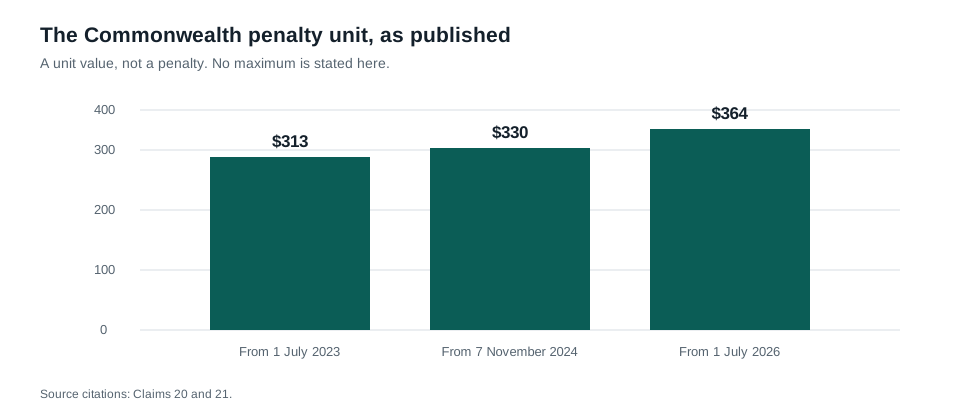
Claims 20 and 21 are AT SOURCE: the Crimes (Amount of a Penalty Unit) Instrument 2026, made under s 4AA(1A) Crimes Act 1914, publishes $364 for offences committed on or after 1 July 2026, and AFSA publishes the earlier $330 from 7 November 2024 and $313 from 1 July 2023 to 6 November 2024. Claim 22 is NOT PUBLISHED and says no primary source states a dollar maximum penalty under s 15. The figure caption is copied byte for byte because the distinction between a published unit and an unpublished maximum is the same distinction a reader needs when looking at a bonus headline and a turnover requirement.
The calculator is therefore a small exercise in reading conditions. Change $1,000 to $500 and the turnover becomes $20,000 on a forty times multiple. Change forty to fifty and the turnover becomes $50,000 on a $1,000 bonus. Change $12.50 to $25 and the unit count halves. The code field is absent on purpose. There is nothing to enter. A string can decide whether the offer is attached, but it cannot decide whether the base is bonus alone, whether the multiple is forty, whether the ceiling is published, or whether AUD remains the unit. Those are the inputs that matter.
Codes and the cashier
A cashier is where a promotion stops being language and becomes an account state. The code is accepted, a balance appears, a requirement is attached, and a set of rules decides what counts. The reader's task is to translate the headline into that account state without inventing any step. On the assumption used here, the account starts with a $1,000 bonus in AUD, the requirement is $40,000 of counted turnover, and the cashier ceiling is not published in the offer copy. The $12.50 average stake gives the reader a unit count of 3,200. None of that says how a particular cashier will behave. It says what must be true before the offer can be costed.
The first cashier question is whether the bonus is separate from cash. A no deposit code may credit a bonus balance that cannot be withdrawn until the requirement is met, or it may credit a chip with its own rule, or it may credit spins whose returns are then subject to a requirement. This page models a bonus balance because the assumption says a $1,000 bonus. It does not model a chip, a spin bundle, or a wallet credit. Those are different shapes. A code attached to a chip can still carry forty times the bonus alone, but the reader must know the chip's value in AUD before the multiplication. A code attached to spins needs the value of the spins and the treatment of any return before the same calculation can be done. A string does not supply those numbers.
The second cashier question is the base. "Forty times the bonus alone" is precise. It means the $1,000 is the base. It does not mean forty times the account balance after later activity, forty times a deposit plus a bonus, or forty times a headline package spread across several deposits. A code for a welcome package may point to several stages, each with its own amount. A code for a no deposit offer may point to one credit. The reader should not add stage figures together unless the terms say the multiple applies to that combined base. The calculator on this page has one bonus field for exactly that reason. It costs a single assumed credit, not a campaign with several parts.
The third cashier question is the ceiling. In this model it is unpublished. That is not the same as saying there is no ceiling, and it is not the same as naming one. Claim 142 is NOT PUBLISHED for Australian deposits, withdrawal times and payout speeds at offshore casinos, and claim 147 is NOT PUBLISHED for what an offshore casino does or does not verify. Those claims stop this page from filling the cashier with imagined behaviour. The page can say the ceiling is assumed unpublished and can explain why that matters. It cannot say what the ceiling is, how it is applied, or what a cashier will do with a particular stake. The gap is part of the cost.
The fourth cashier question is the currency marker. AUD throughout is an assumption with consequences. If the code opens a cashier that records a balance in another unit, the $40,000 AUD total is no longer a direct comparison. The reader should not treat a coin balance, a USDT balance, or a points balance as AUD simply because a local page printed a dollar sign. The offer copy may use "aud", "A$", "au$", a bare dollar sign, or no marker at all. Those are supply strings, not conversion rules. This guide keeps AUD in every line so the arithmetic stays visible. A reader comparing an offer with a different currency needs to rebuild the model in that currency, then decide whether a comparison is meaningful at all.
The fifth cashier question is what happens when the requirement is met. A cleared bonus is not the same as a paid withdrawal. The terms may set a maximum convertible amount, a maximum withdrawable amount, a game restriction, an identity step, or a further condition. This sheet does not publish those terms for the offer class, so this page does not invent them. It also does not state a withdrawal time or payout speed. Claim 142's NOT PUBLISHED finding is a hard boundary. The reader can ask the supplier for its own stated term. The model can only say that $40,000 of counted turnover has been satisfied on the assumed basis.
Codes also create a timing problem. A reader may find a string on a page, open an account later, and discover that the promotion attached to the string has changed. A code may be accepted but attach different terms. A code may be rejected without a reason visible on the landing page. A code may be case sensitive, tied to a field, or tied to an account state. Those are operational details of a promotion program, not facts from the sourced claim record. The safe reader treats the accepted code as the start of a fresh reading exercise. Check the credited amount after acceptance. Check the multiple after acceptance. Check the currency after acceptance. Check the terms after acceptance. The string is not a contract summary.
The commercial choice is often between a larger headline with less legible terms and a smaller headline with more legible terms. On the model, $1,000 at forty times the bonus alone costs $40,000 of counted turnover. A $200 bonus at forty times the bonus alone costs $8,000. A $200 bonus at sixty times the bonus alone costs $12,000. A $1,000 bonus at thirty times the bonus alone costs $30,000. A code that unlocks the $1,000 balance is not automatically better than a code that unlocks the $200 balance once the multiple and the ceiling are read. The purchase is the set of conditions, not the size of the string's campaign.
A reader may also see a code attached to both a money figure and a spin figure. The two should not be blended into one base unless the terms say so. A $1,000 bonus and 200 spins are not $1,200 of bonus for the purpose of this model. Spins have a stake value, a game, and a treatment of returns. The model has one bonus amount and one multiple. Adding a spin count to a dollar amount would be a category error. The same discipline applies to a chip figure. A chip is a promotion unit until its AUD value and its terms are known. The code is merely the instruction that asks the supplier to credit it.
Verification is another place where a reader needs a boundary rather than a procedure. Claim 143 is AT SOURCE and quotes AUSTRAC: from 29 September 2024, all online gambling service providers must complete the applicable customer identification procedure before creating an online gambling account or commencing to provide any designated service. Claim 146 is NOT PUBLISHED and says AUSTRAC's page does not qualify that phrase, so this sheet does not resolve how far it reaches an offshore operator with no Australian presence. Claim 147 is NOT PUBLISHED and says no source states what an offshore casino does or does not verify. The page states those limits and gives no advice on avoiding an identity check. A code is not a way around an identity step, and no procedure is described here.
Payment language needs the same restraint. Claim 138 is NOT PUBLISHED and says nothing authoritative is published about PayID as a gambling payment method. Claim 139 is NOT PUBLISHED for Neosurf. Claim 140 is NOT PUBLISHED for scheme rules from Visa, Mastercard, Apple Pay or Google Pay about Australian gambling. Claim 141 is NOT PUBLISHED for a list of banks offering gambling blocks, and quotes BetStop only as saying many major banks let a person block gambling transactions and that the person should contact their bank. This page does not turn any of those gaps into a cashier claim. The code may sit beside a payment logo, but a logo is not a published term about availability, limits, fees, blocking, or speed.
The most useful cashier habit is to write the offer as four lines before entering anything: credited amount, base, multiple, ceiling. On this page those lines are $1,000 AUD, bonus alone, forty times, unpublished. The result is $40,000 and 3,200 units at $12.50. If a supplier's terms cannot fill those four lines after the code is accepted, the comparison is incomplete. That is not a reason to estimate the missing line. It is a reason to price the uncertainty. An unpublished ceiling is a real cost because it leaves the reader unable to plan the path from the credited balance to the cleared balance.
The Act and the price of a dispute
This is the page's single comparator section. It costs what a reader gives up when the code opens an offer outside the Australian system. It does not say whether a player may or may not use an offshore casino, does not say whether an agreement is enforceable or unenforceable, and does not say whether the reader has or has not got Australian Consumer Law rights against an offshore casino. Claims 23, 24, 163 and 165 are NOT PUBLISHED and keep those questions open. What can be stated is the statutory structure, the regulator's published practice, the scope of BetStop, and the regulator's own description of a consumer's recourse.
Claim 1 is AT SOURCE under s 4 definition, paragraph (e): a gambling service includes a service for the conduct of a game played for money or value, of chance or mixed chance and skill, where a customer gives or agrees to give consideration. Online pokies, slots, roulette, blackjack and live dealer tables sit inside it. Claim 2 is AT SOURCE under s 5(1): a prohibited interactive gambling service is a gambling service provided in the course of carrying on a business and provided to customers using, among others, an internet carriage service. Claim 3 is AT SOURCE under s 5(3), which is a closed list of exclusions. Claim 5 is AT SOURCE reading ss 4, 5 and 8B together: an online casino served to a person at home is a gambling service, provided in the course of a business, over an internet carriage service, therefore prohibited under s 5(1), excluded by nothing in s 5(3). There is no exclusion for a licensed online casino because the Act contains no such category.
Claim 14 is AT SOURCE under ss 8E and 15AA. Section 15AA is the licence route and online casino is not on it, because "regulated interactive gambling service" is defined by s 8E(1) as a closed list that does not include online casino. Claim 15 is AT SOURCE reading ss 15, 15AA, 8E and 69: a State or Territory licence cannot authorise an online casino served to a person at home, because the Commonwealth prohibition in s 15 applies regardless of any licence, and the only provision making a State or Territory licence relevant, s 15AA, applies to a different closed class. Those claims are the reason the licence aside on this page states the absence plainly: No Australian licence exists for this product. No argument about a licensed domestic alternative and an offshore alternative is written here, because there is no domestic licensee whose obligations could be held against an offshore one.
Claim 6 is AT SOURCE under s 15(1): it is an offence to intentionally provide a prohibited interactive gambling service with an Australian-customer link, with a penalty of 5,000 penalty units. Claim 7 is AT SOURCE under s 15(2A): the civil penalty is 7,500 penalty units. Claim 8 is AT SOURCE under ss 15(2) and 15(2B), which make both run per day. Claim 9 is AT SOURCE under ss 3, 15, 15AA, 15A and 15C: s 15 is written about the provider, and no offence or civil penalty provision directed at a customer for using a prohibited service was found. That claim permits this page to say the statutory liability falls on the operator. It does not permit a sentence saying playing is without cost or that a reader's use is legal. Claim 23 is NOT PUBLISHED and bars that conclusion.
Claim 20 is AT SOURCE: the Crimes (Amount of a Penalty Unit) Instrument 2026 publishes a penalty unit of $364 for offences committed on or after 1 July 2026. Claim 21 is AT SOURCE: AFSA publishes $330 from 7 November 2024 and $313 from 1 July 2023 to 6 November 2024. Claim 22 is NOT PUBLISHED: no primary source states a dollar maximum penalty under s 15, because the Act states units, the instrument states a unit value, multiplying is arithmetic, and the body corporate multiplier was not verified. The figure on this page is the published unit value, with the byte for byte caption from Appendix D. No maximum penalty in dollars is printed as a sourced figure.
Claim 156 is AT SOURCE under Parts 3 and 8: a complaint to ACMA is a regulatory complaint, not a claim; the toolkit in claim 28 is civil and administrative, with formal warnings, civil penalty enforcement, infringement notices, injunctions, enforceable undertakings, remedial directions and continuing contraventions; nothing in Part 3 or Part 8 provides for a complainant to recover money, and no provision found gives a complainant any remedy at all. Claim 157 is AT SOURCE under s 19: only an individual residing in Australia, a body corporate carrying on activities in Australia, or the Commonwealth, a State or a Territory may complain. Claim 158 is AT SOURCE from BetStop's own page: its route for an online casino complaint is ACMA and nothing else.
Claim 159 is AT SOURCE from the ACMA compliance report named in claim 17. ACMA says consumers who access these websites have little or no recourse, that winnings may not be honoured, and that incentives and pressure tactics are used to target gamblers; it says the services do not have the customer protections expected in Australia. Claim 160 is AT SOURCE from the Commonwealth's 2017 paper named in claim 31: many consumers are unaware the offshore sites they use are unlicensed in Australia, and there is limited legal recourse if they run into difficulties obtaining winnings or deposits. The paper also lists what offshore operators do not do: pay Australian taxes or racing and sporting fees, share suspicious betting information with law enforcement or sporting bodies, or provide more than minimal harm minimisation and consumer protection. Those are the published words behind the price of a dispute.
Claims 163, 164 and 165 are NOT PUBLISHED and shape the boundary of this section. Claim 163 says no source reached says whether or how Australian Consumer Law is enforced against an offshore gambling operator with no Australian presence, so a page may not say a reader has ACL rights against an offshore casino and may not say they have none. Claim 164 says no Australian alternative dispute resolution scheme, ombudsman or arbitration body covering online gambling was located, and this sheet names none, so a page may not name an Australian body that will hear a dispute against an offshore casino. Claim 165 says whether an agreement with an offshore casino is enforceable, and whether civil proceedings lie to recover money, turn on whether regulations under s 69A exist; none was located, so no page may assert either answer. The consequence for a buyer is an absence of a local dispute path, stated as an absence, not an invented present tense rule.
BetStop belongs to the same cost, and this section uses only the scope claims. Claim 59 is AT SOURCE reading ss 4, 15, 15AA and 61GB together: BetStop's obligations reach only Australian-licensed online and phone betting operators; they do not reach a casino game, which is not a wagering service under the s 4 definition, and they do not reach an offshore operator, because s 61GB requires the service not to contravene s 15AA(3). Claim 60 is AT SOURCE from BetStop's own page, and the sentence is quoted here as published: "BetStop - the National Self-Exclusion Register does not apply to online casino games or other gambling services that are illegally provided in Australia. You can make a complaint about these services to the ACMA". That is a statement about the register's own scope. It is not a statement about what any offshore operator will accept, checks, or does not check.
Claim 81 is NOT PUBLISHED and is the hard stop: no primary source quantifies how many offshore casinos accept registered individuals, and nothing supports a claim that any proportion do; the published material is the scope rule at claims 59 and 60. Claim 82 is NOT PUBLISHED and records that nothing here describes, and no page may describe, how a registered individual could gamble. This page gives no mirrors, no proxies, no VPN advice, no second accounts, no advice on registering without documents, no route past a bank block, and no procedure past an identity check. It states the consequence: BetStop registration does not, by its own terms, reach an offshore casino. It does not turn that absence into a feature. No sentence here can be followed as an instruction to get round a self exclusion register, an identity check, or a bank block.
Claim 37 is AT SOURCE from the same ACMA report as claim 17, with the three sentences already quoted in claim 159. Claim 38 is AT SOURCE from that report: ACMA contacted 52 software providers and providers of local payment services, recorded that Australian traffic to the majority of targeted casinos decreased by at least 90 per cent by June 2021, and identified 56 illegal offshore online casino services as targets. Claim 28 is AT SOURCE under ss 64A to 64G and describes the regulator's toolkit. Those claims show activity against supply, not compensation for a reader. The reader's $40,000 turnover model and the regulator's enforcement toolkit are different ledgers. One belongs to the offer's terms. The other belongs to the regulator's powers.
Claims 44, 45 and 46 are AT SOURCE from the ACMA quarterly reports: April to June 2026 records 187 websites referred to internet service providers for blocking, January to March 2026 records 109, and July to September 2025 records 71. Claim 48 is SOURCES DIFFER and is a news report, not a regulator's own number: Yogonet, 17 October 2025, says "Since November 2019, a total of 1,338 illegal gambling and affiliate websites have been restricted", attributed to ACMA in general terms without naming a report, while no cumulative website-blocking total is available from any readable ACMA page. This page states the per-quarter figures at source, states the news report's figure as what that report says, and picks neither as the cumulative total. It does not add the quarters into a cumulative sourced figure.
Claim 49 is SOURCES DIFFER and this page gives both published framings without choosing one: ACMA's Act page says "over 100" services left the market, its interactive gambling landing page says "Over 220", and the 2024-25 report says "about 220 ... over eight years". None is presented as the figure. Claim 50 is SOURCES DIFFER and this page states both estimates without resolving them: GBGC gives US$175 million for 2020, H2 Gambling Capital gives A$1,475 million for 2020, ACMA notes the difference and does not reconcile it, and the 2017 paper says the Review estimated "could be as high as $400 million annually". No single number for Australian offshore spend is stated here.
Claim 22, claim 23, claim 24 and claim 25 are NOT PUBLISHED and are used only as limits. Claim 22: no dollar maximum penalty under s 15. Claim 23: no primary source states in terms that an Australian player commits no offence by using a prohibited service. Claim 24: no regulations under s 69A were located, so no page may assert that an agreement is unenforceable or enforceable. Claim 25: no count of offshore operators serving Australia is published by any source reached; ACMA publishes investigations, sites investigated, breaches and sites referred for blocking, none of which is a market size. A NOT PUBLISHED claim is a sentence this page would otherwise have invented. It is printed as a gap and nothing else.
Claim 163 is NOT PUBLISHED for ACL enforcement against an offshore gambling operator with no Australian presence. Claim 164 is NOT PUBLISHED for an Australian alternative dispute resolution scheme covering online gambling. Claim 165 is NOT PUBLISHED for regulations under s 69A and keeps the agreement question open. Those three claims are cited again here because the aside at the end of the page cites 5, 14 and 15 and says No Australian licence exists for this product. The licence absence is structural. The dispute absence is what that structure costs the reader when a bonus code has been accepted, $40,000 of counted turnover has been modelled, and a cashier decision goes the wrong way.
The commercial conclusion is not a legal verdict. It is a cost. A reader pricing a $1,000 no deposit code on forty times the bonus alone is also pricing the absence of a local licence condition, the absence of BetStop's obligation for this product, the absence of a published Australian dispute body for an offshore casino complaint, and the regulator's own statement that consumers have little or no recourse. The code does not supply any of those. The multiple does not supply any of those. The cashier does not supply any of those. They are the terms of sitting outside the system, and they are stated here because a buying guide that prints only the bonus headline has left out the most expensive condition.
Published gaps and missing numbers
The claim record is as useful for what it refuses to publish as for what it states. A page about no deposit bonus codes is surrounded by numbers that circulate freely: welcome amounts, spin counts, withdrawal windows, payment speeds, return to player percentages, operator counts, market spend, and penalty totals. This page uses only the numbers that the sourced record permits, plus the clearly labelled model figures in AUD. Where a claim is NOT PUBLISHED, the page says that nothing is published and states nothing else. Where a claim is SOURCES DIFFER, the page states what each source says and never picks one. That discipline is the difference between a costed guide and a set of plausible figures.
Claim 51 is NOT PUBLISHED: no ACMA page reached states that website blocking can be got round, and this sheet says nothing about how. Claim 52 is NOT PUBLISHED: ACMA publishes no register of offshore operators, no list of safe offshore operators and no rating of any operator; its only register in this field is of licensed interactive wagering providers, containing no casinos. Claim 53 is NOT PUBLISHED: ACMA's licensed interactive wagering providers page did not render a list on retrieval and no provider count could be read, so no page may state how many Australian licensed wagering operators there are. Those gaps matter to a buyer because a code page can easily imply that an operator has been checked against a local register. No such register exists for this product.
Claim 22 is NOT PUBLISHED and is already reflected in the figure caption: no dollar maximum penalty under s 15 is stated. Claim 23 is NOT PUBLISHED: no primary source states in terms that an Australian player commits no offence by using a prohibited service. Claim 24 is NOT PUBLISHED: no regulations under s 69A were located, so the page cannot say an agreement is enforceable or unenforceable. Claim 25 is NOT PUBLISHED: no count of offshore operators serving Australia is published by any source reached. Each of those gaps closes a sentence that a writer might otherwise reach for. The page keeps the gap visible rather than replacing it with a confident paraphrase.
Claim 80 is NOT PUBLISHED: no source states how many operators are connected to BetStop. Claim 81 is NOT PUBLISHED: no primary source quantifies how many offshore casinos accept registered individuals, and nothing supports a claim that any proportion do. Claim 82 is NOT PUBLISHED and records that nothing here describes how a registered individual could gamble. The page cites 59 and 60 for the scope rule, and stops. It does not say that an offshore casino will accept a registered person, does not say that any of them checks, and does not say that any of them does not. It gives no procedure, no workaround, and no framing that turns "not on BetStop" into a feature. Zero content here helps a reader past a self exclusion register, an identity check, or a bank block.
Claim 94 is NOT PUBLISHED: no instrument made under s 15C(4A)(d) was located, so a page may not say any payment method beyond the statutory list is covered. Claim 95 is NOT PUBLISHED: no primary source states that a bank must block a gambling transaction, and a page may not state that any named bank does or does not offer one. Claim 103 is NOT PUBLISHED: the Commonwealth gambling reforms page carries a Last updated field with no date in it, so this sheet cannot date the measures beyond their stated implementation dates. Claim 104 is NOT PUBLISHED: this sheet did not research State and Territory inducement statutes and states no provision from any of them. A payment or inducement claim is not available just because a search phrase asks for it.
Claim 138 is NOT PUBLISHED for authoritative material about PayID as a gambling payment method, claim 139 for Neosurf, and claim 140 for scheme rules from Visa, Mastercard, Apple Pay or Google Pay about Australian gambling. Claim 141 is NOT PUBLISHED for a list of banks offering gambling blocks, and permits only the BetStop sentence that many major banks let a person block gambling transactions on their bank accounts and that the person should contact their bank and ask them how they can help. Claim 142 is NOT PUBLISHED for Australian deposits, withdrawal times or payout speeds at offshore casinos. This page states no withdrawal time, no payout speed, and no deposit minimum as a market figure. The $12.50 figure is an average stake in the model, not a deposit term.
Claim 146 is NOT PUBLISHED for how far AUSTRAC's unqualified phrase "all online gambling service providers" reaches an offshore operator with no Australian presence. Claim 147 is NOT PUBLISHED for what an offshore casino does or does not verify. Claim 154 is NOT PUBLISHED for any ATO source addressing winnings from a gambling service unlawful to provide in Australia, and claim 155 is NOT PUBLISHED for ATO material on deductibility of gambling losses for an individual. Claim 154 is the reason this page does not say winnings from an offshore casino are tax-free in Australia. Claim 149, an AT SOURCE quotation from IT 2655, says "There is no Australian case in which the winnings of a mere punter have been held to be assessable", but claim 153 says Income Tax Rulings do not have the force of law. Neither is a tax promise about this offer.
Claim 163, claim 164 and claim 165 are NOT PUBLISHED and are the dispute gaps. Claim 171 is NOT PUBLISHED: this sheet has no number for the minimum return to player on an Australian gaming machine, because Appendix B of the land-based standard was not retrievable. Claim 172 is NOT PUBLISHED: no minimum game cycle time, spin duration or spin speed figure was found. Claim 173 is NOT PUBLISHED: no maximum bet per game and no loss limit was found. Claim 174 is NOT PUBLISHED for any RTP, spin speed, stake cap or loss limit binding an online casino serving Australia, and states the reason as structural: there is no Australian licence for online casino, so there is no Australian licence condition and no Australian technical standard attaching to one. That is an absence of an Australian rule, not an assertion that an operator's own figures are false or absent. Claim 175 is NOT PUBLISHED for RTP, hit rate, volatility or maximum win for any named game title or studio.
Claim 187 is NOT PUBLISHED: no source states who operates the National Gambling Helpline, so a page may not attribute it to any organisation. Claim 188 is NOT PUBLISHED: no State or Territory gambling helpline number is on this sheet. If support numbers appear on a site page, they must be quoted exactly as their publisher states them and with the service name that source uses. Claim 186 is SOURCES DIFFER: the number 1800 858 858 is the same across sources, but "National Gambling Helpline", "Gambling Helpline" and "Gambler's Help" all appear as service names, and this sheet does not pick one. Those claims are not offer facts, but they show the same rule at work: where sources differ, state each; where nothing is published, stop.
Claims 48, 49 and 50 are the SOURCES DIFFER set used on this page, each handled without a choice. Claim 48: the news report's cumulative figure is stated as what the news report says, the per-quarter ACMA figures are stated at source, and no cumulative total is published as a sourced number. Claim 49: "over 100", "Over 220" and "about 220 ... over eight years" are all stated as ACMA framings, and none is presented as the figure. Claim 50: US$175 million, A$1,475 million and "could be as high as $400 million annually" are all stated with their sources, and no single Australian offshore spend number is selected. The user's allowance for claims 71, 109 and 187 against 46, 45 and 44 is not used to force a selection here; those claims are outside the comparator slice for this page and no cross-claim arithmetic is written.
The remaining AT SOURCE claims in this slice are used with their provisions or publishers named. Claim 26 is s 21(1), ACMA may investigate on its own initiative or on a complaint. Claim 27 is s 19, the Australian connection for complainants. Claim 28 is ss 64A to 64G, the civil and administrative toolkit. Claim 156 is Parts 3 and 8, no complainant money remedy. Claim 157 is s 19. Claim 158 is BetStop's own route to ACMA. Claim 159 is ACMA's compliance report. Claim 160 is the Commonwealth's 2017 paper. Claim 1 is s 4 definition paragraph (e), claim 2 is s 5(1), claim 3 is s 5(3), claim 5 is ss 4, 5 and 8B read together, claim 6 is s 15(1), claim 7 is s 15(2A), claim 9 is ss 3, 15, 15AA, 15A and 15C, claim 14 is ss 8E and 15AA, claim 15 is ss 15, 15AA, 8E and 69, claim 20 is the Crimes (Amount of a Penalty Unit) Instrument 2026 under s 4AA(1A) Crimes Act 1914, and claim 21 is AFSA. Citation by claim number never replaces that attribution.
The buyer's benefit from this section is negative space. A code page that prints a withdrawal time, a payment speed, a minimum RTP, a licence label, a tax promise, a market size, a cumulative blocking total, or a named dispute body would be more complete and less true. The gaps are not omissions to hide. They are the boundaries of the published record. The standfirst's assumption, the $40,000 calculation, and the $12.50 unit are the only numbers this page adds, and they are labelled as a model. Everything else is either a claim with a provision or publisher, a difference stated twice, or a silence left intact.
Choosing between code offers
Choosing between code offers is a comparison of conditions, not a collection of strings. Start with the credited amount in AUD. Then fix the base. Then fix the multiple. Then look for the ceiling. Then check whether the terms say what happens to bonus value, winnings, and any residual balance. Then price what is absent. That order keeps the $1,000 to $40,000 model in view and stops the reader from treating a code as a value in itself. A code that is accepted and opens a $1,000 bonus with forty times the bonus alone asks for $40,000 of counted turnover. A code that is accepted and opens a smaller balance with a lower multiple may ask for less. The string does not decide which is cheaper.
A practical comparison sheet for a reader can be written in plain lines, without a comparison table and without naming an operator. Line one: code accepted, yes or no. Line two: credited amount, AUD. Line three: bonus alone or deposit plus bonus. Line four: multiple. Line five: turnover, which is line two times line four when the base is bonus alone. Line six: ceiling, published or unpublished. Line seven: currency marker in the cashier. Line eight: maximum convertible or withdrawable amount, if the terms publish one. Line nine: what the terms say about a bonus that has not cleared. Line ten: the local protections the offer does not carry. The first nine belong to the supplier's terms. The tenth belongs to the comparator section and the licence aside. No line asks the reader to trust a vote count, a star, a score, or a claim that somebody tested the offer.
On that sheet, the assumed offer reads: accepted code, $1,000 AUD, bonus alone, forty times, $40,000, ceiling unpublished, AUD throughout, maximum not modelled, uncleared balance not modelled, and no Australian licence exists for this product. The $12.50 average stake becomes a side note: 3,200 counted stakes if every dollar of stake counts and if the average stake is allowed in full. The reader can now compare a second offer without copying a string into a spreadsheet as though it were a number. If the second offer has a $500 bonus and fifty times the bonus alone, the turnover is $25,000. If it has a $2,000 bonus and twenty times the bonus alone, the turnover is $40,000. The larger headline and the smaller headline can produce the same requirement. The code is not the differentiator.
The unpublished ceiling deserves its own weighting. A published ceiling lets the reader plan the path in stake units. An unpublished ceiling leaves the $12.50 unit as an illustration and the real path unknown. A buyer can treat that as a cost even without a number, because the missing term prevents a complete plan. The page does not say the ceiling is high, low, fair, or unfair. It says the ceiling is assumed unpublished and explains what cannot be calculated as a result. That is a commercial judgement a reader can make: an offer with a legible ceiling is easier to price than an offer whose ceiling appears only after the code has done its work.
The absence of a local licence condition also belongs in the choice, but it must be phrased as an absence. The reader is not choosing between a licensed Australian online casino and an offshore one. Claim 5, claim 14 and claim 15 are AT SOURCE and establish that no Australian licence exists for this product. The choice is between offers outside the Australian system, with ACMA's published description of little or no recourse, no BetStop obligation for online casino games, and no named Australian body located to hear a dispute against an offshore casino. A code cannot add those protections. A larger bonus cannot add them. A lower multiple cannot add them. They are the standing cost of the product class, and they sit beside the $40,000 turnover rather than underneath it.
Support choices should be kept separate from offer choices. BetStop's own page says the register does not apply to online casino games or other gambling services illegally provided in Australia, and directs a complaint about those services to ACMA. Claim 60 is AT SOURCE. The same organisation publishes support material, but this page gives no procedure for gambling while registered, no route past a bank block, no route past an identity check, and no suggestion that a person should seek an offer outside the register's reach. A reader who wants help can use the support pages named on this site. A reader who wants a cheaper bonus can use the costing method. Those are different decisions and this page does not blend them.
Links at the end of the page point to Reading the offers, The margin we assume, Knowing when to stop, and the money disclosure page, because those pages hold the method, the assumption, the stopping point, and the commercial arrangement. They also point to the three child keys under this hub, because a reader searching for no deposit bonus codes may actually be looking for a chip figure, a combined money and spins figure, or a free chip in Australia. Each child has its own model. This hub keeps the general rule: the code is a condition, the multiple is the arithmetic, the ceiling is the missing input, AUD is the unit, and the dispute position is the cost that does not appear in the banner.
A reader should also resist the language of certainty. This page does not say guaranteed, does not say we tested, does not say our team, does not say we played, does not say rated by players, and does not print stars, votes, scores, or a count of operators. It models, calculates and cites. The calculator uses the reader's inputs. The claims use numbers only. The assumptions are stated once in the standfirst and repeated where the arithmetic needs them. The organisation behind the page is Lucky Aussie Reels, and the method is written so that it survives a code being replaced, a banner being rewritten, or a promotion being withdrawn. Forty times $1,000 is the constant. The string is not.
A final comparison habit is to ask what would change the decision. If the multiple changed, the turnover would change. If the base changed, the turnover would change. If the currency changed, the model would need rebuilding. If the ceiling became published, the unit count would become more useful. If a local licence condition existed, the dispute position would change, but claims 5, 14 and 15 say it does not exist for this product. If the code changed, none of those would change by itself. That is the whole argument. The reader acts on the terms, and the code only opens the door to reading them.
Questions readers ask
- Does a no deposit bonus code change the wagering multiple?
- No. The code is a condition for attaching the offer. On this page's assumption, a $1,000 AUD bonus with forty times the bonus alone requires $40,000 of counted turnover. Entering a different string does not change that arithmetic unless the attached terms change.
- Why does the page use $12.50?
- It is an average stake unit in AUD, not a cashier limit. $40,000 divided by $12.50 gives 3,200 counted stakes. The ceiling is assumed unpublished, so the unit shows scale and does not become a withdrawal plan.
- Is the $40,000 figure a loss, a win, or a withdrawal amount?
- It is a turnover requirement calculated from the assumed bonus and multiple. It is not a loss, not a win, and not a statement about how much can be withdrawn. The model costs the condition; it does not predict a result.
- Does BetStop apply to an online casino opened with a code?
- Claims 59 and 60 are AT SOURCE. BetStop's obligations reach licensed interactive wagering services, and BetStop says the register does not apply to online casino games or other gambling services illegally provided in Australia. Claims 81 and 82 are NOT PUBLISHED, so this page says nothing about what an offshore operator accepts, checks, or does not check and gives no procedure for gambling while registered.
- Can ACMA recover my bonus or winnings through a complaint?
- Claim 156 is AT SOURCE: a complaint to ACMA is a regulatory complaint, not a claim, and nothing in Parts 3 or 8 provides for a complainant to recover money. Claim 159 is AT SOURCE: ACMA says consumers who access these websites have little or no recourse. Claims 164 and 165 are NOT PUBLISHED, so no Australian dispute body is named and no answer is given on enforceability.
- Are there Australian licence conditions behind these codes?
- No Australian licence exists for this product. Claims 5, 14 and 15 are AT SOURCE under ss 4, 5, 8B, 8E, 15, 15AA and 69. The page states that absence and does not compare a domestic licensee with an offshore one, because there is no domestic licensee for online casino.